

Chapter 19 10/03 GBPUSD: Will the "Downward Wave 5" Structure Usher in the Last Decline?
The UK PMI manufacturing rose slightly in September, with a final value of 44.3, higher than the 39-month low of 43.0 last month. However, despite a slight improvement, an in-depth study of five sub-indices of PMI (new orders, output, employment, purchasing inventory, and supplier delivery time) shows that the performance of the industry continues to be sluggish.
Fundamentals
The final manufacturing PMI of the UK in September released on Monday rose slightly compared with the data in August, from 43 in August to 44.3 slightly higher than expected. Despite a slight increase, the reading is still at a worrying low level, one of the worst levels in the past 14 years. The weak manufacturing activity has aroused people's concerns about the overall UK economy, limiting the increase of the GBP in the whole trading day.
Rob Dobson, director of global market intelligence at Standard & Poor's, said: "The manufacturing industry was still in a state of contraction in September, and the weak situation at home and abroad affected the reception of new orders, resulting in further reduction in output." Producers said that the cost-of-living crisis and the recent rapid rise in interest rates are causing losses, increasing the possibility that the overall UK economy will fall back into contraction in the second half of this year. "The whole manufacturing industry has felt the economic downturn, and the demand for families and enterprises has declined."
The persistent warnings about the health of the UK economy have deterred investors, who chose a safer competitor (USD instead of GBP) in this week's trading. As the GBP is increasingly sensitive to risks, it is still more susceptible to market sentiment today. The GBPUSD continued to fall on Tuesday. As of writing the article, the trading price of the GBPUSD is 1.2062, the lowest level since November 30, 2022.
Looking ahead, the final PMI of the UK service industry in September will be released on Wednesday, which may aggravate people's concerns about the risks faced by the UK's important service industries, thus further depressing the GBP. In addition, there is a lack of noteworthy data in the UK this week. After a series of pessimistic data are released, the GBP may face more risks driven by external factors.
Technical Analysis
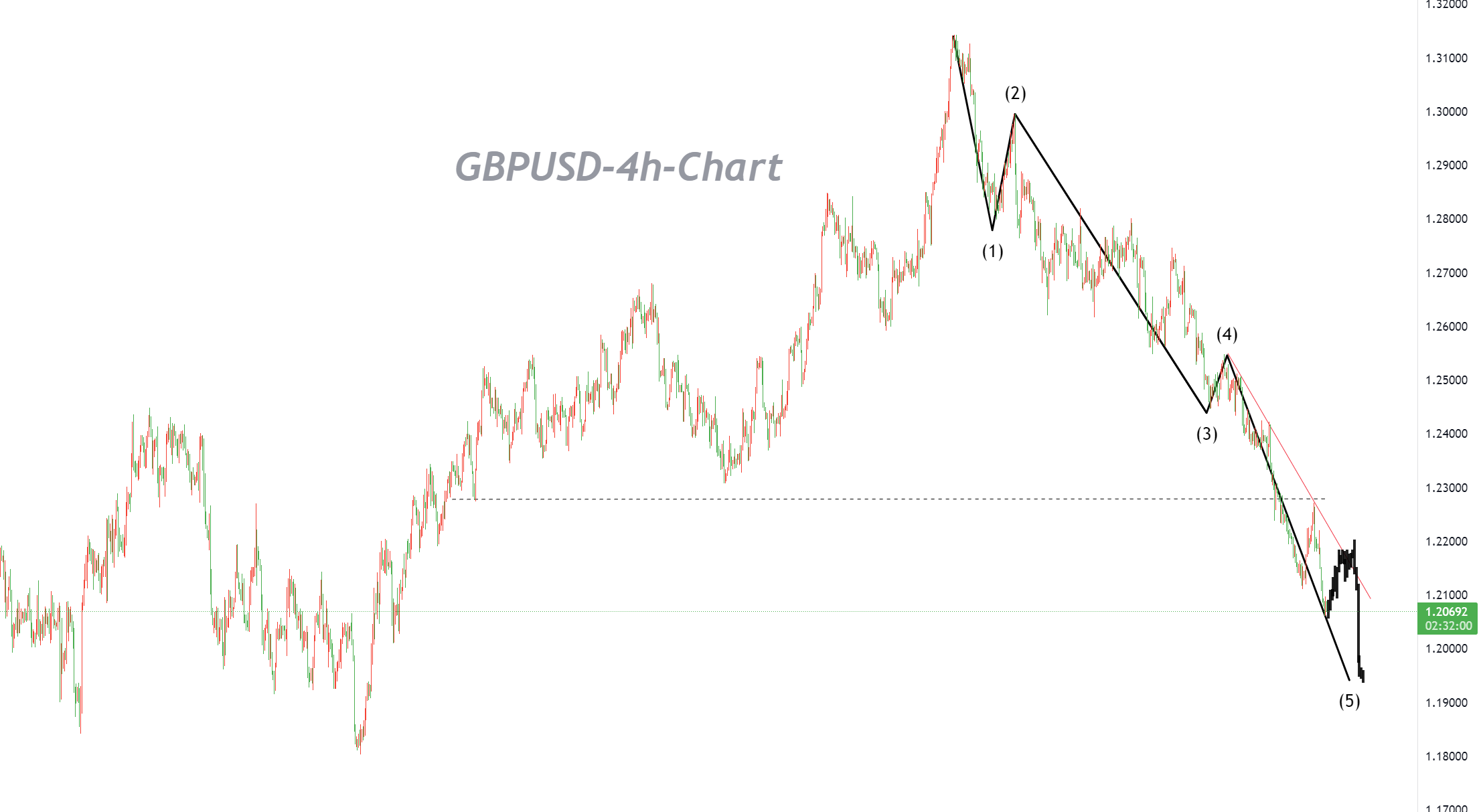
Since the formation of the 15-month high of 1.3148, the GBPUSD has been in a descending structure with descending highs. The structure is currently forming a "downward Wave 5" pattern. Nevertheless, the momentum indicator shows that the Relative Strength Index has entered the oversold threshold of 30 and the Stochastic indicator is touching the oversold area of 20, both of which suggest that the recent downtrend may be overdone.
If the downtrend resumes, the price may initially touch the psychological barrier of 1.2000. A break above this range could pave the way for the March bottom at 1.1800.
If it resumes its rally on the back of key momentum (oversold), then the 1.2180 area will be the first upside resistance for the price to enter a correction, with the May low of 1.2307 likely to be the next hurdle if the market moves higher. Any further price advance should be limited to this point to ensure that the downward Wave 5 structure is intact.
Overall, the GBPUSD descending structure remains intact, but with the GBPUSD having reached an oversold state, a rebound cannot be ruled out. However, after such a rebound, it is recommended to go short at the highs.
Trading Recommendations
Trading direction: Short
Entry price: 1.2170
Target price: 1.1800
Stop loss: 1.2326
Deadline: 2023-10-17 23:55:00
Support: 1.2019, 1.1937, 1.1800
Resistance: 1.2180, 1.2193, 1.2279


