

Chapter 22 10/04 USDJPY: Upward Trend Is Still Intact Even After a Strong Sell-off
The Bank of Japan (BOJ) made an emergency bond purchase on Wednesday, which bought more bonds than it had planned before, but failed to break the yield of Japanese government bonds from a 10-year high. The yield of benchmark 10-year Japanese government bonds is currently hovering around 0.78%, the highest level since September 2013, which fell slightly the day before.
Fundamentals
On Wednesday, the BOJ said that in addition to regularly purchasing Japanese government bonds, it will also purchase bonds worth JPY675 billion with a maturity of 5 to 10 years. The BOJ also announced the quotation for regularly buying bonds with other maturities. The amount of all bonds remains unchanged.
Recently, global bond yields have been rising, and the yield of U.S. Treasury Securities hit a 16-year high on Tuesday because the market is worried that the Fed will maintain higher interest rates for a longer period. In contrast, the BOJ has not yet withdrawn from the ultra-loose monetary policy, although people's expectations for policy changes have increased.
This additional bond purchase comes at a time when the JPYUSD strengthened after briefly falling to 150.00. The BOJ proposed to purchase 10-year bonds far more than the market expected, but the effect was very limited. With the JPY falling to this level and the increasing speculation about the BOJ's policy adjustment, it seems difficult to reverse the trend of rising yields.
After the exchange rate of the JPYUSD soared from 150.00 to 147.00 overnight, market observers went crazy, which triggered speculation that the Japanese government might secretly intervene to push up the troubled currency. Although evidence of buying JPY and selling USD abound, senior Japanese officials are still tight-lipped today.
Shunichi Suzuki, Minister of Finance of Japan, remained silent rather than confirming such a statement when facing reporters. He didn't confirm the speculation about intervention. Suzuki reiterated the standard narrative, emphasizing the desirability of a stable currency trend driven by the market and reflecting economic fundamentals.
Suzuki Shunichi said: "The currency exchange rate should be driven by the market and fluctuate steadily, reflecting the fundamentals. Sharp fluctuations are not desirable." Suzuki pointed out that the government is monitoring the market development very carefully with a sense of urgency and will take appropriate measures to deal with excessive fluctuations, but it does not rule out any options.
Implicit volatility is a key indicator, which affects the official view on whether the trend of the JPY has reached an alarming range.
Masato Kanda further pointed out that even if there is no sudden change, with the passage of time, gradual but unilateral major currency fluctuations are classified as excessive fluctuations. However, he did not directly comment on the overnight rise of the JPY.
Technical Analysis
After yesterday's strong sell-off, the USDJPY still managed to hold onto its short-term uptrend channel, continuing its modest approach to the one-year high of 150.16. Nonetheless, momentum remains weak, with the Relative Strength Index (RSI) and Stochastic still not out of overbought levels, suggesting that the market continues to be cautious.
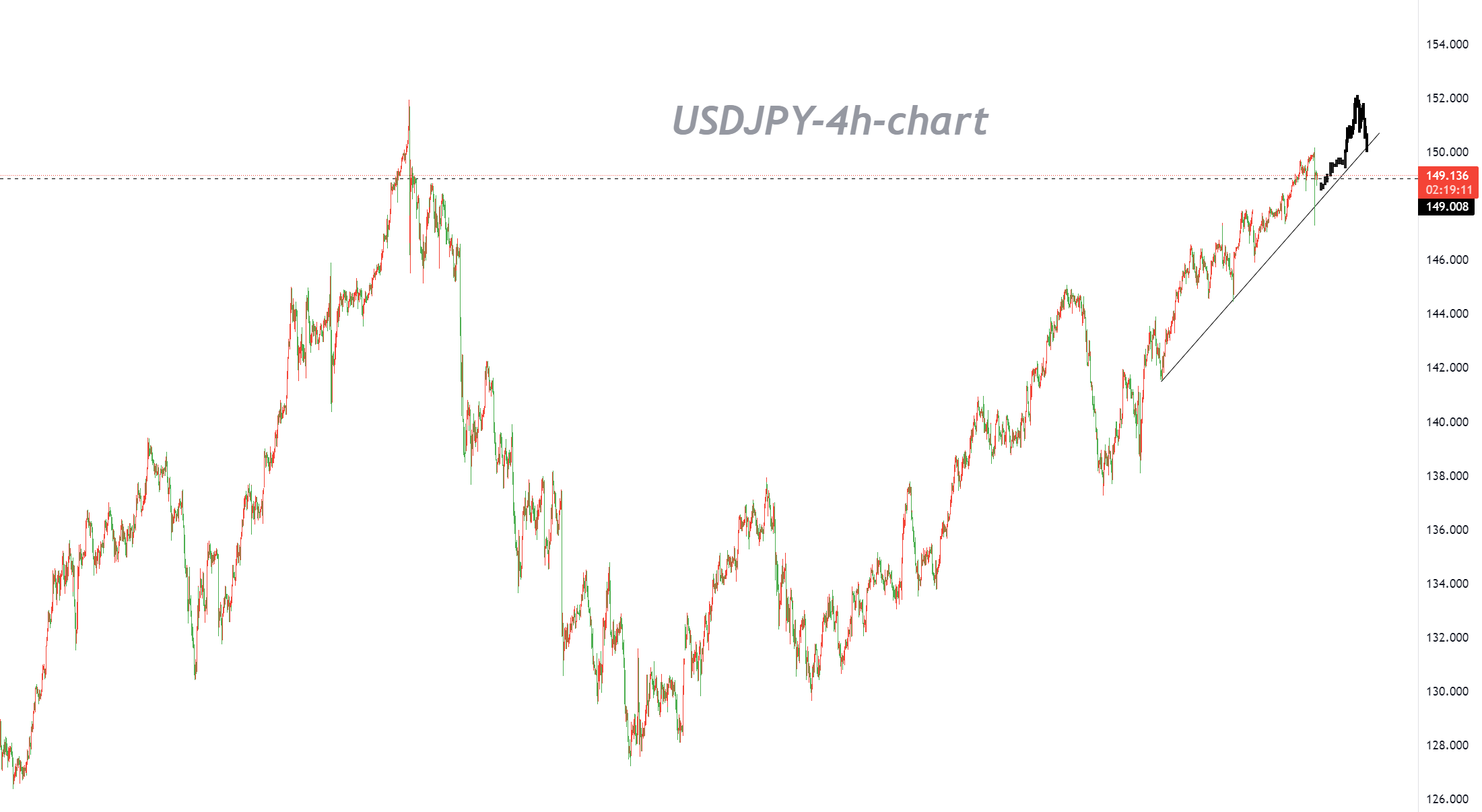
However, if the price continues to hold above the channel support line at 148.00, an accelerated move up towards resistance at 150.37 is possible. A break above this resistance could see the bulls move towards the 2022 top at 151.94.
If the market closes below such a channel, it could test the 20-day SMA near 147.70. If bears also break below that bottom line, they could next target the area between the 50-day SMA and the 144.54 restriction zone
Overall, the USDJPY could see another bullish adjustment as there are no signs that U.S. Treasury Securities yields are close to their peak, meaning that the USDJPY could move higher even if the BOJ continues to intervene. It is recommended to buy the dips.
Trading Recommendations
Trading direction: Long
Entry price: 148.50
Target price: 151.72
Stop Loss: 147.00
Deadline: 2023-10-18 23:55:00
Support: 148.51, 147.48, 147.00
Resistance: 149.69, 150.16, 150.37


