

Chapter 43 10/20 GBPUSD: Market Returning to Triangle Consolidation to Boost Bullish Confidence
Summary: UK retail sales declined by 0.9% in September due to the squeeze on consumers' wallets, and consumer confidence continued to worsen in October. These clear signs of weakening consumer demand have significant implications for the Bank of England and may potentially signal an entry into a recession.
Fundamentals
UK retail sales in September saw a substantial month-on-month decline of -0.9%, well below the expected -0.4%. Excluding sales of automotive fuels, the volume dropped by -1.0%.
Looking into some details, sales at non-food stores fell by -1.9% month-on-month, and non-store retailing declined by -2.2%. Shoe store sales grew by 0.2%, and automotive fuel sales increased by 0.8%.
On a quarterly basis, the three-month volume to September decreased by -0.8% compared to the preceding three months, with volumes excluding fuels falling by -1.0%.
In terms of value, retail sales declined by 0.2% month-on-month, with sales excluding automotive fuels down by 0.4%.
In terms of the market, the UK's retail sales data for September, released today, is weaker than expected, underscoring the challenges faced by consumer activity in the UK. While inflation rates are estimated to be decreasing according to the UK's Office for National Statistics, it remains uncertain whether this will translate into actual consumer activity. The gap between retail volume and value has yet to narrow.
Bank of England Governor Andrew Bailey, in an interview with the Belfast Telegraph, mentioned that he was "not surprised" by the latest inflation report released on Wednesday. The report indicated that September CPI increased by 6.7% compared to the previous year, consistent with the growth rate in August.
Bailey added that the inflation rate "was not far off what we were expecting." More reassuringly, core inflation has slightly declined, which he finds "quite encouraging."
He optimistically expected to see a "noticeable drop" in the headline rate of inflation when October figures are released thanks to the sharp rise in energy prices last year falling out of the annual comparison.
However, Bailey warned that "Pay growth as measured is still well above anything that’s consistent with the (inflation) target."
In light of the data, the pound against the US dollar has further declined, reinforcing the belief that the Bank of England might find it challenging to pivot back to interest rate hikes after the recent pause. Simultaneously, the weaker pace of the UK economy exceeds expectations, potentially necessitating a rate cut by the Bank of England in early next year.
Technical Analysis
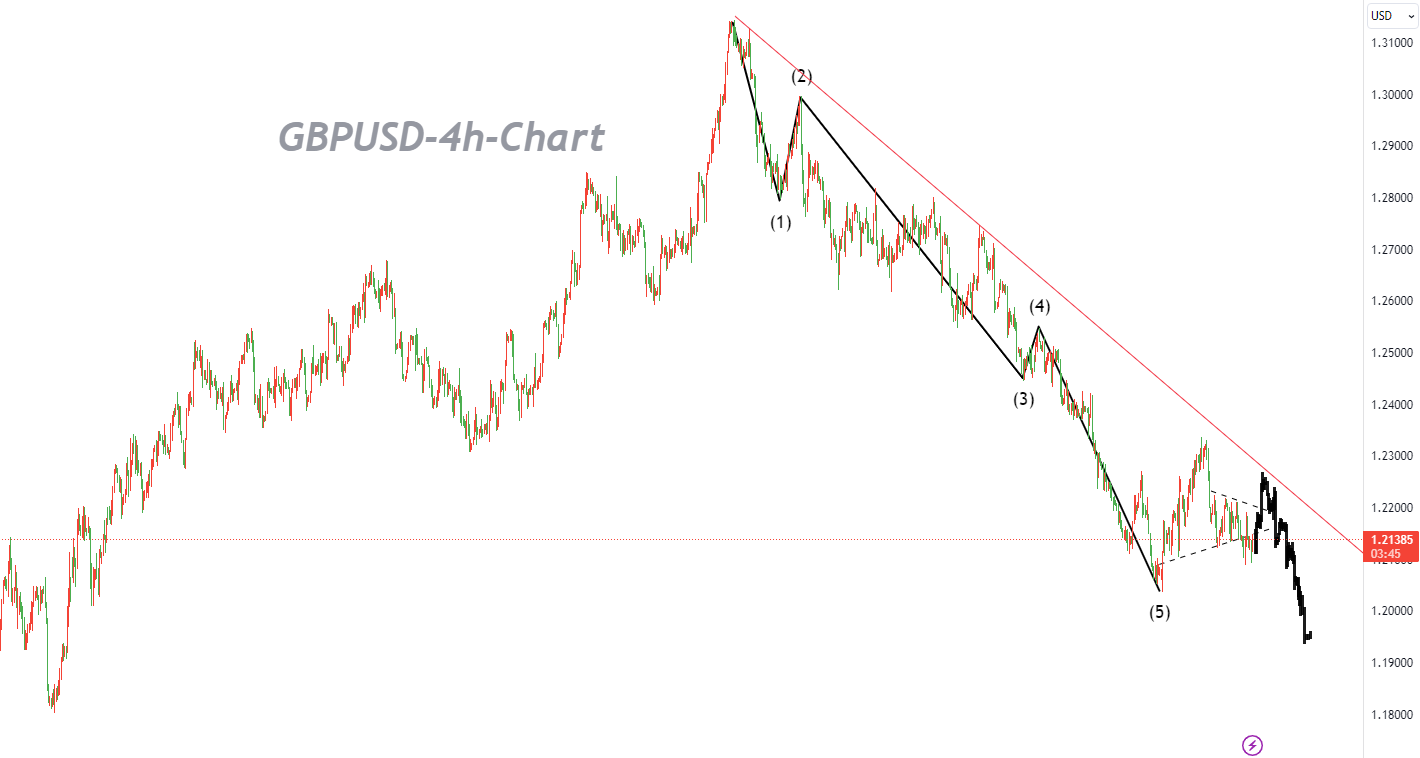
After the release of UK inflation data for September, the British pound appeared quite weak, but it found solid support once again when it dipped below 1.2100 against the US dollar. However, the Relative Strength Index (RSI) in the 4-hour chart remains well below 50, indicating a bearish bias remains intact. If the asset closes below 1.2100 in the 4-hour chart, bears may take action once more. In such a scenario, the 1.2050 level can be considered the next bearish target before testing the psychological level of 1.2000.
On the upside, the 20-period SMA in the 4-hour chart will act as dynamic resistance around the 1.2150 level. Bulls would need a further rebound to the resistance zone of 1.2190-1.2200 and a breakthrough to ensure a bullish move towards the 1.2300 range.
Overall, with the double bottom pattern forming once again, we believe that bulls may overcome the impact of the poor inflation data and rise once more. In terms of trading, a focus on buying the dips is recommended.
Trading Recommendations
Trading Direction: Long
Entry Price: 1.2014
Target Price: 1.2375
Stop Loss: 1.2000
Valid Until: 2023-11-03 23:55:00
Support: 1.2123, 1.2106, 1.2084
Resistance: 1.2223, 1.2304, 1.2338


