

Chapter 45 10/23 GBPUSD: Bulls Struggling for a Comeback While Market Won't Blindly Follow
Summary: During the week of October 20th, the GBPUSD faced substantial selling pressure and experienced wide-ranging fluctuations due to mixed economic data and increased risk aversion in the market.
Fundamentals
In the week of October 20th, a slew of concerning economic data heightened concerns about the possibility of a recession in the UK. Notably, the release of the UK's average income data on Tuesday revealed a slowdown in the labor market for the period from June to August. Although wage growth remained steady at 7.8%, a slight dip from the previous 7.9%, the data showing inconsistent wage growth and inflation raised worries. This led to speculations that the Bank of England might keep interest rates unchanged in November.
Simultaneously, the UK's Consumer Price Index (CPI) reported an inflation rate of 6.7%, still the highest among G7 nations. Despite the higher-than-expected inflation rate, the market believed it might not be enough to prompt the Bank of England to raise rates in November.
Furthermore, the latest UK retail sales data, released on Friday, was a cause for concern. Retail sales declined by 0.9% in September after rising by 0.4% in August. The sharp drop in consumer spending sparked concerns about an economic recession in the UK, causing the pound to decline during the week.
Additionally, the US dollar experienced fluctuations throughout the week due to changes in US economic data and mixed comments from various sources.
Stronger-than-expected US retail data for September, released on Tuesday, came in at 0.7%, just slightly lower than August's 0.8%. Sustained consumer spending indicated resilience in the US economy and alleviated concerns about a weak retail sector. As the safe-haven currency, the "US dollar" garnered investor attention, slightly boosting bets on Fed interest rate hikes.
At the same time, a multitude of speeches from Fed policymakers tempered the US dollar's rise. Many policymakers adopted a notably vague tone in their speeches, warning against letting recent optimistic data influence their overall decisions at the November meeting.
Fed Chairman Jerome Powell's speech on Thursday reflected the recent uncertainty. "A range of uncertainties, both old ones and new ones, complicate our task of balancing the risk of tightening monetary policy too much against the risk of tightening too little," Mr. Powell stated. "Given the uncertainties and risks, and given how far we have come, the committee is proceeding carefully."
On the other hand, the US dollar continued to be influenced by market risk sentiment, with concerns about the Middle East situation aiding in limiting losses for safe-haven currencies.
Looking ahead to this week, the latest UK unemployment data is set to be released on Tuesday, with the unemployment rate expected to remain stable. Unless the data significantly deviates from the predicted 4.3%, its impact on the pound's performance may be minimal.
Also on Tuesday, the UK's Purchasing Managers' Index (PMI) will be published. Both the services and manufacturing indices are expected to rise, but as both industries are anticipated to remain in contraction territory, there may still be negative implications for the pound.
Technical Analysis
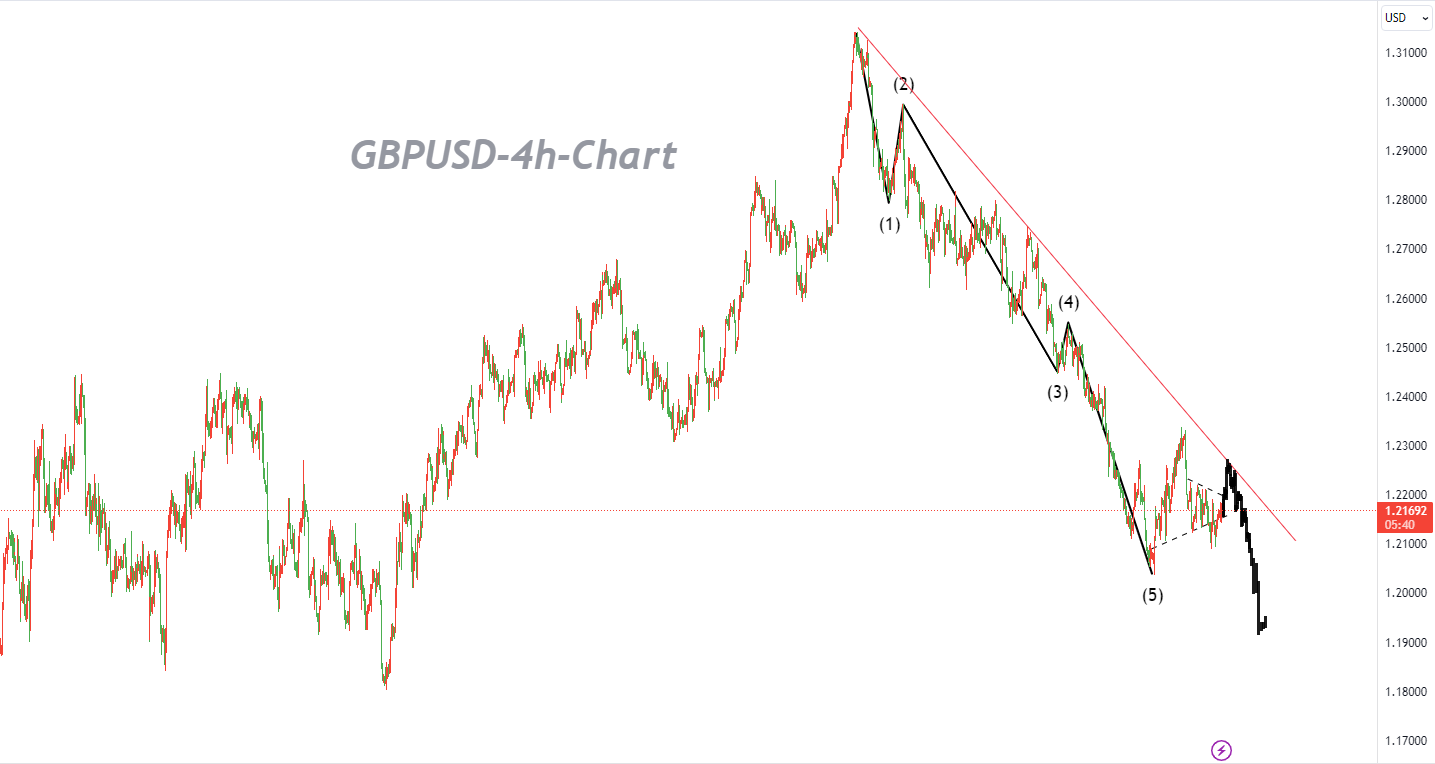
The GBPUSD had a turbulent week of trading last week. Despite two instances of breaking below the triangular consolidation range, the price failed to sustain a downward trend. Currently, the bulls are struggling to pull the exchange rate back into the triangular consolidation range.
While the upward trend aligns with our expectations, with the weakness of the US dollar, we anticipate that this asset may continue to rise. However, contrary to last Friday's strategy, this time our primary strategy is bearish. This is due to expectations that the US dollar will find solid buying interest below the 105.80 level (currently at 106.08, bearish on the dollar).
The GBPUSD is currently struggling to recover within the triangular consolidation range, and a closing price above the 1.2190 resistance level could trigger a decent recovery wave. The next major resistance level is around 1.2220. Any further upside may push the asset to touch the 1.2250 resistance in the short term, which is the entry point for our current strategy. In terms of trading strategy, the focus is on going short at highs.
Trading Recommendations
Trading Direction: Short
Entry Price: 1.2250
Target Price: 1.1848
Stop Loss: 1.2395
Valid Until: 2023-11-06 23:55:00
Support: 1.2074, 1.2037, 1.2000
Resistance: 1.2169, 1.2203, 1.2250


