

Chapter 50 10/24 WTI: Buy the Dips as the Selling Is in an Oversold Condition
Abstract: On Tuesday, international crude oil was erasing its earlier gains, as the Israeli conflict seemed to take a back seat in the headlines and eased concerns about tight supply.
Fundamentals
International crude oil prices fell sharply overnight, the conflict between Palestine and Israel ignited the gunpowder barrel in the Middle East, the fragility of crude oil supply was highlighted, and the risk assets may digest the theme of recession in advance.
Since the beginning of this week, countries have called for peaceful settlement of disputes, and the risk sentiment has cooled down, and the risk premium of crude oil has moved down. EU leaders called for a "humanitarian pause" in the conflict this week, and the foreign ministers of six countries, including Iran, held a meeting of foreign ministers of 3+3 countries, stressing that disputes should be settled peacefully and attacks against innocent civilians should be stopped immediately.
It has been half a month since the Palestinian-Israeli conflict broke out, and its influence is not as strong as that of the Russian-Ukrainian conflict. The situation has not been further expanded. It is expected that geopolitical events will be repeated, and it is hard to say that crude oil will be separated from geopolitical risks.
In addition, the supply-side disturbance is still there, and it is difficult for major oil-producing countries to maintain the pace of production reduction, unexpected decline in inventories, and rising supply in Venezuela.
The market is now turning its attention to the upcoming inventory report of API and EIA, which may affect the trend of this product.
A large reduction in inventory may reassure investors because demand is still supported, which may lead to further price increases. On the other hand, rising oil prices may indicate a decline in consumption or an increase in supply, which may lead to a further decline in crude oil prices.
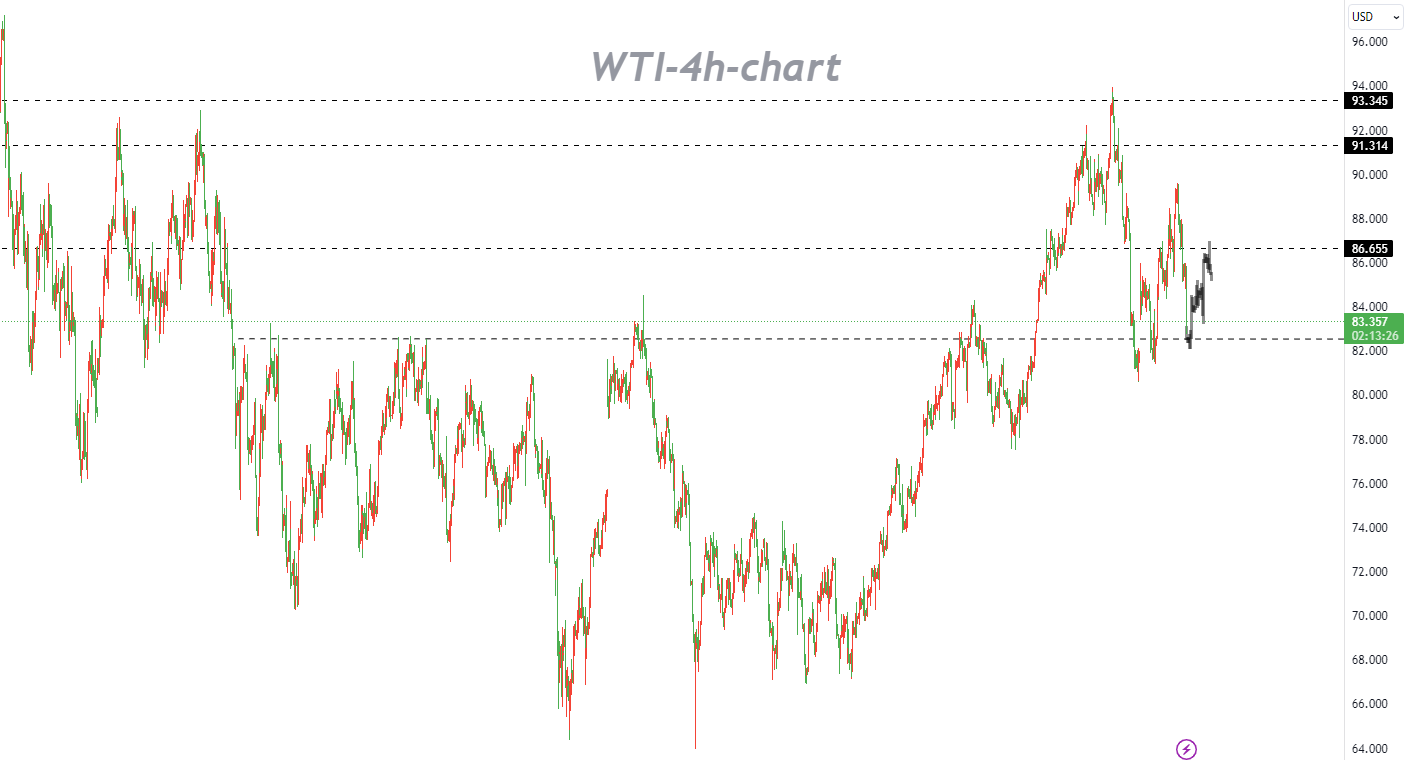
Please note that the wedge pattern ranges from about US$82.00 to US$90.00, so the resulting selling may continue on the same scale. Overall, geopolitics risks are superimposed with macro-disturbances, and crude oil is treated as a shock in the short term.
Technical Analysis
WTI crude oil had earlier consolidated within a rising wedge pattern and then broke out, indicating a downtrend was forming at the same height as the formation.
However, the price has not yet retraced to retest the former wedge support level for more selling pressure. The Fibonacci retracement tool also shows other levels where bears could join.
The 38.2% Fibonacci level at US$87.10 is near the bottom of the wedge, while the 50% Fibonacci level at US$87.62 is near the 100 SMA dynamic inflection point. A larger correction could reach the 61.8% Fibonacci level at US$88.14, which could be the bottom of the bearish retracement.
However, 100 SMA is still higher than 200 SMA, indicating that the path of least resistance is upward, or that there is a chance that the upside may resume. However, the trading price of crude oil is still lower than these two indicators, so the SMA may maintain a dynamic resistance level.
Stochastic is also indicating an oversold condition, so any rise would confirm that the bulls may be taking over. Similarly, the Relative Strength Index is also moving higher, suggesting that bullish momentum may be developing. It is recommended to buy the dips.
Trading Recommendations
Trading direction: Long
Entry price: 82.50
Target price: 87.00
Stop loss: 80.50
Deadline: 2023-11-06 23:55:00
Support: 82.50, 81.43, 80.64
Resistance: 84.41, 85.99, 87.88


