

Chapter 53 10/25 GBPUSD: Explore the Feasibility of GBP Bottoming with Small Stop Losses
Abstract: After the number of employed people decreased by 133,000 from May to July, the number of employed people in the UK decreased by 82,000 in the latest quarter. The UK's job market is more tense than previously expected, but this is unlikely to affect the Bank of England's (BOE) interest rate decision.
Fundamentals
The Office for National Statistics (ONS) has changed the calculation method of employment data. Previously, it has postponed the release of unemployment and employment data to make the best measurement.
Figures released on Tuesday showed that in the three months to August, the UK lost 82,000 jobs, down from 207,000 jobs in the previous month. While the unemployment rate remained at 4.2%. 4.3% lower than the previous value. This is the highest level in the past two years, higher than 3.5% a year ago.
The data shows that the labor market is more tense than previously thought. However, given that other indicators show that the employment rate is declining, this has caused the BOE to stop a series of sharp interest rate hikes aimed at curbing the pressure of rising wages and prices.
The BOE will want to see the job market further relaxed at the current level before cutting interest rates. Before ending the interest rate hike for 14 consecutive months, the monetary policy committee of the central bank will pay attention to the impact of the tight labor market on inflation.
Although there is evidence that wage growth will slow down later this year, and the analysis of the UK Recruitment & Employment Confederation shows that UK employers reduced job vacancies for the first time in more than two years last month, it is still too early to call on the BOE to end the current tightening cycle.
Technical Analysis
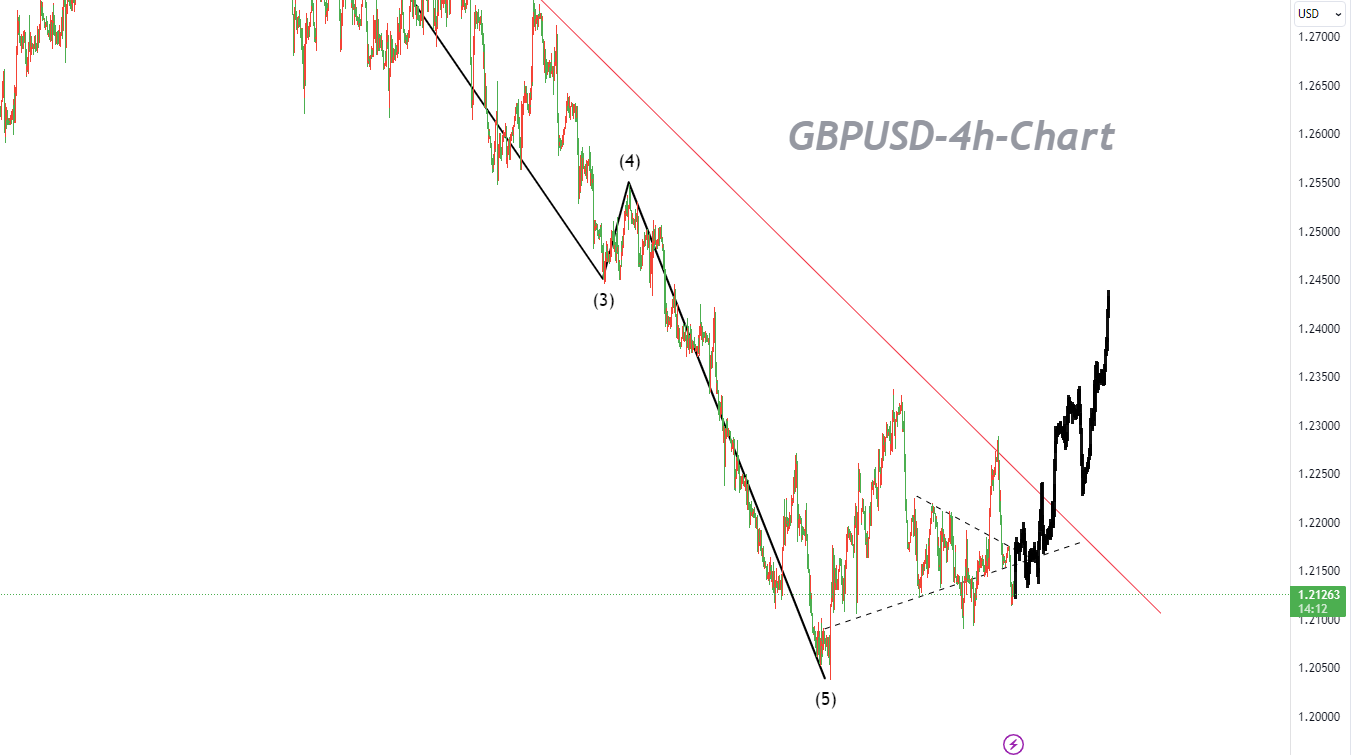
The GBPUSD fell back after surging in yesterday's trading, with prices once again returning to the lower half of the fluctuation range, suspending the stop-loss. The Relative Strength Index in the 4H timeframe fell below 50, closing below the 100 SMA and 50 SMA, reflecting a bearish bias.
On the downside, 1.2100 is the key support. If the market fails to hold this level, there could be a risk of further declines towards 1.2050.
In terms of exploring the feasibility of a GBP bottoming, the lows must continue to move up, and the bulls need to clear the resistance level of 1.2190-1.2200, that is, the intersection of 100 SMA (4H) and 23.6% Fibonacci retracement, to attract technical buying. In this case, 1.2250 and 1.2300 may be regarded as the next resistance levels. Breaking through 1.2337 will mean that the bulls have officially bottomed out. It is recommended to buy the dips with small stop losses.
Trading Recommendations
Trading direction: Long
Entry price: 1.2120
Target price: 1.2340
Stop loss: 1.2000
Deadline: 2023-11-08 23:55:00
Support: 1.2085, 1.2038, 1.2026
Resistance: 1.2154, 1.2207, 1.2264


