

Chapter 17 09/28 WTI: Bulls Take Profits, But Whether the Peak Has Been Reached Remains to Be Seen
Summary: WTI crude oil prices traded as high as $93.98 per barrel on Thursday, with the primary driver of the significant price increase still being OPEC+ countries' voluntary production cuts. However, Saudi Arabia may relax these cuts earlier than expected.
Fundamentals
WTI crude oil prices were at $87.87 in Tuesday's trading but have surged to levels above $93.00 as of this morning, a gain of over 6% in just two days.
This is in response to market reaction to news about a decrease in US crude oil inventories (expected to decrease by 320,000 barrels, but actually decreased by 2.16 million barrels). According to Reuters, inventories are approaching historic lows. Perhaps US authorities are trying to mitigate the impact of high oil prices on inflation by releasing the Strategic Petroleum Reserve (SPR), but data suggests that these efforts may not yield the expected results.
Now, the bulls must hold their ground around the $93 level. However, if the upward momentum has not been exhausted, we may continue to see prices rise.
On the other hand, overbought markets, the desire to lock in profits in long positions before the weekend, and statements from US authorities could all be factors that prompt a reaction in the crude oil market. All of these could contribute to the formation of a correction.
On another note, Saudi Arabia may be closer to announcing that its mission in the crude oil market is accomplished than traders realize. This comes as Saudi Arabia has significantly reduced production at a time when global fuel demand is at record levels, driving Brent crude oil prices close to $100 per barrel. This might be enough incentive for Saudi Arabia to begin restoring production sooner rather than risk further economic damage from soaring prices.
Traders may have underestimated the possibility of Saudi Arabia stopping production cuts earlier. Saudi Arabia does not want to deliberately tighten the market to the point of price spikes, as it would lead to demand collapse and subsequently a bubble. The truly wise approach to keeping prices in check is for Saudi Arabia and OPEC+ to announce their views, and they have already scared away speculative longs and shorts. They're not quite there yet, but they're getting closer to their goal.
Technical Analysis
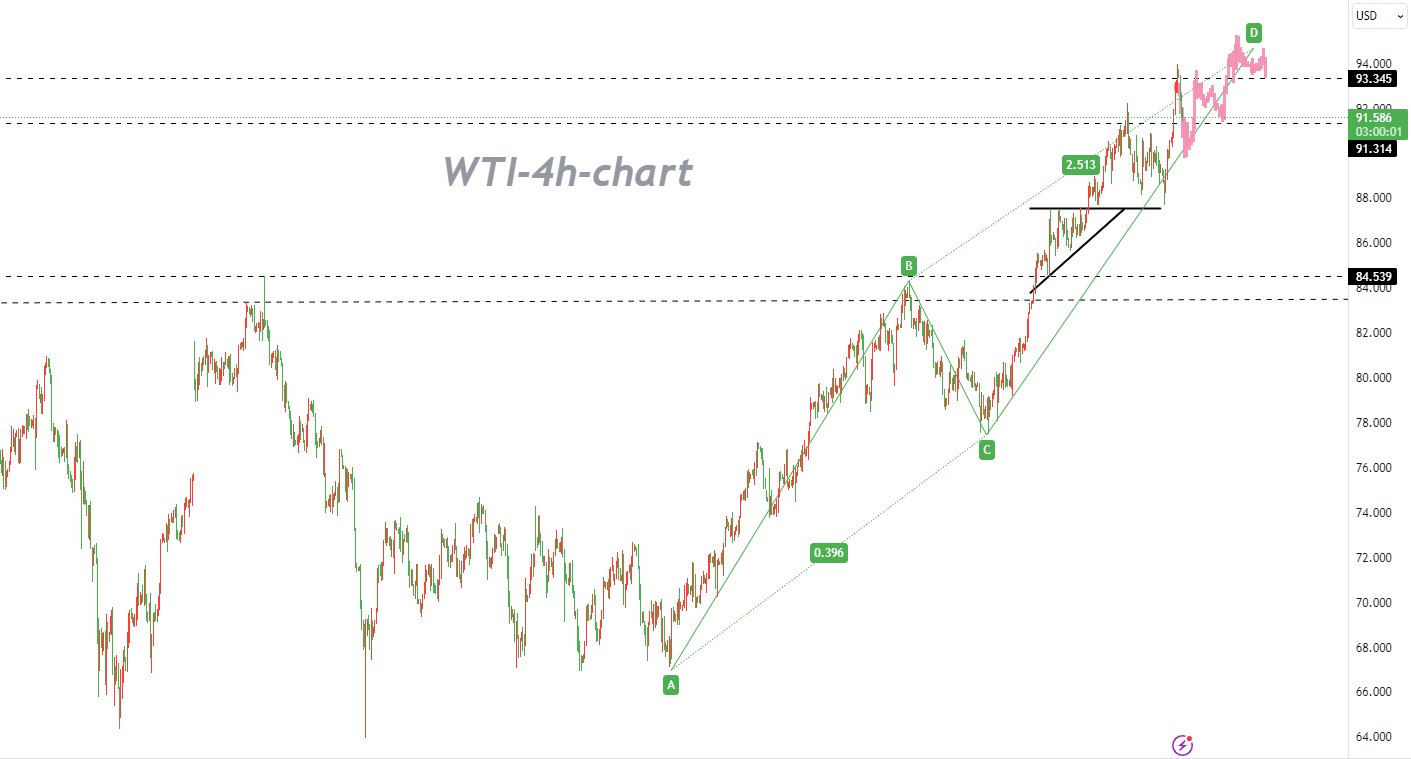
WTI crude oil rose to its highest level since August 2022 on Thursday. So far, due to overbought conditions indicated by the RSI, stochastic oscillator, and Bollinger Bands, a price correction has occurred. However, whether this round of price correction signifies that the crude oil price of $93.98 per barrel is the recent peak remains uncertain and requires further observation.
Specifically, if the price retraces significantly and falls below the critical support level of $89.20, then the recent high of $93.98 per barrel may become the recent peak, making it challenging for prices to reach new highs. If the bulls hold onto this critical support level, the market may continue to rise, testing the 50% golden Fibonacci retracement ratio at $95.16, ranging from $126.49 to $63.96. If the bulls attempt to push prices higher again, resistance may halt around the August 2022 peak at $97.80. Further upward movement could be stopped at the July 2022 resistance level of $102.00.
However, if the bears break below $89.20 and push prices lower, it could lead to prices revisiting the $80.00 level.
Overall, although WTI crude oil has displayed continued strength, reaching multi-month highs in line with expectations, the possibility of a downward correction should not be ruled out as the recent rally has severely entered overbought conditions. In terms of trading strategy, a "cautious watch" approach on buying the dips is preferred.
Trading Recommendations
Trading Direction: Long
Entry Price: 90.00
Target Price: 95.13
Stop Loss: 87.70
Valid Until: 2023-10-12 23:55:00
Support: 90.90, 89.74, 87.79
Resistance: 92.31, 93.98, 95, 13


