

Chapter 30 10/16 USDCAD: Bullish Trend Persists, Yet Structure Appears Overcrowded
Summary: As the US dollar weakens, the USDCAD exchange rate remained on a downward trajectory for the second consecutive trading day on Monday. Canadian inflation data will be a focal point on Tuesday.
Fundamentals
Inflation data and business outlook surveys will be the focus of Canadian economic data this week.
Currently, the market expects the year-on-year increase in Canada's overall Consumer Price Index (CPI) for September to decrease from 4% in August to 3.8%. Growth in energy prices may accelerate. Gasoline prices in September saw a slight dip from August but remained nearly 7% higher than the same period last year, compared to a 1.5% year-on-year increase in August.
The Bank of Canada is particularly concerned with recent price increases in a series of "core" indicators designed to better measure Canada's (rather than globally generated) inflationary pressures.
We anticipate that the price growth, excluding food and energy prices, will slow to 3.3% year-on-year, slightly above the upper limit of the central bank's target range of 1%-3%, despite the ongoing surge in mortgage interest costs. However, the three-month rolling averages for the central bank's preferred "trimmed" and "median" price growth indicators both accelerated to an annualized 4.5% in August. This has raised concerns that, despite a weak macroeconomic environment, fundamental price growth has not slowed down.
Firms' price-setting behaviour will also be front-and-center in the BoC's own Business Outlook Survey. Prior surveys showed that firms were making larger and more frequent changes to prices during the initial spike in inflation. Subsequent surveys have suggested that the pendulum is swinging back but the BoC's Deputy Governor Vincent reiterated earlier this month that a return to "normal" price-setting behaviour is needed to get inflation sustainably back to target. Firms' inflation expectations will also be watched closely along with consumers' views from the separate Survey of Consumer Expectations.
We anticipate that, given the recent softening of economic growth indicators, the central bank will signal a weak business condition. Furthermore, labor shortages are expected to ease as unemployment rates rise and job vacancies decrease.
In the short term, the CADUSD has the potential for a moderate recovery. If the BoC maintains key interest rates at a higher level for a longer period and reduces interest rates by a smaller margin than the Fed, the Canadian dollar should benefit.
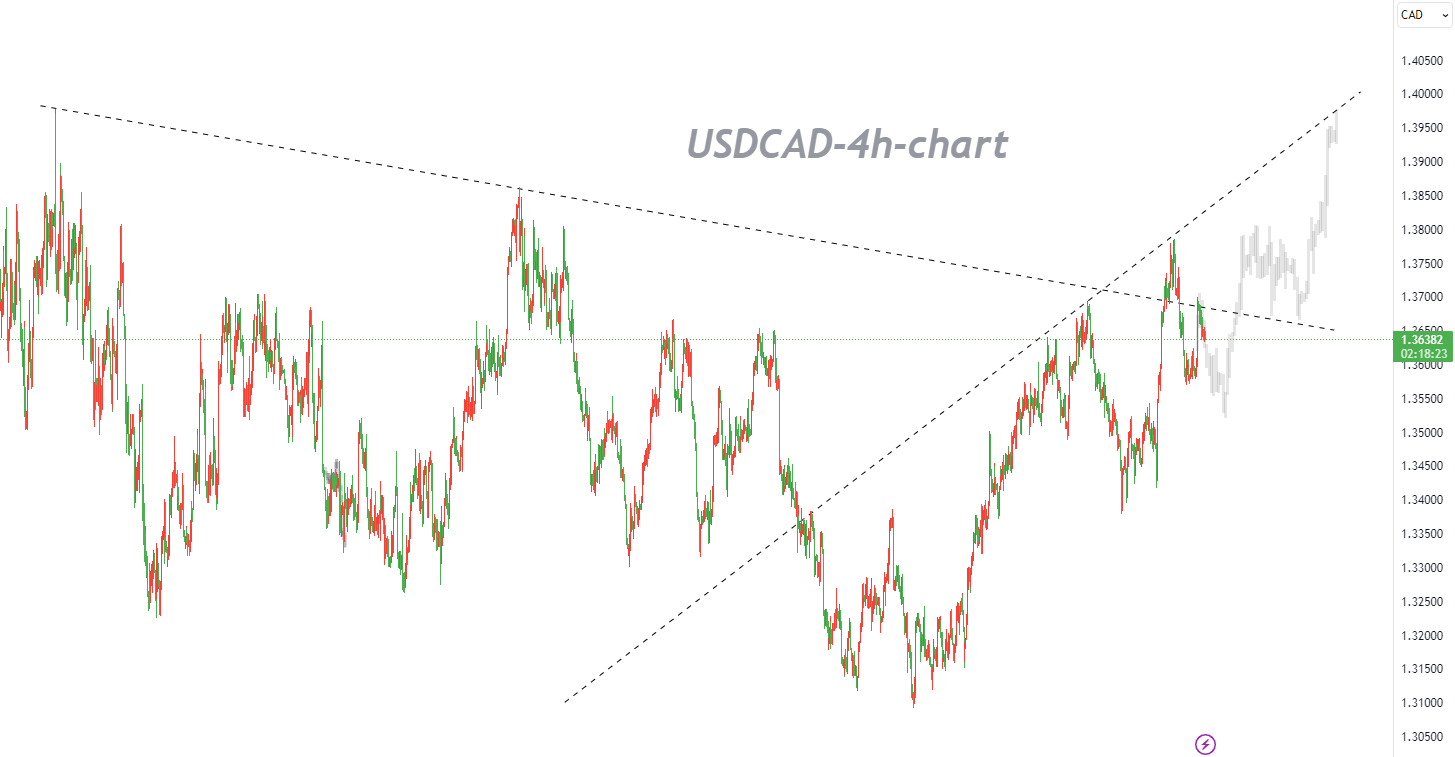
The USDCAD recently reversed from the resistance level of 1.3800 (a downward trend since October 2022), coinciding with the upper daily Bollinger Band and the resistance trendline of the upward channel that has been in place since July. The bearish reversal from the 1.3800 resistance level prevented an early July retracement.
Given the strength of the 1.3800 resistance level and the overbought condition of the daily stochastic oscillator, it is expected that the USDCAD will further decline towards the next support range at 1.3530-1.3515.
Technical Analysis
The USDCAD gathered strong bullish momentum in trading last Thursday, edging higher after the release of the US September consumer report, which allowed it to reverse the weekly losses into gains. However, as the time cycle became overly crowded, a pullback in the upward trajectory was in line with expectations.
The asset currently remains above a cluster of moving averages. Nevertheless, a descending trendline that began at the top in 2020 has resumed its role as an upward resistance, halting the bullish action just below the 1.3700 level. Despite some positive signs in the relative strength index (RSI) and the stochastic oscillator, a lack of sustained upward momentum suggests that the bulls require more structural adjustments to push higher.
On the downside, the 20-day and 50-day SMAs provide short-term support around the 1.3500 level, maintaining the market within a range that has held since July. Simultaneously, the 200-day SMA operates within the same range, providing relatively smooth price action. Therefore, if the market further declines to the 1.3530-1.3515 range, it could trigger a strong rebound and lay a solid foundation for the bulls to test the 1.3800 level.
Overall, although the recent bullish structure of the USDCAD appears attractive, and the "head and shoulders" pattern formed since March 2023 provides a bullish foundation, further upside movement still requires more structural adjustments due to the relatively crowded time cycle. Therefore, going short at highs should be the primary approach for trading.
Trading Recommendations
Trading Direction: Short
Entry Price: 1.3630
Target Price: 1.3516
Stop Loss: 1.3700
Valid Until: 2023-10-30 23:55:00
Support: 1.3623, 1.3596, 1.3569, 1.3484
Resistance: 1.3694, 1.3785, 1.3816, 1.3862


