

Chapter 38 10/18 EURUSD: Buy the Dips as the Intraday Deviation Remains Neutral
Abstract: The consumer price index (CPI) in the eurozone increased by 4.3% in September, down from 5.2% in August. The core CPI was finally determined to be 4.5% year-on-year, down from 5.3% last month.
Fundamentals
According to data released by Eurostat on Thursday, the consumer price index in the eurozone increased by 4.3% year-on-year in September, which was slower than the 5.2% in August, in line with market expectations. Among them, the service industry contributed the most to the price increase, and the energy price decreased compared with the same period last year.
The inflation rate in the eurozone varies greatly, with prices in the Netherlands dropping slightly year-on-year, prices in France and Italy rising above average, and prices in Hungary rising by more than 12%. The slowdown in overall inflation may persuade the European Central Bank (ECB) to keep interest rates unchanged next week for the first time since last June and may end the long-term interest rate hike cycle.
Since the September meeting, inflation and growth data have basically met expectations. Considering the clear guidance of the ECB, it is expected that there will be no change in the upcoming meeting. We expect Lagarde to acknowledge the discussion on promoting PEPP reinvestment in the Q&A section of the press conference, thus indicating the austerity tendency, although there is still some selectivity in her communication.
At present, the market expects that the policy interest rate of the ECB will remain basically unchanged in the next six months, and then a very slow and gradual interest rate reduction cycle will begin from the second quarter of next year. From April 2024 to April 2025, the interest rate was cut by 89 basis points.
We predict that energy prices may rise faster in the future, but the inflation rate in other areas, including food, should fall faster, thus helping the overall inflation rate reach 2% by the end of next year. The ECB may cut inflation expectations before December, paving the way for a potential rate-cut cycle starting in March next year.
Technical Analysis
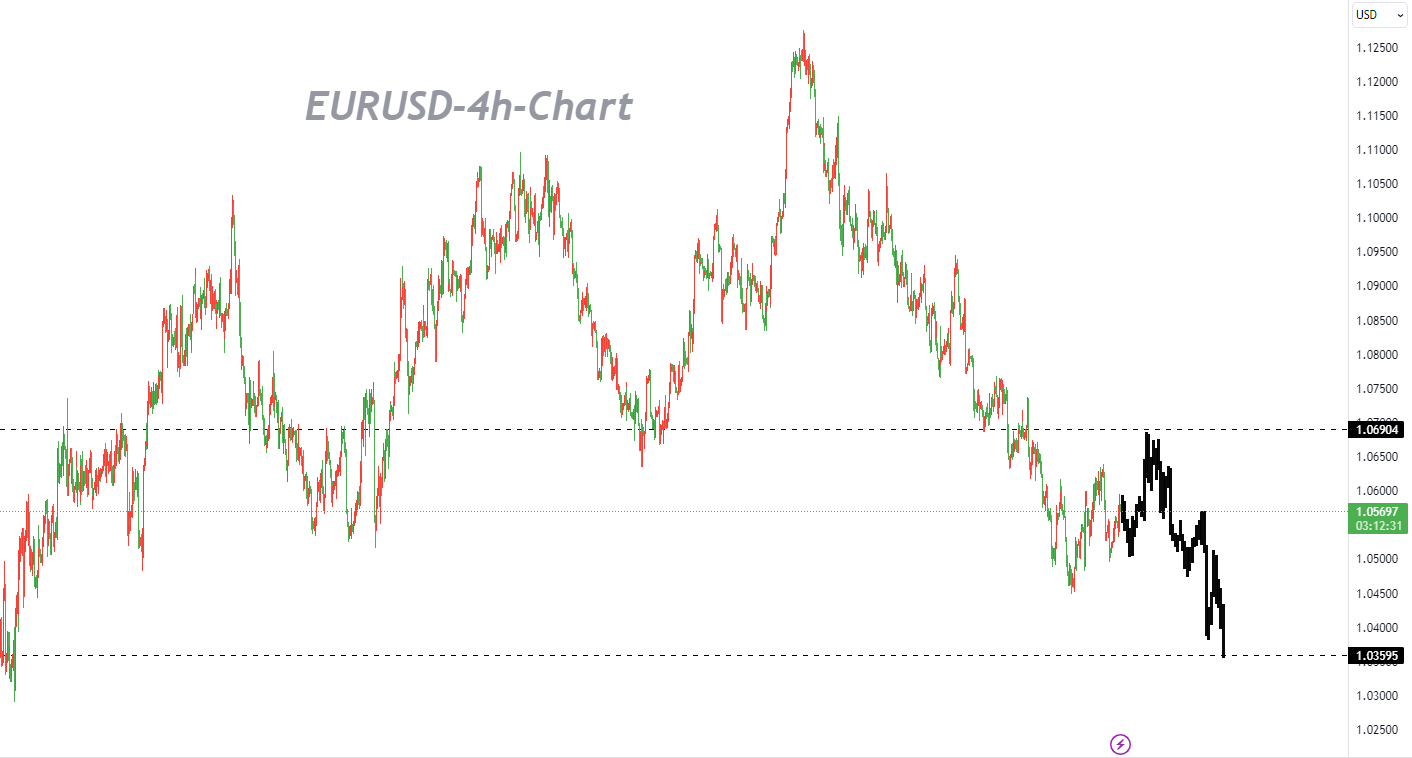
The EURUSD lost momentum below 1.0600 on Wednesday and fell to 1.0550. As reflected by Wall Street's bearish opening, the negative shift in risk sentiment helps the USD find demand and suppress the EURUSD when the market pays close attention to geopolitics.
At the same time, the intraday deviation of the EURUSD continues to remain neutral, but the momentum continues to fall back in the intersection. It reflects the strong selling interest before the threshold of 1.0600. However, it is the same as the trend structure of the GBP, and we hope that the situation will develop in a good way.
On the upside, the EURUSD is currently facing resistance near the 61.8% Fibonacci retracement, which moves downward from the fluctuation high of 1.0639 to the low of 1.0495. The next major resistance level is around 1.0595. An upward breakthrough of 1.0595 may lay the foundation for another rise. Under the above circumstances, the EURUSD may rise to the range of 1.0700.
If not, the exchange rate may start a new round of decline. The first main support is located at 1.0530. If the downside breaks through 1.0530, it may fall to 1.0500. The next support level is around 1.0480, below which it could start to fall sharply. It is recommended to buy the dips on the technical chart.
Trading Recommendations
Trading direction: Long
Entry price: 1.0482
Target price: 1.0700
Stop loss: 1.0400
Deadline: 2023-11-01 23:55:00
Support: 1.0530, 1.0500, 1.0480
Resistance: 1.0595, 1.0639, 1.0709


