

Chapter 39 10/19 WTI: Selling Pressure Returns as Expected, Focus Remains on Shorting at Highs
Summary: A possible US-Venezuela deal may have limited short-term supply impacts due to Venezuela's outdated infrastructure. Demand remains the primary short-term driver for oil prices. The EIA report indicates a surprising 4.5 million barrel inventory decrease, suggesting an improvement in demand conditions.
Fundamentals
The US is temporarily lifting some key sanctions on Venezuela's oil and gas industry. This comes after the Venezuelan government and opposition reached an agreement on presidential elections, which was welcomed by the US.
In November 2022, the White House relaxed sanctions on Venezuela, allowing joint ventures between Chevron and Venezuela's state-owned oil company to increase crude oil production. Since then, the country has been exporting around 165,000 barrels of crude oil to the US daily.
Yesterday, the US Department of the Treasury issued a six-month waiver authorizing transactions with Venezuela's oil and gas sector. The Treasury Department also noted its readiness to "modify or revoke the authorization" if the commitments are not fulfilled.
Currently, oil traders are closely monitoring the Middle East, where recent turmoil has driven oil prices higher. The lifting of US sanctions on Venezuela could help cool this trend.
Due to sanctions and economic stagnation, Venezuela's current oil production is only a third of what it was a decade ago. However, with Chevron's operations returning, daily production has exceeded 800,000 barrels this year. As long as the conflict persists, the oil market will continue to focus on the Persian Gulf region, but the extent to which oil prices surge will depend on whether Venezuela can bring about a larger supply rebound.
Since October 7, tensions in the Israeli-Palestinian conflict have been escalating, causing significant volatility in the global oil market. Market concerns revolve around the potential involvement of Arab nations, which could lead to reduced or interrupted oil supplies in the Middle East, causing oil prices to rise substantially once again.
However, looking at the supply-demand dynamics for crude oil this year, the primary driver of the price increase has been the proactive production cuts by OPEC+, rather than a significantly robust demand causing a shortage of oil supply. Looking at the fourth quarter and next year's global economic growth, it is highly probable that the economies of developed countries in Europe and the US, which have been impacted by high interest rates, will continue to slow down. International organizations such as the EIA and IEA have consistently lowered their expectations for oil demand growth. Still, it is unlikely that the Israeli-Palestinian conflict will trigger a repeat of the oil embargoes of the 20th century. Oil prices are likely to spike and then retreat.
The US EIA's crude oil inventory data for the week ending October 13, released yesterday, shows inventory decreases across all categories, with demand remaining a key driver of oil prices.
The EIA data confirms the API report, with inventory reductions in all categories, most notably a sharp drop in gasoline inventories. The replenishment of the Strategic Petroleum Reserve (SPR) has stalled, with virtually no progress in the past six weeks. Cushing crude oil inventories have fallen to their lowest levels since October 2014. Fernando Valle, a senior oil and gas analyst, points out that Brent and WTI forward curves have risen due to expectations of potential ongoing supply interruptions.
Technical Analysis
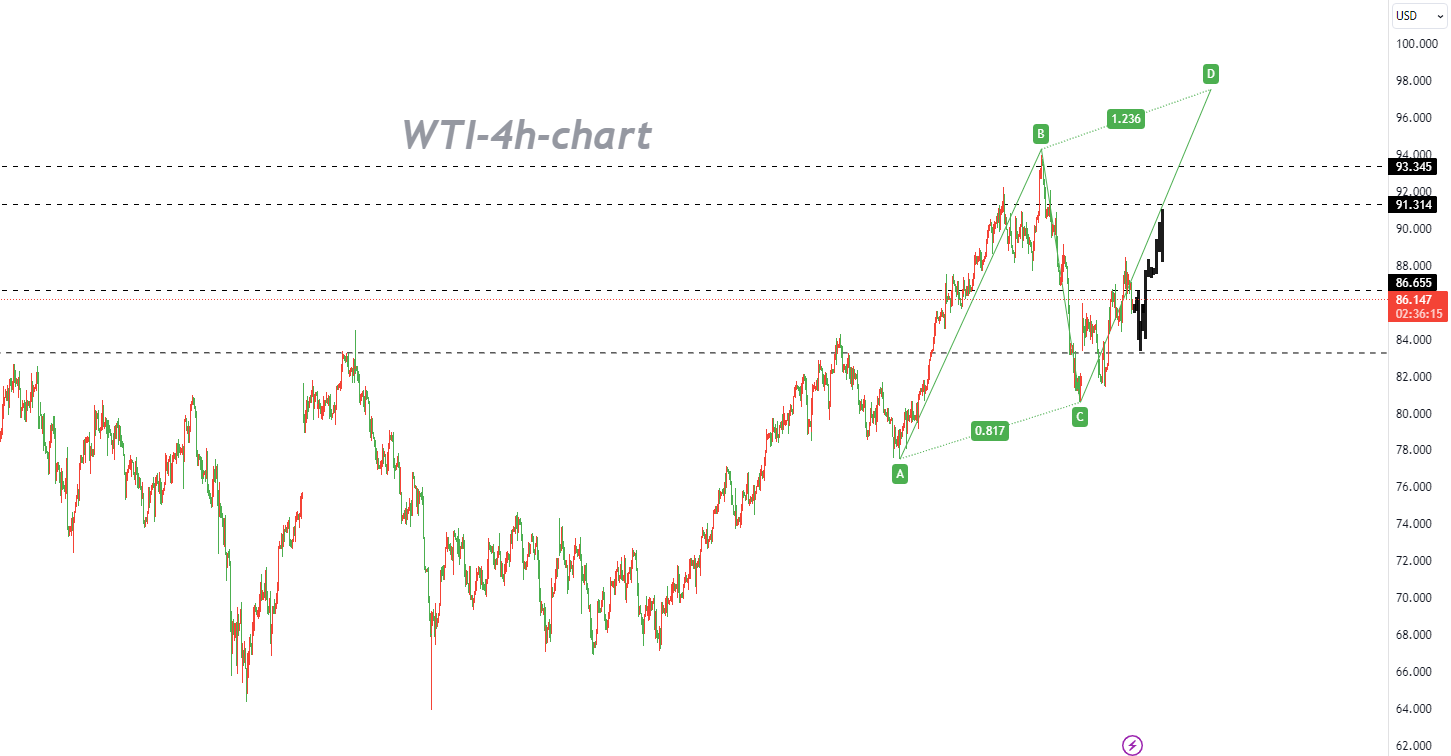
On the front of the intermediate-term trend, WTI crude oil is forming higher lows and higher highs, connected by an ascending channel that has been maintained since mid-month. The price is testing the range channel support level, which could eventually lead to a bounce towards the upside target point D.
The 100-day SMA is above the 200-day SMA, indicating the path of least resistance is upward, and that support is more likely to hold than be breached. In this scenario, the next move for crude oil may target higher Fibonacci extension levels.
The 38.2% Fibonacci extension is at $88.43 per barrel, while the 50% level is near $89.00. Stronger upward momentum could push crude oil prices to the 61.8% extension level at $89.49 or the 76.4% level near the channel's top. The full extension price will be at $97.52.
In terms of the short-term trend, however, the stochastic oscillator points downward, reflecting bearish pressure, so a price breakdown might occur. Breaking below the 200-day SMA dynamic support level could be sufficient to confirm the formation of a downtrend.
The RSI is also heading down to suggest a return in selling pressure, and the oscillator has some room to move further south before reflecting an oversold condition. Nonetheless, a price surge could mean that buyers are ready to return. In terms of trading strategy, it is recommended to focus on going short at highs.
Trading Recommendations
Trading Direction: Short
Entry Price: 87.70
Target Price: 82.00
Stop Loss: 90.30
Valid Until: 2023-11-02 23:55:00
Support: 86.97, 85.72, 84.37
Resistance: 88.45, 89.14, 90.07


