

Chapter 40 10/19 AUDUSD: Overall Negative September Employment Data Intensifies Downside Pressure Amid Rekindle
Summary: As tensions in the Middle East escalate, the Australian dollar is once again weighed down by global risk aversion, while Australia's domestic employment data is mixed, providing little support for the asset.
Fundamentals
Data released by the ABS Labour Force Statistics on Thursday showed mixed conditions in the Australian job market for September. Employment growth fell well short of expectations, with only 6,700 jobs added in the country, far from the expected 20,300 job additions. A deeper look into the data reveals a significant decline in full-time employment by 39,900, offset by an increase in part-time positions by 46,500.
While the market expected the unemployment rate to remain stable, the unemployment situation slightly improved, dropping from 3.7% to 3.6%. However, this decrease may be attributed to a decline in labor force participation, which decreased from 67.0% to 66.7%. Meanwhile, the total monthly hours worked decreased by 0.4% on a monthly basis, equivalent to a reduction of 8 million hours.
Kate Lamb, ABS head of labour statistics, emphasized that considering the average monthly employment growth of 35,000 people in the past two months, it is consistent with the annual average growth. However, Lamb also pointed out that the drop in the unemployment rate in September indicates that it is primarily due to people transitioning from the unemployed category to those who are not part of the labor force.
Furthermore, she noted, "The recent softening in hours worked, relative to employment growth, may suggest an easing in labour market strength."
In terms of the market, the Australian September employment report puts the focus on next week's inflation data for the Reserve Bank of Australia (RBA) as they consider whether to resume rate hikes at their next meeting. However, the result itself may not be enough to counter the RBA's concerns about inflation.
RBA Governor Michele Bullock warned on Wednesday that there are signs that inflation may become sticky, and the central bank is very cautious about risks. Today's data may not have any impact on any direction - the labor market is slowing, but it is a gradual process, and the market remains very tense.
Hawkish comments from the RBA increase the likelihood of a rate hike in November, and next week's inflation data will be crucial evidence.
Consumer price data for the third quarter will be released on October 25. The market currently believes that the upside risk to the core inflation rate will exceed the RBA's own forecast of 0.9%. The core inflation rate is expected to rise to 1.1% and show persistent cost pressures in the services sector.
We believe the RBA will be forced to revise its inflation forecast, with the risk no longer focused on bringing inflation back to target within the existing timeframe without further rate hikes. We expect the RBA to raise rates by 25 basis points to 4.35% in November. Currently, futures indicate a 26% probability of a rate hike at the policy meeting on November 7.
Technical Analysis
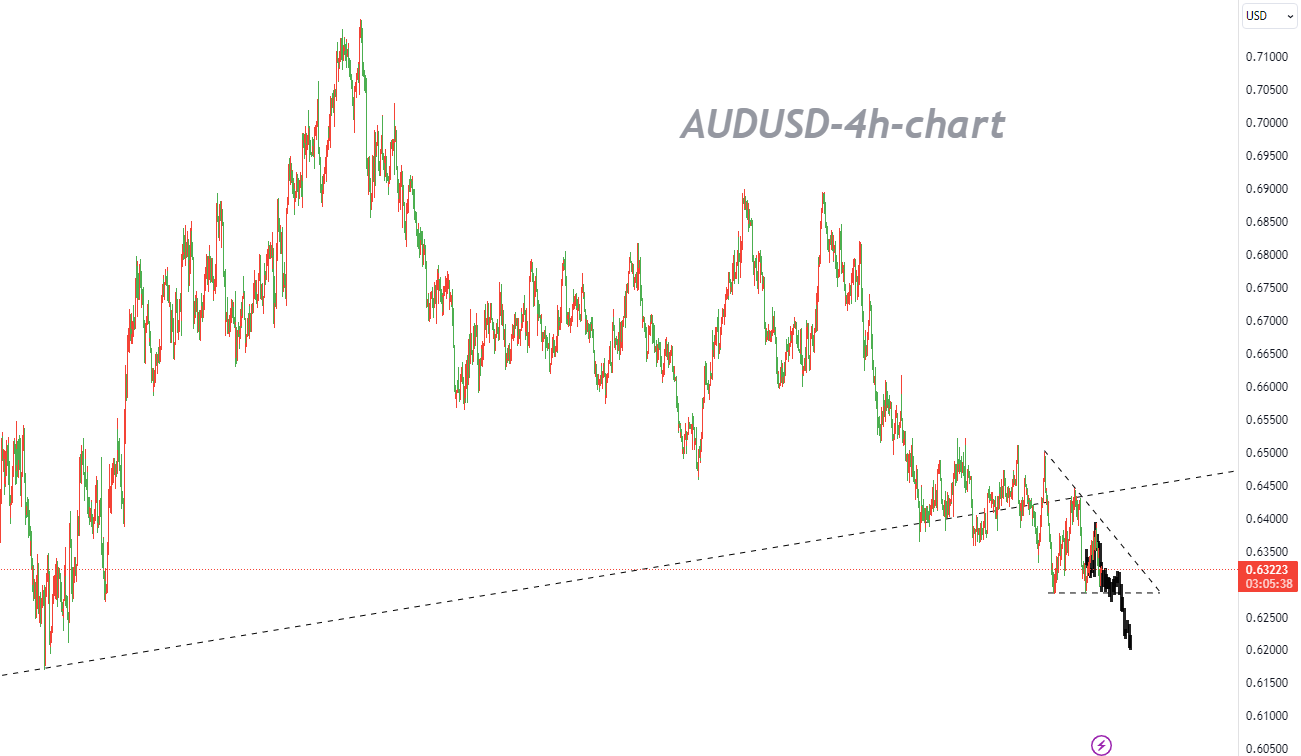
The AUDUSD has seen consecutive declines for the second day in a row, driven by overall negative Australian employment data for September, intensifying the downward pressure amid rekindled risk aversion.
The latest weakness adds pressure to the support level around 0.6285/0.6286 (of October 3rd/13th), and a breach of this level would indicate that a larger downward trend is likely to continue, exposing the 2022 low at 0.6170.
According to technical indicators, the bulls have not gained additional upward momentum, and the Relative Strength Index (RSI) finds it challenging to rise above the 50-neutral threshold. Meanwhile, the stochastic oscillator continues to decline, reflecting market skepticism as the price remains below the 50-period SMA at 0.6360.
If the bears manage to push the price below the support line at 0.6285, the focus may shift to the psychological level of 0.6200, which was last touched a year ago. Further selling pressure may find support within the 0.6100-0.6120 range.
Overall, despite a rebound in the New York session, the AUDUSD still lacks confidence. To gain full control, the asset needs to accelerate its breakthrough at 0.6430. In terms of trading strategy, it is recommended to focus on going short at highs.
Trading Recommendations
Trading Direction: Short
Entry Price: 0.6400
Target Price: 0.6200
Stop Loss: 0.6525
Valid Until: 2023-11-02 23:55:00
Support: 0.6285, 0.6272, 0.6200, 0.6170
Resistance: 0.6338, 0.6365, 0.6398, 0.6452


