

Chapter 84 11/13 AUDUSD: Momentum Indicator Maintains Positive Territory, Yet Bearish Trend Remains Intact
Summary: Over the last week, the Australian dollar recorded a decline against the US dollar despite the Reserve Bank of Australia's (RBA) interest rate hike. The strength of the US dollar dampened the Australian dollar's momentum, prompting increased market attention on this week's release of the US Consumer Price Index (CPI) data. Additionally, key data from Australia, including third-quarter wages and October employment figures, will be closely watched.
Fundamentals
Last week, the RBA's decision to increase the cash rate by 25 basis points to 4.35% aligned with market expectations, with approximately 80% of the rate reflected in the currency market. RBA Governor Michele Bullock's statement summarized information received since August's official forecasts, indicating that "the risk of inflation remaining higher for longer has increased". Economic growth and inflation both being higher than expected are causes for concern.
While this statement was largely anticipated by the market, there was a reaction to an unexpected change in the wording of the final paragraph, shifting from "may need to further tighten monetary policy" (used in the past 6 meetings) to "whether further tightening of monetary policy." This change clearly does not rule out the possibility of future rate hikes.
RBA Assistant Governor Marion Kohler confirmed this expectation in today's speech, stating that the anticipated decline in inflation is expected to be a "more gradual process than previously thought." This outlook stems from the current economic environment characterized by a "still-high level of domestic demand," "strong labour," and other cost pressures, with these factors expected to keep the inflation rate hovering just below 3% by the end of 2025.
Kohler pointed out that the recent trend of declining inflation is mainly driven by "lower goods price inflation," contrasting sharply with "domestic inflation," especially in the services sector, showing resilience. Domestically sourced inflation has been "widespread and slow to decline".
Kohler also emphasized the delicate challenges faced in managing future inflation in the next stage, predicting this stage to be "more drawn out than the first phase," aligning with the experiences of other developed economies facing similar inflation patterns.
Furthermore, she warned of potential unforeseen challenges, citing the recent rise in fuel prices as an example, where supply shocks could unpredictably impact overall inflation.
Kohler highlighted the uncertainty of the road ahead in managing inflation, stating, "The road ahead could be bumpy."
Given the significant risk still priced into the currency market for further RBA tightening, the surprising underperformance of the Australian dollar against many major currencies is notable. With limited current data, there is a general perception that the likelihood of a rate hike on December 5th is low. However, by May 2024, the cash rate is expected to rise by another 20 basis points (with an 80% probability of a rate hike). Therefore, in terms of short-term yield differentials, the support for the Australian dollar has significantly improved in the past few weeks.
Technical Analysis
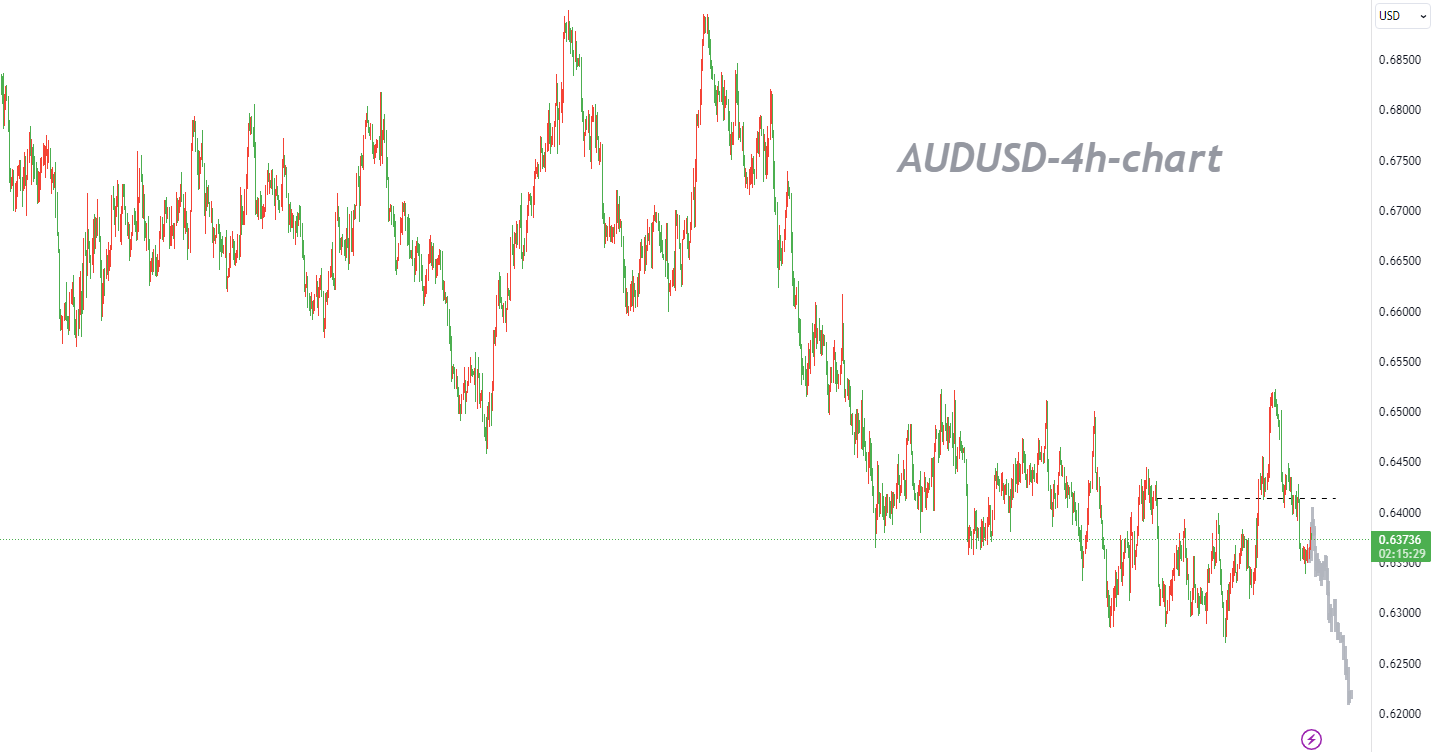
Last week, the AUDUSD posted declines for five consecutive days, with a drop exceeding 2%, erasing much of the gains from the previous week.
The recent hawkish shift by the Fed has exerted increased pressure on the Australian dollar, simultaneously offsetting the Reserve Bank of Australia's re-emergence of a hawkish stance due to concerns about persistent inflation (as evidenced by the rate hike last week).
Currently, the technical structure of the AUDUSD in the daily chart has significantly weakened. The price has fallen below the crucial support level at 0.6370, and the moving averages have turned into a bearish pattern. The RSI is declining but still remains in positive territory.
On the other hand, the stochastic oscillator, deeply oversold, may slow down the pace of the bearish momentum. If the downward speed is constrained, and the bearish trend remains intact, it should provide better selling opportunities. The initial downside target range is below 0.6300, followed by a pause, maintaining a bearish bias. In terms of trading, the strategy leans towards going short at highs.
Trading Recommendations
Trading Direction: Short
Entry Price: 0.6392
Target Price: 0.6287
Stop Loss: 0.6520
Valid Until: 2023-11-27 23:55:00
Support: 0.6329, 0.6314, 0.6285, 0.6270
Resistance: 0.6366, 0.6396, 0.6408, 0.6426


