

Chapter 15 Gold Depreciated Again in A Weak Pattern (11.13)
Fundamentals
In Monday's (November 13th) Asian session, spot gold oscillated narrowly, and it is now trading at 1935. Last week, gold prices fell below 1950 for the third time before officially declaring an effective breakthrough, resulting in a retracement of 55 dollars. On the one hand, the Fed officials made hawkish remarks due to the cooling of risk-aversion regarding the Palestinian-Israeli conflict. It is also why the gold price tumbled on Friday. Additionally, gold bulls expected that Joint Arab-Islamic States Leaders would solve the Palestinian issue through the resolution at the weekend, but the result was disappointing. In fact, the resolution criticized more on the Israeli attacks on the Gaza Strip, the West Bank, and other places, as well as Israel committing large-scale war crimes. Apparently, it looks like an agreement was reached, but it is still stuck in a vigorous condemnation as there is no substantive plan of action nor any participation. For the gold price, the biggest negative impact is that the conflict did not escalate. After this round of plummeting, gold has returned to our expectations, and the next step is to consider the direction of the gold price. Now, the marginal change is not substantial, offering opportunities for both bulls and bears, and unilateral movements will not reappear, but oscillations will show up. In the short term, the market will be affected by the leader's meeting between China and the U.S. The global downturn will be improved if the relationship between the two countries is promoted, but it is not likely to happen because the U.S. is always provocative even when reaching an agreement. Therefore, we need to trade according to the pattern, and gold will test 1924, a line with important support (where the 60-day SMA is located). If gold plunges to this position at first, aggressive investors can go long with small positions, and continue to go long after further depreciations. The profit/loss ratio will be considerable if investors try several times, with the core to win more with small stop-loss.
News: Fed Chairman Powell said the Fed will "continue to act cautiously". If appropriate, the Fed will not hesitate to further tighten monetary policy. He also claimed that he was not sure whether the Fed had reached the position of 2% inflation.
Today's focus: No important data and investors should focus on the U.S.-China talks.
Technical Analysis
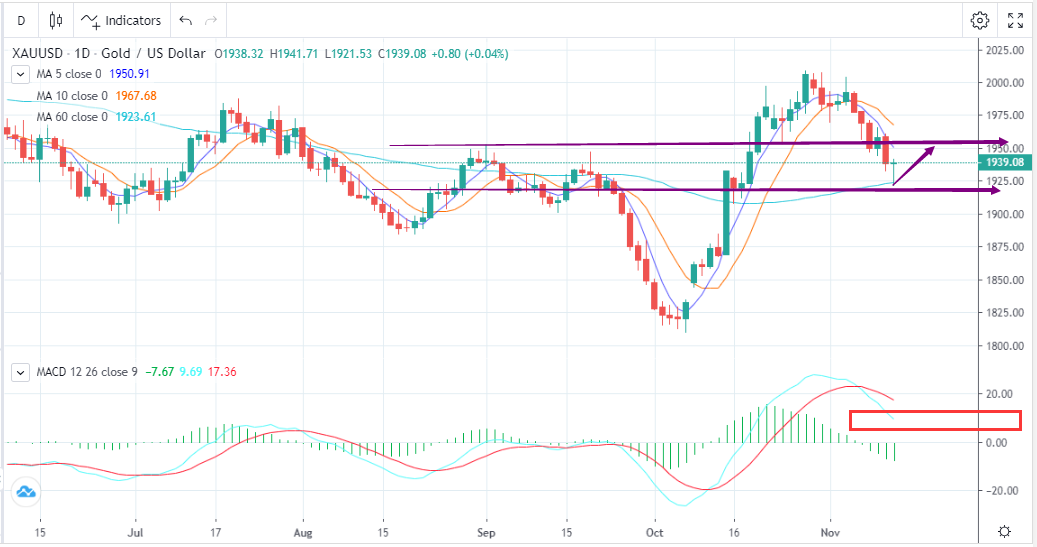
Gold crossed below finally last Friday. It dropped below 1950 effectively, and it may rebound from the bottom after a plummet of 55 dollars. However, investors should manage the trading step to avoid losses. Regarding the daily chart, gold is in an oversold area after continuous depreciation. Thus, investors need to focus on the support near the 60-day SMA (1924), as gold is likely to drop further. Nevertheless, it will be tested many times before gold declined below it (similar to 1950, when gold tried several times to cross through it). Despite a weak pattern, investors should buy at lows by referring to the range from 1924 to 1950.
Trading Recommendations: Buy low and sell high. If gold rebounds to 1953, investors could go short with small positions, and set the stop-loss at 1958. To take profits, the first target will be at 1940, where they can reduce the position size and move the stop-loss to breakeven, and the second target should be at 1924. Meanwhile, if gold plunges to the range between 1920 and 1925, investors could go long with small positions, and fix the stop-loss at 1918. The first target price to take profits will be 1938, where investors can reduce the position size and move the stop-loss to breakeven, and the second target price is 1950.
Trading Recommendations
Trading direction: Long
Entry price: 1923
Target price: 1950
Stop loss: 1918
Support: 1932.000/1924.000
Resistance: 1940.000/1953.000


