There have been so many misconceptions and incorrect assumptions surrounding forex trading that it's scary that they're even considered standard in trading. These remarks are generally held by aspiring traders and the public, but in fact they are not only untrue, hurting the traders themselves, making them miss the chance of success, but also hurting the reputation of trading in the hearts of the public, but forex traders They hardly know it.
In this article, we'll dispel 11 of the most common trading fallacies that are dismissed as myths and explain to you why they're not true.
Hopefully by the end of today's lesson you will have a better understanding of what trading is actually about, what to expect and how to profit from it. Every foreign exchange trading myth (myth) will reveal the truth and explain it in detail:
No.1
MYTH: FOREX TRADING IS ABOUT THE PEOPLE MAKING THIS FAST MONEY!
Fact: You Can’t Lose Money Trading Forex, If You Want To Do Any Trading, You Must Learn To Do It
Perhaps the biggest myth about trading in the public mind is about making quick money. High stakes, fast money, fast cars and more. The stereotypes surrounding trading are so pervasive that most beginning traders get into trading because of these stereotypes, so they start out with completely wrong perceptions and expectations. Once those expectations lose some of their transactional and realistic context, they trigger an unexpected collapse. As the great Warren Buffett said:
Rule 1: Never lose money.
Rule 2: Never forget Rule 1.
- Warren Buffett
That's right, the purpose of forex trading is not to make more money than to make money. The reason is that if you want to make money in the markets, you have to be a risk manager if you want to be, not just any kind of capital protector. If you want to take advantage of the big moves in the market, you have to preserve your trading capital by bidding on your time and be patient in the face of constant temptation.
Not only are you trading the market you see against all other traders, but against yourself, perhaps the hardest "opponent" to beat. Once you get to the point where you can reserve your trading capital and only use it for forex trading opportunities that meet the strict predefined criteria set out in your trading plan, then you will conquer yourself and you will start to learn from other People get money from market participants instead of giving them.
No.2
Myth: You have to be from the Ivy League or Wall Street to be a forex trader
Fact: You don't need to be super smart, forex trading is as tricky as math...
Guess what? You don't need to be a college graduate to be a successful trader. Forex trading is not just some super-genius math guy out there all day arranging coding algorithms. In fact, just as being overly emotional can be bad for trading, so can being overly analytical. Those who are overly analytical tend to overthink and think they have absolutely no perfect trading opportunities.
Ideally, you want to have good intuition and analytical trading skills. Your intuition will give you many trading ideas and a willingness to accept them, but your analytical/forward thinking skills will keep your trading in balance. Only when a trading idea passes through your intuition and your logic and objective analysis do you consider entering it.
The point is that college degrees, IQs and other "credentials" are nothing more than market background noise. Those who trade successfully are their own masters. Master your own actions and behaviors and the ability to control them and you will be successful in trading. All the books and 180 IQ are not going to do you any good if you over trade or risk too much or fail to be disciplined.
No. 3
Myth: To make money in the markets you have to have perfect timing to pick the highs and lows
Fact: Forex trading is not about picking highs and lows, it's about reading charts from right to left...
You don't have to pick exact market turning points to trade Forex the way many imagine. You have to read the graph, the story on the graph, to understand what it's trying to tell you. You can then look for price action signals that "make sense" with that chart story.
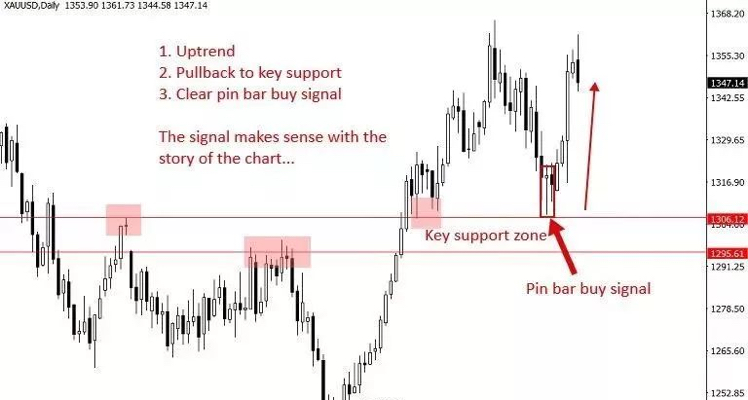
As an example, in the previous gold chart, we can see that the story on the chart looks like this:
As you can see, there is an uptrend on the daily bar chart. We then look for signals at key horizontal supports. The price then fell back to support and formed a clear pin reversal signal there, indicating that a long entry would be appropriate. You can see what happened next. We are reading charts and considering the context in which potential trade entries form, not just trying to pick exact highs or lows without rhyme or reason.
No.4
Myth: You need a lot of money to make money in the market.
Fact: You don't need to have a lot of money to start, a good forex trader can make money no matter the size of the account.
Often, Forex traders believe that to trade successfully, they need a large trading account. However, this is incorrect. In fact, you can lose money on a large trading account just as quickly as on a small one. Even if you have a lot of capital to trade, it is best to start with a smaller account. Can a large stock of trading capital make you more money faster? certainly. But, if you don't know what you're doing, then you can lose that money faster too.
The strategy, skills and mental attitude you need to succeed in forex trading will work on a small account just as much as a large one. It's best to start with a small account and hone your skills, then when you're ready you can deposit more money if you have, or just keep building that small account.
Don't be in a rush! If you create a track record of successful trading on a live account (even a small one), you will become a successful forex trader. Building a successful live account track record over a year or more is something several people can do. If you do this, even on a small account, your success will start to get worse.
No. 5
Myth: You have to know what's going to happen next in the market to make money.
FACT: You don't have to be right or know what's going to happen next to make money, you have to understand that you can never know what's going to happen...
A huge myth about forex trading is that in order to make money, you have to know what's coming next. This couldn't be further from the truth, in fact, it's not even possible. Part of trading is that you have random expectations on any given trade. In a sense, any single transaction, so to speak, is based on random outcomes. This is because at any given time, there are thousands or even millions of variables affecting the market on any given day. So even if you think your trade is completely right, the trade can go in any direction.
If your trading strategy or trading edge comes in, it will work in your favor if that persists, given enough trades, if you are disciplined with your strategy. Most trading edges or strategies simply take advantage of repeated market patterns or price action patterns that develop as a result of people's repeated interactions with the market. So while your trade edge may have a 60% win rate, any single trade has basically a 50/50 chance. So, don't start convincing yourself "I'm right!" about your next trade, because you'll start taking too many risks, getting interested in emotional trading, and it's a disaster.
Instead, recognize and understand that there is a win and lose called random assignment, which is basically what I described above. For any given trading edge or strategy, over time and with a sufficiently large sample size of trading, the trading edge will show a randomly distributed pattern of wins and losses. So, while you do need confidence in your trading ability and chart reading skills, you cannot be confident that you are "right" on any one trade, and you must always remember that any trade can be a loser.
No. 6
Myth: You need a high percentage of forex trading to be a winner
Fact: You don't have to win a high percentage of trades, you have to maximize your winnings.
You've probably heard of risk-reward ratios, but do you really understand their power? You don't need to win all your trades to make big money in the market, in fact, you don't even need to win most of them! How is this possible you ask? Understand and use the risk-reward ratio effectively.
Let's say you set a 1:3 risk reward for each trade. This means, you risk 1R, where R = dollar risk makes 3R or 3 times dollar risk. At this risk reward ratio, you only need to win 25% of your forex trades to break even, of which about 27% are profitable (after commissions/spreads).
Let's do 100 trades. Let's say you lose 70%, where 70 is 100 people; you lose 70R, for example we'll say $700 or $10 per trade ($10 = 1R). Now, if you had a 1:3 risk:reward, all of your winners would get $30, but you only had 30 winners, right? However, that's still a $900 profit! So, you lose $700, but make $900, even though you lose 70% of the time, for a $200 profit!
Risk reward ratio: If your winnings are 1:3, you only need to win 27 – 30% of the time to make money. With a 1:2 risk reward, you only need it about 35% of the time. Forex traders get bogged down trying to win every trade, but it's a stupid game that's so stressful/time consuming it just doesn't work.
If you are a master of price action, a 50% win rate can make you very big money every year with a 1:2 or 1:3 risk reward forex trading. Most traders think they have to win the game with a high percentage, but this is not accurate and is not conducive to proper trading thinking.
No. 7
Myth: Automated forex trading robots or indicators (systems) are the ticket to success!
Fact: If you want to be successful long-term or at any level, then not.
All you have to do is read some market wizard books and you'll quickly realize that most of the greatest traders in the world don't buy forex trading robots, just load them onto their computers and get rich. This pipeline sold by computer programmers who barely know how to read charts is a huge trading myth.
Any completely mechanical trading system or algorithmic trading method will fail over time. Trading conditions change frequently, even quickly. It takes an experienced, educated and skilled human mind to discern good forex trading conditions from bad ones. If trading were as simple as installing some software on your computer and pushing the buy or sell buttons when the software told you to, everyone would be a billionaire.
Think of the most famous traders and investors you know: Warren Buffett, George Soros, Paul Tudor Jones, any trader in the Market Wizards books; they are using their minds instead of forex trading robots. Don't fall for the hype, learn to trade correctly and then use your mind to make trading decisions.
No. 8
Myth: You can only make money in trending markets or 'easy' market conditions.
Fact: Any market condition is game if you know how to trade with price action...
A skilled price action trader can make money in trending markets, markets with high volatility and not perfect trends, range/flat markets and even contratrend markets. Obviously, there are times when the market trades too volatile, but this is where price action tricks come in again; read that chart from right to left and determine if conditions are ripe for a trade. One of the beautiful things about price action is that it can give you good forex trades in trending or sideways markets. As we see below, markets that are limited to trading ranges can provide the savvy price action trader with many good trading opportunities…
No. 9
Myth: Day trading is the fastest way to make money and get a Lamborghini.
Fact: Day trading can cause you to lose money faster than a trip to the casino…
A shorter time frame gives you more opportunities to trade and maybe lose money! – Shorter time frames contain more choppy, meaningless price movements and false signals that will reduce you to a bloody pulp. Believe me, it will be more profitable and easier to focus on the daily charts and see the signals, enter/set, and then leave for the week instead of obsessing non-stop on the low time frame charts. You'll save on forex trading fees, time and effort, and you'll make more money by trading high time slots once or a few times a month with minimal set-and-forget involvement, less time than you trade daily .
No. 10
Myth: I can't use big stops because I don't have much money.
Truth: Money has nothing to do with your ability to take big stops, which is what you need most of the time…
Have you ever heard of position sizing? Here it is - let's say you want to issue a 150 pip stop because that's the best stop you want to place for a trade. However, you only have a $500 account - think the stop is too wide for you? mistake.
All you need to do is lower your position size. If you wanted to risk about $30 per trade on that account, then you would simply resize the $150 position to $0.20, or a $150 pip would be $30 on any XYZUSD pair.
If you don't know about position sizing, you definitely need to make sure you do before you start live trading. Again, you don't need a lot of money to take on bigger stops! You just need to reduce your position size! All my trading is about broader stop loss factors as they keep you in good trade thinking and help you stop forex prematurely as many traders do.
No. 11
Myth: My relatives or friends or told me that forex trading is like gambling.
Truth: You can, if you want!
Finally, perhaps the biggest forex trading myth is that forex trading or any type of financial market speculation is the same as gambling. It's a broad generalization/stereotype that the undealed and uninformed public will take to heart.
The truth is, if you want to gamble, you can do it in the markets. However, you can also think of trading as an advanced, upper-level career that takes time and persistence to master. Unlike gambling in a casino, you can use a proper forex trading education to your advantage as a trader, giving you more experience and screening time. When you go to the slot machines at the Bellagio, your odds are always about the same; pretty slim. Skilled price action traders can trade the markets for a full-time life, easily earning 35% to 65% off their trades. You will never go to the casino and even win 20% of the time. So, forex trading can be gambling, and forex traders are allowed to do so. But if you want to be successful, you have to be focused and skilled so that you can be a game of high skill probability and mental toughness, which has nothing to do with luck.





 Add
Add


