Candle charts are of great significance to me personally, and it is precisely because I have fully mastered the correct use of candle charts that my trading has begun to truly achieve stable profits.
If there is only one technique that can be used in trading, I hope it is candlestick charts. If it is necessary to add a period of use to it, I hope it will be 10,000 years.
Candlestick Origins
Candle charts originated in Japan and were used by Japanese rice market merchants to record the market and prices of the rice market. Due to their incomparable advantages of bamboo charts and discount charts, they were gradually introduced into the stock market and futures markets, and were adopted by the Oriental Introduced to the West, favored by global investors.
After Mr. Steve Nison introduced the candle chart to the West, traders integrated it with Western analysis techniques, which further developed the value of the candle chart and became the mainstream analysis chart today.
Many investors think that the candle chart is very simple at the beginning. It is because they mistakenly think that it is simple and do not pay enough attention to it in thought and ignore its correct form and usage. In the end, because of misunderstanding and misuse, the effect is not ideal. Figure lost confidence.
In this chapter, we will introduce the classic patterns of candlestick charts and the correct and efficient use methods for readers from the shallower to the deeper, laying a solid foundation for the following chapters. Please be sure to read and study carefully, I believe that you will have a new understanding of candlestick charts. Usually candlestick chart is also referred to as K-line chart for short, and we will use these two terms interchangeably below.
Composition of candle (K) line
The K-line is a graph drawn using the opening, closing, lowest and highest prices generated by the market within a given period of time. It can be divided into annual chart, monthly chart, weekly chart, daily chart, hourly chart and minute chart according to different time periods.
For example, what we usually call a daily chart, its single K line records the opening price, closing price, highest price, and lowest price of this day; the hourly chart, its single K line records this hour Opening price, closing price, highest price, lowest price.
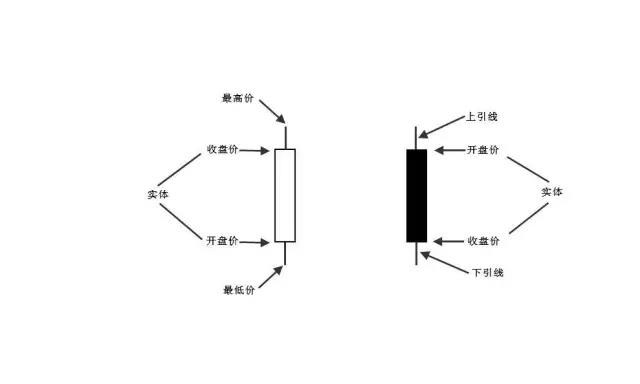
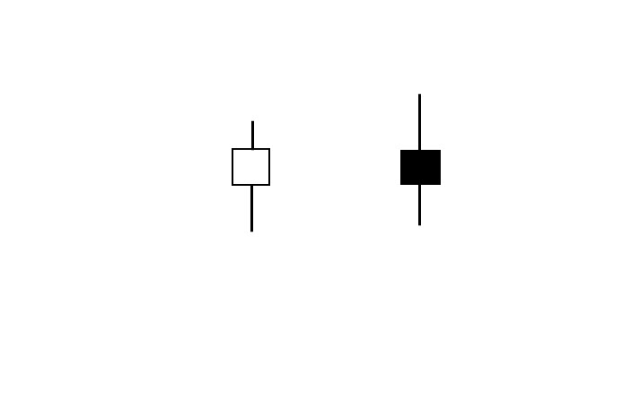
Manually drawing K-lines is very cumbersome and difficult to implement, but modern computer technology has helped us solve this problem very well, and we can easily obtain the candle charts of each period we need from the trading platform. The basic elements of a candlestick are shown in Figure 2.1.
Figure 2.1 Composition of candle lines
The composition of K line includes four elements: opening price, closing price, highest price and lowest price. These four prices divide the entire K-line into three parts: the physical part, the upper lead and the lower lead. The absolute range and relative range between these three have an important role in our trading judgment.
According to the relationship between the opening price and the closing price, we can divide the K line into positive lines and negative lines. When the closing price is higher than the opening price, we call such a K-line a positive line (as shown on the left in Figure 2.1). According to the magnitude of the positive line, we can distinguish it into a small positive line, a middle positive line and a large positive line;
When the closing price is lower than the opening price, we call such a K-line a Yin line (as shown on the right in Figure 2.1). According to the magnitude of the Yin line, we can distinguish it into a small Yin line, a middle Yin line and a Big Yin line.
Big candlestick
The big K-line is the K-line with relatively large absolute range and relative range of the entity of the candle line.
The absolute range means that the price gap between its own opening price and closing price is relatively large. The relative range is the comparison between the K-line range and the K-line range in the most recent period of the market. The candle line range is obviously larger, sometimes it is the previous period. The magnitude of twice or even more multiples of the K line. According to the relationship between the opening price and the closing price, the big K line can be divided into big Yang line and big Yin line.
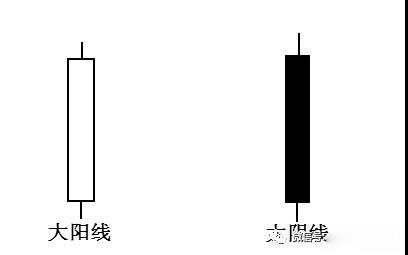
Figure 2.2 Large Candlesticks
The big positive line (as shown on the left in Figure 2.2) generally requires no upper and lower leads or the upper and lower leads are relatively short relative to the entity, which is almost negligible and the entity of the positive line is relatively large. The big positive line indicates that the price has risen sharply during this specific time period, and the market bulls are dominant.
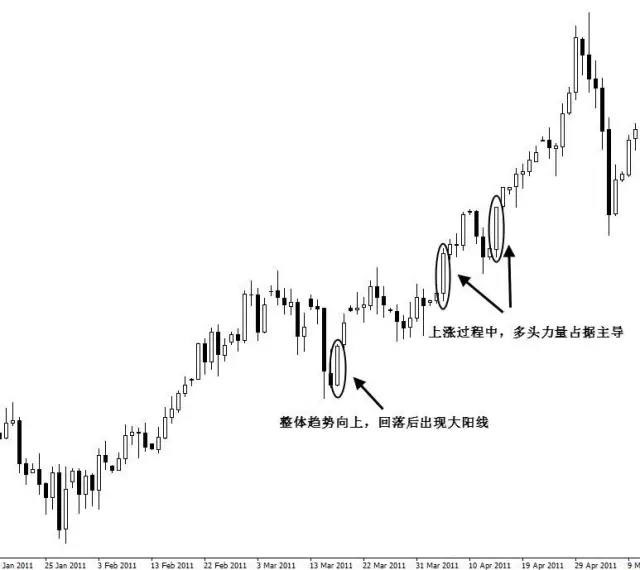
If the big Yang line appears in a downward trend, it shows that the underlying support is strong to a certain extent, and the previous downtrend may end to form a consolidation market or a reversal market; if the big Yang line appears in the rising process, it shows that the bulls are still very strong , there is a high probability that the market outlook will continue to rise and reach new highs.
In our specific trading, if the general trend is upward, we should be highly vigilant when a large positive line appears during the downward correction, which may indicate the end of the correction and the emergence of another opportunity to open a position (as shown in Figure 2.3).
Figure 2.3 Example of Dayang Line
The reason is the same as the big Yin line (as shown on the right in Figure 2.2). It requires no upper and lower leads or the upper and lower leads are relatively short relative to the entity, which can almost be ignored, and the body of the Yin line has a large range.
The big negative line indicates that the price has fallen sharply during this specific time period, and the bearish force in the market is dominant.
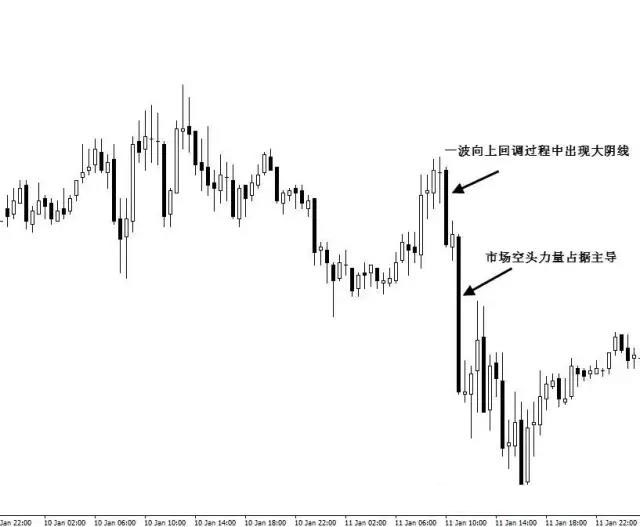
If the big Yin line appears in the upward trend, it shows that the upper pressure is strong to a certain extent, and the previous upward trend may end to form a consolidation market or a reversal market; if the big Yin line appears in the process of falling, it shows that the short position is still very strong , there is a high probability that the market outlook will continue to run downward and hit a new low.
In the case of a downward trend, if a large negative line appears during a wave of upward corrections, it may indicate that this wave of corrections is basically over. At this time, we pay attention to possible short opportunities (as shown in Figure 2.4).
Figure 2.4 An example of a big Yin line
Spindle line (small yin and small yang)
The body of the spindle is relatively small in magnitude. Spindle line is a reversal K-line, which to a certain extent indicates that the original trend has gradually lost momentum, and this trend may come to an end temporarily.
Spindle lines have the following characteristics:
(1) appears in the trend market;
(2) The entity is small, and there is no strict requirement for the entity to be yin or yang.
Figure 2.11 Spindle
Spindle lines are used in trending markets to indicate that a previous trend has lost momentum. It is difficult to use the spindle line alone to judge the market. This K-line is often used in combination with other reversal K-lines. The following is an example to illustrate the judgment of the market by combining the spindle line and the cross star.
Figure 2.12 Combination of Spindle and Doji
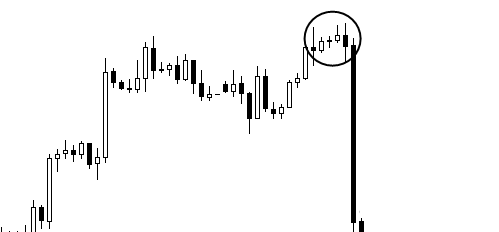
In Exhibit 2.12, the uptrend continued to rise after a pullback, but the first doji pattern appeared after a large white candle that was almost bald, indicating that the rally temporarily lost momentum.
Then the market closes the spindle at a high level after a brief adjustment of three consecutive candles. This spindle once again shows that the previous upward trend has lost momentum and the spindle and the previous small Yang line form a set of downward engulfing patterns. It can be seen that the market then started a rapid and sharp decline.



 Add
Add


