Introduction
In the previous article, we discussed the issue of trend analysis, which mentioned that after the trend is discovered, whether the signal that can better identify the trend with the cooperation of the Guppy system has better stability. Obviously, the Guppy system It better solves the demands of stability. But the ensuing problem is that, in fact, in the ever-fluctuating market prices, only about 30% or less of the time actually presents a unilateral trend, and 70% of the time the price may be in a volatile trend. However, In order to grasp the possible trend market as much as possible, traders will have to face the possible losses caused by repeated price in the volatile market. Therefore, after discovering the signal that the trend may come, how to better measure the strength of the trend is particularly important for traders. At this time, the ADX average trend indicator comes in handy.
Understand the calculation principle of ADX
ADX is not a directional indicator, it just helps traders measure the strength of a trend. In fact, in most conventional trading software, the ADX indicator does not require you to calculate it yourself, just take it and use it directly. We just use its calculation principle to let traders have a better understanding of ADX. The indicator is composed of three values on the surface, which are the average movement index (ADX), the positive direction index (+DI), and the negative direction index (-DI).
Among them, DI=DM (directional movement value)/TR (true interval), DM means that when the fluctuation interval of the root K line exceeds the largest part of the fluctuation interval of the previous K line, it is +DM when it exceeds upwards, and it is +DM when it goes downwards. Excess is -DM, and because TR belongs to a value in a real interval, it must be a positive number, so the division between DM and TR will result in the positive and negative results of DI. Remember, +DI means upward direction, -DI represents the downward direction, so when +DI crosses -DI, you will see that the price presents an upward market, and vice versa, it is a downward market. Of course, you need to know this principle, but we It is not for traders to focus on the judgment of the long and short direction of the ADX indicator, because as I said just now, the actual application of ADX itself to the judgment of the direction is not obvious, it only helps the market to measure the strength of the direction.
So its average sports index (ADX) is the focus of our attention. Multiply the positive number of the sum and difference of +DI and -DI by 100, and finally we can choose the average value of 14 cycles of DX for reference. From this ADX indicator is formed. When the ADX reading is larger, it means that the trend is more obvious. On the contrary, the ADX curve turns downward, which means that the trend has signs of weakening.
The use of ADX indicators
1. Use the strength of ADX for trend following
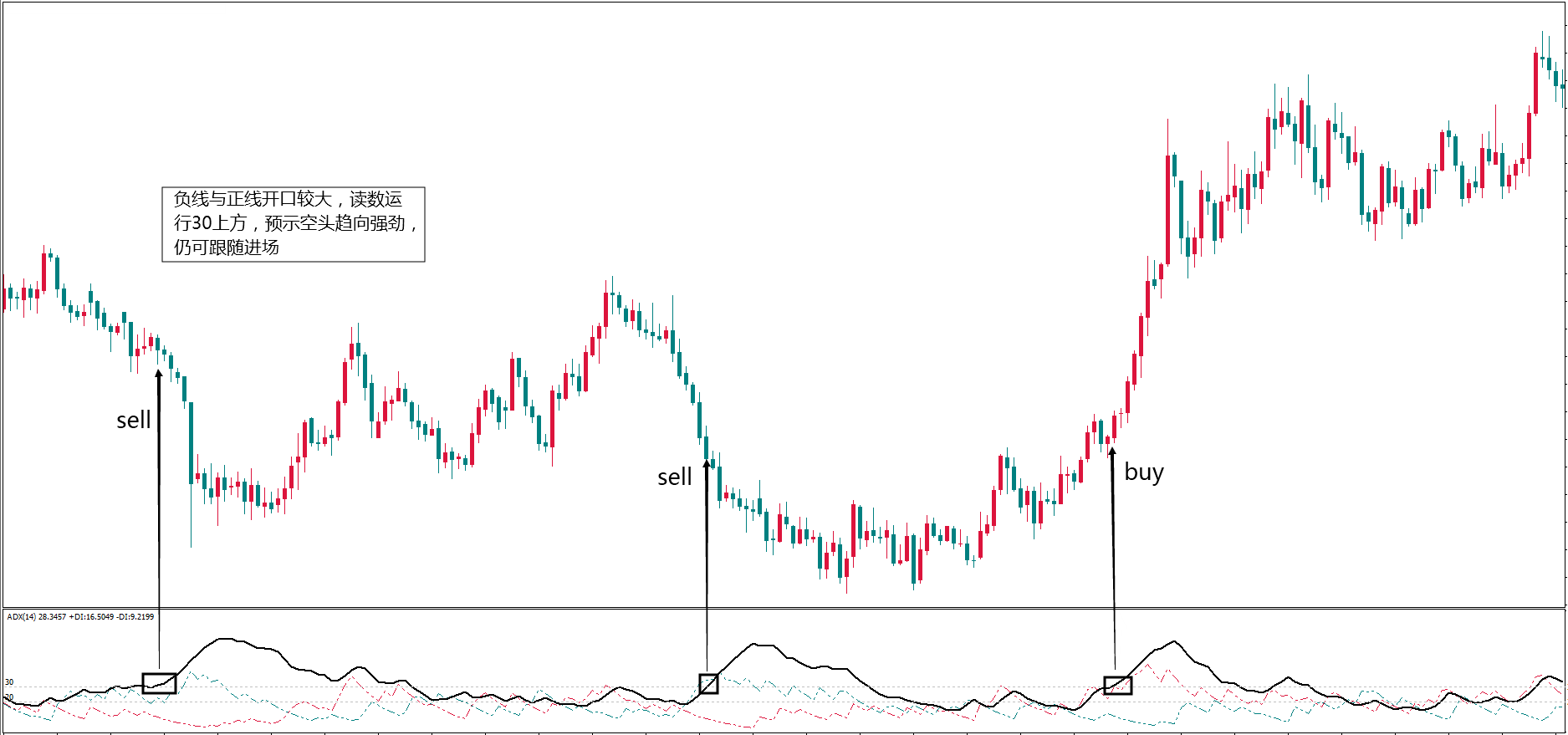
In the application of ADX, it is very important to observe the reading of ADX. Generally, when the reading is above 30, the trend tends to be relatively strong. When a trader finds a trend and has the idea of continuing to enter the market, if so When the opening of the positive and negative lines is relatively large, and the ADX value runs above 30, you can intervene decisively. As shown below:
2. Take advantage of ADX's high-level turning head to make a profit
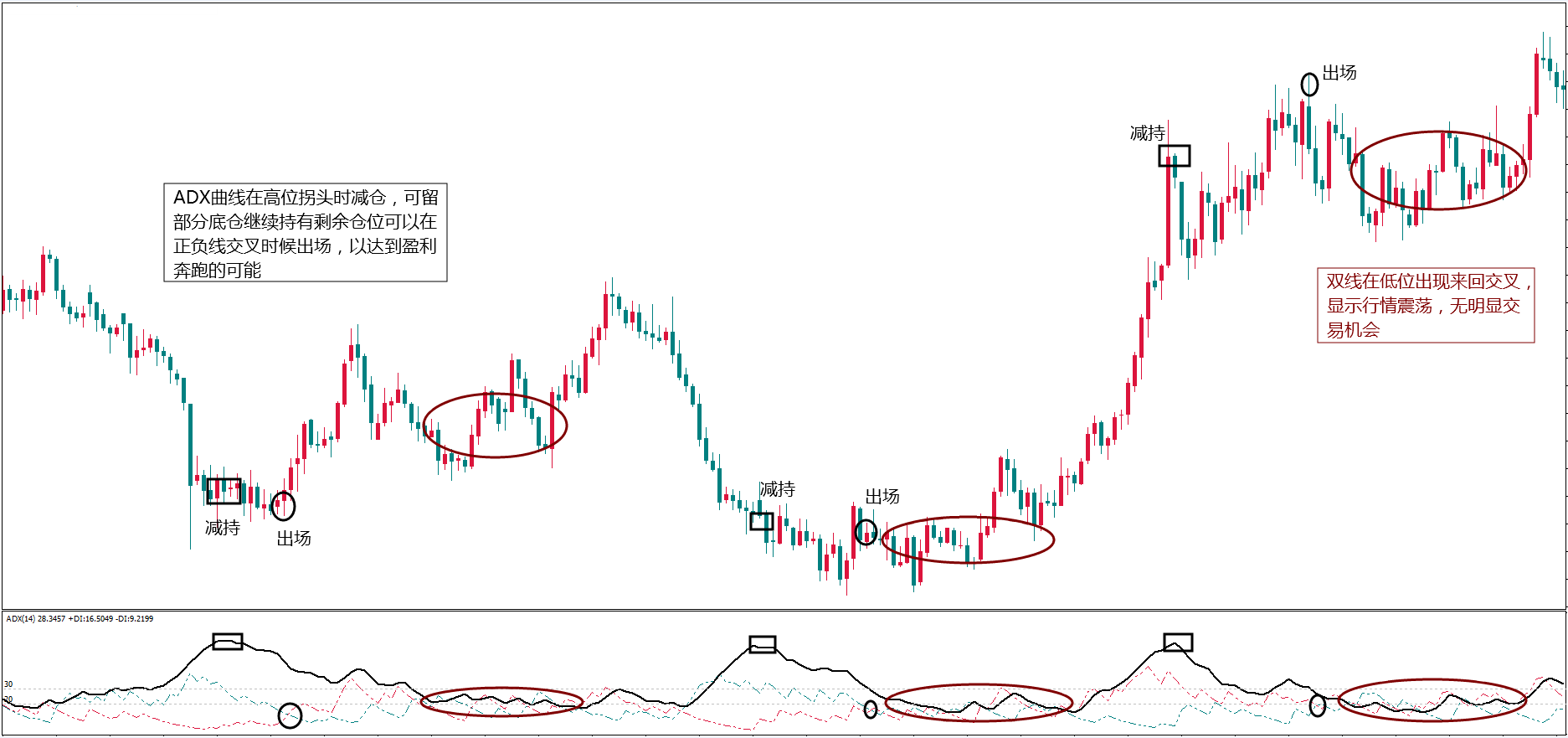
Another function of ADX is to judge when a position in a trend should be profitable. When a trend continues to extend, the reading of ADX may continue to rise. If the reading is larger, the curve turns downward (generally For example, it is around 60, and there may be differences in different trading varieties), then at this time, traders may consider taking part of their positions to take profits, but you can still decide based on the opening of the two positive and negative ID curves For the holding of the remaining positions, if the double-line opening is still large at this time, it means that although the trend momentum may be exhausted, there are still some aftermaths, but if the positive and negative lines have begun to form a cross, then all positions need to be exited at this time . Let's take a look at the same trend chart again.
From the picture above, traders can find that when the ADX curve turns at a high level, it can be said that this trend is basically over. Therefore, at this time, traders need to make profits and reduce positions in time, and now take most of the profits into their pockets. . However, in the third turn, the price still showed a aftermath rise after the turn of the curve, and then there was a shock trend, so if we choose to exit the remaining bottom position when the positive and negative lines cross, because The risk has been controlled by reducing the position before, and this time the bottom position has allowed the profit to run again.
3. Find the opportunity to trade when the trend is obvious
Also in Figure 2, traders will find that when the positive and negative lines of ADX are at a low level and cross repeatedly, and the ADX curve also falls to a low level and loses momentum, the overall market has fallen into a turbulent trend. At this time, for trend traders It is said that there is a lack of trading opportunities, so you can choose to avoid such a market through the ADX indicator and reduce your own cost of holding positions. In the same way, you can choose the timing or variety when the ADX indicator is strong.
Finally, we need to emphasize that the effect of using the ADX average trend indicator alone is not very ideal. It requires traders to use other analysis methods or indicators to find the signal generated by the trend, and then use the ADX indicator to refer to whether it is suitable for the moment Timing of entry. Therefore, only when traders understand its true role can it be used with ease.


 Add
Add


