


Stay in touch!
Subscribe to our newsletter to get the latest updates on live market analysis, trading strategies and more. You can unsubscribe anytime.
By subscribing, you agree to Trading.live Privacy Policy.


Controlling the withdrawal of funds is like protecting the water storage in the tank, otherwise the water will flow eastward and be happy.
There are many ways to withdraw funds. Some people calculate the profit-making funds into the principal amount of each transaction, and some people use each transaction as a statistical unit to calculate the withdrawal ratio.
Let me share with you my actual operating experience, because I have verified these in real offers, and I think they are very practical and easy to copy. The core of my work is "the road is simple".
1. Control the original capital investment
I use 2% of the original principal as my capital usage standard for each transaction. Note that it is the original principal, and I will not convert profits into principal to expand transaction investment. If the profit of the account doubles the original principal, then I will increase the principal to twice the original principal for the first time as the original principal for the next transaction. For example, my original principal is 500 US dollars, and I will withdraw it every time the account makes a profit to ensure that my account principal is always equal to the original principal, which is 500 US dollars. Until my profit reaches $1,000, which is twice the original stake, then I will increase my original stake to $1,000, which is protected by:
1. My original capital investment is always kept at $500, and my biggest loss is $500.
2. With the expansion of account profits, I always maintain a rigorous and prudent trading mentality, and quit greed.
2. Make a reasonable fixed stop loss for the variety
Setting stop loss is a must-have skill for every trader. There is a saying that "entering the field depends on courage, and exiting the field depends on ability". Therefore, it is very important to set an appropriate fixed stop loss point, which can not only ensure that your account profits are protected, but also avoid unnecessary losses due to unreasonable stop losses.
The key point here is that you need to understand the market characteristics of each product. For example, the fixed stop loss points of crude oil are different from those of the Hang Seng Index, and the fixed stop loss points of crude oil for 1 hour are different from those of 4 hours. How? A large number of replays and data statistics are used to find out the reasonable retracement points of the product price. On this basis, I usually choose to expand by 5 to 10 points by 10 points.
3. Reasonable matching of appearance methods
There are two exit methods for each transaction, the first is fixed take profit, and the second is manual exit.
There are 3 ways to manually enter the market, including floating profit retracement. This way of exiting is very important, because it can ensure that I have a proper profit in this transaction. Setting the floating profit retracement also requires a lot of review to set a reasonable number of floating profit points for each product.
These three aspects are very practical and easy-to-replicate methods for me to control the withdrawal of funds. I hope it will be of good reference value to you. Thanks!
Copyright reserved to the author
Last updated: 08/22/2023 12:59
 Add
Add


In foreign exchange investment, how to control the withdrawal of funds?
I think that in order to control the withdrawal of funds well, two aspects must be achieved. One is to improve the accuracy rate, and the other is to stop losses in time. In summary, it is actually a matter of how to consider the profit-loss ratio.
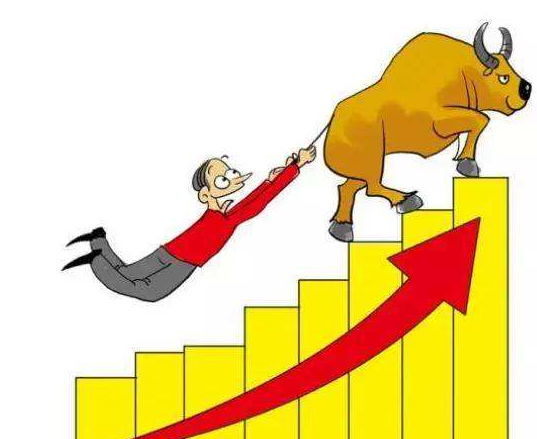
The profit-loss ratio is the ratio of profit and loss for each transaction in the investment market.
There is only one secret or recipe for success in the investment market. That is to ensure that you win more when you win and lose less when you lose. We must look at investment transactions from a systematic perspective.
The profit-loss ratio of the investment system = the sum of the profits of all investment profit orders in a period of time/the sum of the losses of all loss orders in the same period of time.
In the long run, the ratio of investment profit and loss is a quantitative indicator that directly reflects the comprehensive level of investors. From the perspective of historical statistics, the successful systems that can effectively control the withdrawal of funds and make a lot of money in a long-term and stable manner are all systems with a high profit-loss ratio. Only a system with a high profit-loss ratio can make the return on investment move steadily to the northeast under the premise of low drawdown.
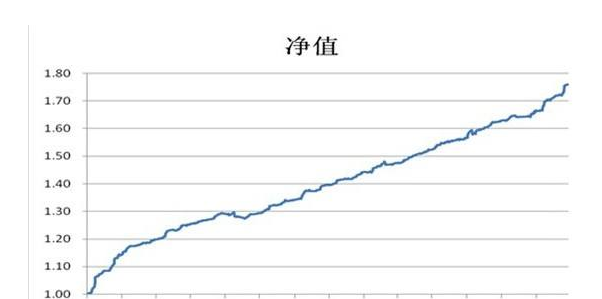
Therefore, if you want to effectively control the withdrawal of funds, the most correct way is to create a system with a high profit-loss ratio. So, how to build it?
I personally think that in order to build a system with a high profit-loss ratio, what needs to be done is to increase the success rate and at the same time focus on increasing the profit margin and reducing the loss margin. Come on, let's take a look at the formula for the composition of the profit-loss ratio:
Profit-loss ratio = (success rate × average profit margin) / (failure rate × average loss margin)
From the formula, we can see that the profit-loss ratio is directly proportional to the success rate and profit margin, and inversely proportional to the stop loss margin. In fact, from the perspective of mathematical probability, there is a ceiling in the improvement of the success rate, because it is difficult to increase after it reaches a certain level, so the focus is on increasing the profit margin and reducing the loss margin, which is actually how to effectively Take profit and stop loss. So, how to control the withdrawal of funds? In a word, cut off losses and let profits run!
Copyright reserved to the author
Last updated: 08/07/2023 01:12
Add

If the answer to this question is simple and rude, there are only two words, stop loss.
In the process of foreign exchange trading, with the fluctuation of the market, it is very common for the account to have a floating loss, but in order to prevent the floating loss from being too large, it is necessary to take a stop loss operation.
The common ways of stop loss are fixed stop loss, time stop loss, financial stop loss and technical stop loss.
Fixed stop loss, as the name implies, means that after each order is placed, a fixed value is taken as the final stop loss point. For example, during the gold operation process, a stop loss of 3 dollars is set each time.
Time stop loss, that is to say, the rigid requirement of using time as the stop loss. For example, when using four hours as a trend operation, you can combine the 15-minute chart on the hourly chart to find the opportunity and point to place an order. After the order enters the market, When the next four-hour K-line is generated, if there is no profit, then decisively stop the loss and get out. Another level is to use the time zone as the stop loss condition. For example, in the operation of the Asian market, if there is no profit at the beginning of the European market, the stop loss will be out. The operation of the European market is also in the US market. And so on.
The stop loss of funds stipulates that the loss of each order operation shall not exceed a percentage of the total funds, such as 10%, or 15%, etc., which should be set reasonably according to the individual's financial situation.
Technical stop loss is based on technical analysis, and takes important support or pressure levels or important price points as the conditions for stop loss exit.
The above four methods are the most common ways to control the withdrawal of funds in the process of foreign exchange operations. Each method has its own advantages and disadvantages. It is recommended to make a reasonable choice based on your own capital situation and operating style.
Copyright reserved to the author
Last updated: 08/13/2023 16:08
Add

The withdrawal of funds has been introduced in many trading books. The withdrawal of funds is an unavoidable thing in trading. The key point is how to effectively control it. What is its goal? What are the points of concern? What are the influencing factors?
First of all, different systems have different flexibility. A system that earns more in a trending market will also lose a lot in a volatile market; a system that increases its position with profit will also have a large loss during a loss period; an intraday system is different from an overnight system. A certain difference is related to the daily fluctuation range. According to the classic turtle trading rules, it is not possible to be profitable every month, nor can it be guaranteed to be profitable every quarter, and it is even possible to lose money in some consecutive 12 months. Because there may be continuous losses, and the loss amount will be greater than the deposit amount, and the retracement time may be as long as half a year, which will cause great trouble to fund management. If the position is relatively heavy and full, then when the unfavorable market does appear, if there is no follow-up financial support, the trader may be eliminated in a large range. This is also the basic threshold for portfolio traders. The capital curve is also like the price K-line, there will be peaks and troughs, and different systems will have different retracements and different retracement times. Because the intraday system has the fastest trading frequency, an excellent intraday system with positive expectations will have a relatively small retracement range and short retracement time, because the intraday system is less dependent on the emergence of trend market, and the real There will be a short period of time for valuable trend quotations.
As far as the retracement cycle is concerned, a good intraday system can often make profits for two consecutive months in arbitrarily consecutive months, and the capital curve for three consecutive months will surely hit a new high. However, it is difficult to achieve this in a system that increases positions profitably and increases positions multiple times. The position-adding system often has a situation of earning money and losing money. The position-adding system can obtain huge profits and have a relatively higher total profit-loss ratio, but at the same time it needs to bear more risk of retracement. There are pros and cons to everything. Although the intraday system is not that strong in profitability, it is relatively better at retracement defense and can use greater leverage; the system that makes profits and increases positions has strong profitability, but the strength of colleagues’ retracement is the amount of retracement. The retracement time is often unbearable, and if the fund management is not done well, you will lose more.
Looking back, what is the goal of controlling the retracement? Two points: first, the amount of retracement is small, and second, the retracement time is short. What do you need to pay attention to? The characteristics of the trading system, the characteristics of the market, and the characteristics of product fluctuations. For the second-order trend trading of the capital curve, when the capital curve retraces, it is necessary to appropriately reduce the input of troops, and when the capital curve is stably moving to the northeast, the position can be appropriately expanded.
Copyright reserved to the author
Last updated: 08/13/2023 23:30
Add

Both statements are correct and incorrect. These two answers must depend on their premise.
What we need to pay attention to in the process of trading is the risk ratio of the total position of the account. If someone has a low position in a single transaction but has a large position at the same time, the risk of total withdrawal of his account will be very high.
Speaking of how to fix your retracement range, it must involve your historical review. Historical review has several advantages for retracement risk control.
1. To let you understand the attributes of this variety, you should have a clear understanding of the shape and stop loss requirements of this variety's special market.
2. The history will calculate your average stop loss points. The premise is that your transactions must be consistent. If the consistency is not enough, your results will be very random.
3. Understand your retracement month. Every system will have a retracement period. You need to understand the market and time of your retracement period.
Since each person's strategy is different, the monthly retracements are also different, and the methods of shock and trend are also different. One requires a winning rate and the other requires a profit-loss ratio. In short, you still need to keep exploring by yourself. What others give are suggestions and strategies that do not apply to everyone.

Copyright reserved to the author
Last updated: 08/11/2023 15:17
Add

Controlling "Healthy" Drawdowns
First, drawdowns are simply a function of probability and expected returns, and the results tend to converge. For example, you might have a 50% chance of winning, but that doesn't mean you'll have a few losers in a row -- just as you might have a few winners in a row. It's just a result of probability (think coin toss).
Secondly, there are still some capital withdrawals that are controllable, and they are caused by the execution of trading plans and market conditions. Drawbacks can actually come down to your trading strategy not being good enough, or the market environment not being conducive to your strategy, so you may need to take a break. For example, a trader may encounter difficulty trying to trade a range breakout and need to take a step back. Typically, pullbacks occur in the face of difficult trading conditions and minor trading errors.
We can never be perfect in any situation, so you need to realize and face that. If the current deal is not going well, it is always prudent to reduce the size of the deal. There is a saying we often hear: "Once in doubt, wait and see or withdraw." This saying has always been applied to trading as well. Sticking to this principle will go a long way in helping the suspension of retracements. This is a good time to test yourself and see if you are making the right trades and handling risk appropriately. Whether your current trading situation is good or bad, it is recommended that you continue to review your transactions and follow the plan.
One of the most common and clear-cut reasons for poor results is overtrading and poor risk management. When things aren't going your way, you need to think about these two reasons first, because it's something you can control and correct immediately.
In the final analysis, the key is to have a clear and sober sense of self. Know what factors drive trading results, and address any issues that may require your control.
Copyright reserved to the author
Last updated: 07/31/2023 23:26
Add

1. In terms of personal experience, for a good trading plan, first of all, you must determine what the corresponding position of the order you are currently trading is? ? ? ---Band medium and long-term, or intraday short-term, this must be strictly distinguished
2. If it is short-term within the day, I usually close it within the day and do not hold it overnight; if it is long-term in the band, it is necessary to observe how much the sub-level long-short volume can release Chengdu, and the main force of long-short to determine the strength of the market entry. Generally speaking, you all know how long it takes to hold a single order, so I won’t introduce more
3. Regarding the range described in your subtitle, it can be understood as a medium-to-long-term band. Like the usual layout of a wave-band mid-to-long-term trend market, generally speaking, you will test positions in the space where the market is changing from long to short, and then confirm it. Increase the position, if the test position fails, the order will be cut directly, if the test position is successful, the remaining loss amount will be matched according to the largest stop loss corresponding to the medium and long-term in the current band to match the increase position
4. As you said, if there is a shock and retracement, then I can understand that the timing and price of your entry are not so optimistic. Personally, you refer to point 3, and the position of your intervention is more often It is in the position of adjustment, and it is more inclined to do short-term within the day. Since the situation you described is to do mid- and long-term in the band, the timing and price of intervention are not so optimistic, but there are solutions, as mentioned in the third point. Batch warehouse"
Copyright reserved to the author
Last updated: 08/09/2023 09:14
Add

It is very simple to control the withdrawal of funds. It is nothing more than the problem of stop loss setting. The methods of stop loss setting include fixed stop loss, technical stop loss, capital stop loss and time stop loss, etc., which can be adjusted according to personal timing. Choose the stop loss method that suits you.
In the description of the problem, you mentioned that the capital retracement is 2%, as a way to set the capital stop loss, so how big is your capital? If it is a fund stock of 10,000 US dollars, if the drawdown is controlled at 2%, it will also lose 200 US dollars. Assuming that under the current huge volatility of gold, it is easy to hit a stop loss, unless you have a volume of 10,000 US dollars and only make orders of 0.1 or even 0.01. But in this way, the utilization rate of funds will be very low, and the benefits of leverage in foreign exchange will not be reflected. If this is the case, it is completely possible to build a platform without the domestic bank just now.
So in actual operation, it can be controlled so low. It mainly depends on your capital. If it is one hundred dollars, then a 2% retracement is already a lot, but for ten thousand dollars In other words, this retracement does not seem to be that much.
Generally speaking, the retracement rate is calculated based on the retracement rate of each transaction. Of course, if the account is in the process of swing operation and there is a floating profit increase, you can use this fund retracement rate as the final calculation. It's hardcore to play, but since it's a swing trade, at least there won't be a situation where floating profit turns into floating loss, and then stop loss and exit.
Personally, I generally do not take capital retracement as the standard for stop loss. I personally prefer the setting of fixed stop loss or technical stop loss, which will be more worry-free
Copyright reserved to the author
Last updated: 08/09/2023 05:07
Add


This depends on the size of your account funds and whether you have economic pressure. If the funds are more than 20,000 US dollars, you can control it at 2%. You can do it, but if you have economic pressure, the funds are only 200 US dollars. You control a hammer, 0.01 lot 4 You will find it boring to stop the loss in US dollars, so you can easily not sit still. In addition, if you have no economic pressure, you can play with 0.01 hands, mainly to exercise your trading style.
Copyright reserved to the author
Last updated: 08/08/2023 18:23
Add

Not published yet, I can only post a picture
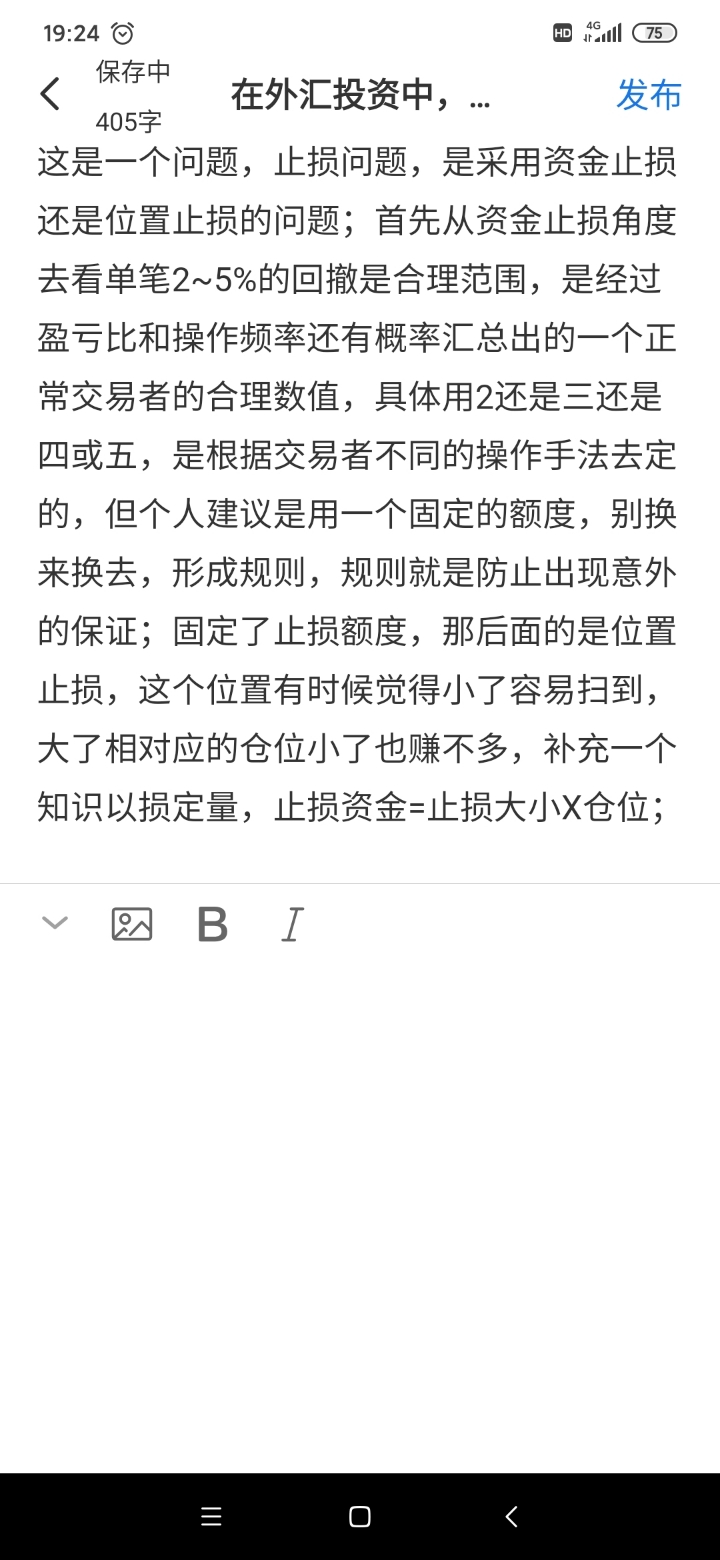
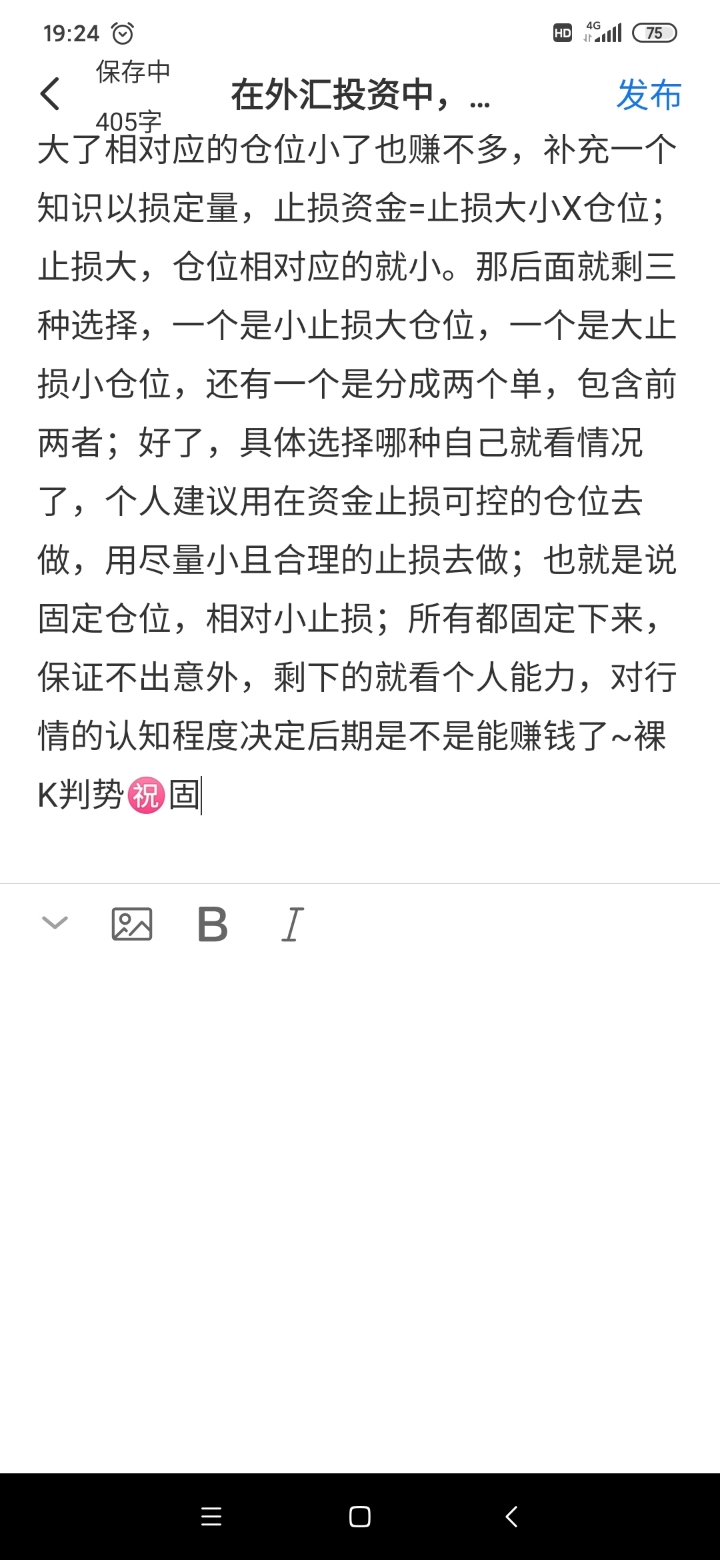
Copyright reserved to the author
Last updated: 08/07/2023 20:52
Add

It is not terrible to encounter a retracement, the terrible thing is that the trader does not solve the problem. Dealing with drawdowns requires traders to establish a risk management plan. One is to ignore market fluctuations after a reasonable position is established. First determine the maximum risk that can be taken in the transaction, determine the maximum retracement rate, and then plan the size of your position;
The other is rolling operation, the position remains unchanged, and the cost of capital changes according to the market. However, this method has high requirements for traders, who need to grasp market reversals and deviations in real time, and skillfully apply K-line patterns and technical indicators, and have plenty of time.
Generally, the normal retracement caused by the ups and downs in the transaction is healthy and ideal. During this period, your losses are well controlled, and the account balance can return to a new high without too much effort; but it is not healthy More attention should be paid to the retracement of the stock market. When the losses start to accumulate to a catastrophic level, the situation will go wrong. It can be seen that how to manage the withdrawal of funds is also extremely important. I hope that the content of Emperor Classroom today can help you.
Suppose your foreign exchange trading account principal is $5,000. During the transaction, the account amount rose to $10,000, then fell to $4,000, then increased to $12,000, and then fell to $3,000. It rose again to $13,000.
In this case, the funds have experienced two retracements: the first retracement is from 10,000 to 4,000 US dollars, the retracement range is 6,000 US dollars, and the retracement rate is 6000/10000=60%; the second retracement is 12,000. To $3,000, the retracement range is $9,000, and the retracement rate is 9,000/12,000=75%.
Therefore, the account has a maximum drawdown of 75% since the account was opened.
Copyright reserved to the author
Last updated: 08/06/2023 15:23
Add

Fund withdrawal management refers to how to allocate funds in investment to maximize the use of funds to obtain the greatest possible profit; while risk management refers to considering the degree of risk in transactions and the tolerance of investors in order to minimize investment risks.
The most important content of risk management is how to stop loss, followed by how to stop profit. As people generally understand, "revenue and risk are twin brothers", fund management and risk management also need to be skillfully combined to achieve a balance between maximizing returns and minimizing risks. Next, the author introduces several commonly used methods of fund management and use in combination with graphics. Each method has its own strengths and weaknesses, and the key lies in how investors use it flexibly. Money management methods vary by municipality:
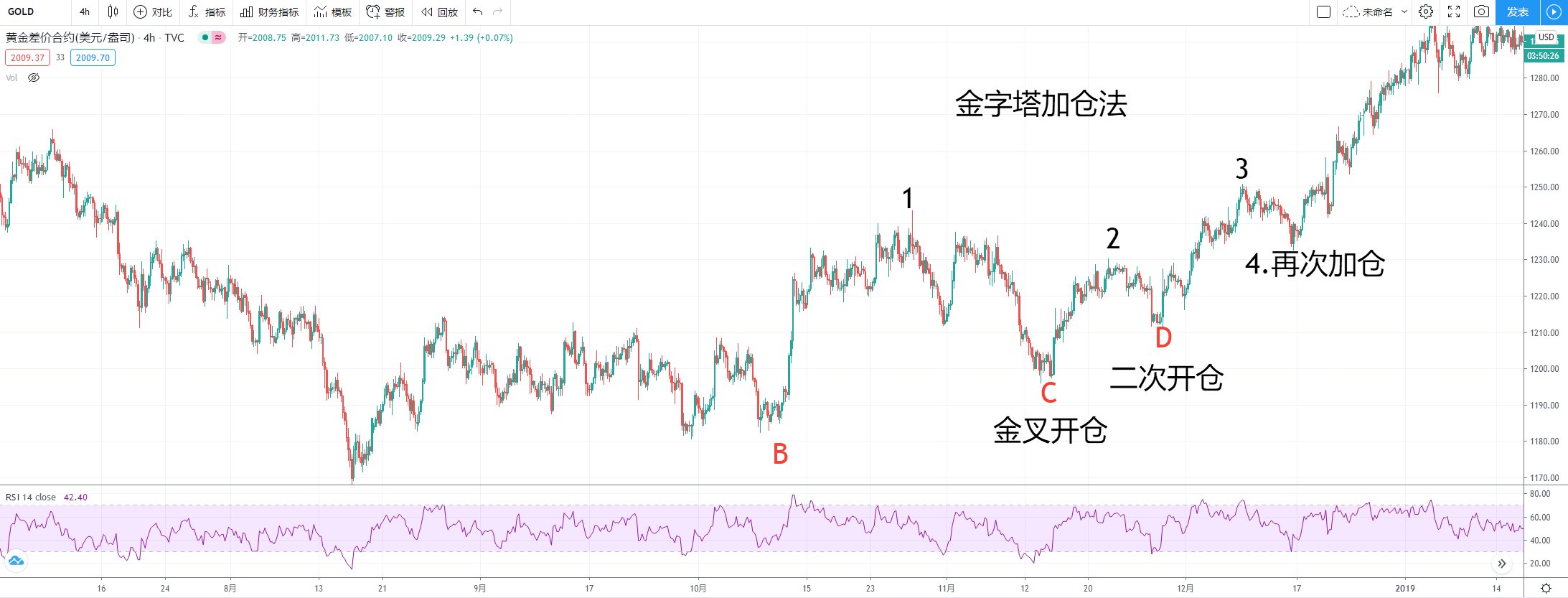
The first method of using funds is what is commonly referred to as the pyramid method. Assuming that the investor has a principal of 100,000 US dollars, the investor buys 30,000 US dollars at a certain point, such as gold at 1400; when the gold rises to a certain point, such as gold at 1500, the investor believes that gold will continue to rise, but There has been a period of increase, and the subsequent increase may be relatively limited, so the amount of funds is reduced to 20,000 US dollars when buying again; when the gold reaches 1550, investors still believe that it will continue to rise, so they buy more, and because now The increase is greater than when the first increase was made, and the upside may be smaller, so invest less money than the first increase, such as $10,000.
The second method is called the inverted pyramid coding method. With our understanding of the pyramid coding method above, our understanding of the inverted pyramid coding method is much simpler. Taking the above example as an example, the inverted pyramid method is to buy 10,000 US dollars, then buy 20,000, and then buy 30,000. Each time you add more and more funds, so it is called the inverted pyramid method. .
The difference between this method and the pyramid overweight method lies in investors' judgment on the market. At the point of gold price of 10,000 US dollars, investors are still not very sure about the rising trend of gold, so small funds intervene; at the point of buying at 20,000 US dollars, the trend of the market is more certain, and the investment is increased; At the buying point of 30,000, investors believe that the rising trend will continue, and they are more confident, so they invest more funds. The investor's grasp of the market determines the scale of investment funds. The greater the grasp, the more investment funds.
Copyright reserved to the author
Last updated: 08/06/2023 15:24
Add

Money management boils down to a few key principles:
1. Good position control to minimize risks.
2. Resolutely stop loss.
3. Don't use too much leverage.
4. When you start to lose money, don't easily increase your position.
5. When you experience a severe losing streak, get out and take a break.
All of these principles should work together to protect your money, and the extent of the drawdown lies in your understanding of money management.

Copyright reserved to the author
Last updated: 08/06/2023 08:13
Add

Why is it set so low? If you can really control the withdrawal of 10,000 US dollars and only withdraw 200, then you only deposit 2,000 and the withdrawal is controlled at 200, isn’t it the same? The 8,000 I saved Yu'e Bao is not good?
Copyright reserved to the author
Last updated: 08/06/2023 02:49
Add

An example of how a successful system trader manages drawdowns. The following practice comes from the article "Futures China Interview with the Barber: Investing in Futures in a Controllable and Systematic Way" by Qihe.com. Barber Zhang Weifu is relatively well-known in the futures quantitative trading circle, and his practice of using fund management to actively control the maximum drawdown is even more commendable. Generally speaking, that is, for every 15% profit or loss of the funds invested in the transaction, the position will double or be reduced by half. Specifically, its rules are:
1. The maximum withdrawal of funds cannot exceed 30%. Once it exceeds 30%, no transactions will be made for at least half a year.
2. Funds continue to withdraw: if the total funds withdraw by 15%, the position will be reduced by half, that is, 1/2 position is traded, if 1/2 position loses 15%, that is, the total funds will lose 7.5% after the loss of 15%, and then Reduce the position by half, and so on, and then reduce the loss again.
3. Restoring positions after reducing positions: If the total capital draws back by 15%, the capital equity starts to rise, and the 1/2 position increases by 15%, that is, when the total capital recovers about 7% after a loss of 15%, the original position will be restored.
4. After the position is reduced, the position is restored, and then withdrawn: The barber did not specifically explain this point. I personally infer from the meaning of the context. Cut in half for no reason.
Of course, with regard to the withdrawal of funds, everyone’s tolerance is different. Some people think that a 5% withdrawal is unbearable, and some people think that a 40% withdrawal is fine, but there is one thing to pay attention to. Yes, fund management must be combined with your own risk appetite.
Copyright reserved to the author
Last updated: 08/01/2023 21:39
Add

How to control the retracement? I think that if we make orders according to our emotions, it is difficult to control them at 2%. The retracement is basically out of control.
Some people will say that it is good to use an EA, but if you are dealing with a variety with high volatility, such as gold, the market price of 50 points per minute is considered normal, so it is a bit difficult to control the retracement at 2% for a long time . With a lot of capital, it is better to control the long-term, but it is difficult to control the short-term.
Using the harmonious form of Wall Street's mainstream trading technology seems to be able to solve this problem.
Copyright reserved to the author
Last updated: 08/10/2023 23:28
Add

The withdrawal of funds is equivalent to how much your principal has lost. For example, in a $1,000 account, if you lose 2% after a period of trading, then your capital drawdown is 2%. It is normal to have a retracement when doing transactions, but if you do not plan the retracement rate within the specified time period, then you are equivalent to sending money. Therefore, according to your actual situation, you need to prepare for the maximum retracement rate. My general maximum retracement rate is 4%, and the cycle is within one month. I think I have certain profitability, but since I am a small retail investor, I am relatively conservative in retracement. If you observe the retracement rates of trading giants and trading institutions, you will find that their retracement rates are very low. Within 30%, for the highest profit, it is blood on the tip of the knife
Copyright reserved to the author
Last updated: 08/15/2023 00:34
Add

Retracement can only be controlled, not eliminated. To control the retracement of your own capital curve, it basically depends on two points: transaction level and position size.
1. Transaction level.
For example, in the short term, the retracement at the daily line level will be greater than that at the hourly line level. In the small cycle and small level, because there are more profit and loss combinations in a short period of time, this will have a smaller retracement than the daily line level capital curve. . In the unfavorable period, it seems that the retracement will be relatively small, but in the long run, because of the existence of slippage before the transaction cost, the vulnerability of the small cycle level is stronger, and it is more difficult to make stable profits.
2. Position size.
The more positions you open, the larger your possible retracement, and the smaller the position you open, the less possible retracement you have, because there are fewer positions when there is a loss, which is the most basic factor to control the retracement.
To control the retracement, either method can be used, of course, the combination of these two methods will be better.
For example, when profits start to spit out, in order to prevent excessive profit taking, you can reduce your trading level and look for reversal points in small cycles, but this will also make you miss some big trend market. Or you can also choose to start reducing your position and start reducing your position, so that you can avoid excessive retracement. But the result is also very clear, and you must not be able to create huge profits later. Profit and loss come from the same source. If you want to obtain greater profits, you must bear greater risks and greater drawdowns.
The size of the retracement you bear determines how big your profit is.
As with the Turtle Trading Rules, some say the drawdown is too large. That's because the Turtles have increased their positions, actively enlarged their risk exposures, increased their positions four times, and only exited the trading system when they fell below the 10-day low. During these 10 days, your profits will often be wiped out by more than half or even wiped out. is out, so can its retracement be small?
But the reason why it is willing to bear so many retracements is that it wants to rise strongly in a wave of major trends. Everything is a trade-off.
I have made a living from trading for 13 years, and I insist on sharing dry trading goods, follow me, and let you avoid detours.
Copyright reserved to the author
Last updated: 08/23/2023 00:57
Add

If there is no trading, there is no retracement. If there is no other suitable channel for making money except trading, then you must accurately grasp the pulse of the market and have an accurate judgment on the market instead of relying on luck
Copyright reserved to the author
Last updated: 08/26/2023 15:20
Add

0
work
0
subscriber