


Stay in touch!
Subscribe to our newsletter to get the latest updates on live market analysis, trading strategies and more. You can unsubscribe anytime.
By subscribing, you agree to Trading.live Privacy Policy.


Thank you. This short question proposes three concepts, 1. Trend trading, 2. Moving take profit, and 3. Moving take profit. The subject’s understanding of moving take profit is a dead cross take profit, and the understanding of moving take profit is a breakthrough Step back. This is completely inconsistent with the trading system of the sleepy home.
Let me talk about the long-term and short-term issues first. First of all, it does not depend on what time period the K-line you use, but on how much space you are going to capture the expected profit. I can capture a market that may last for two or three weeks on the hourly line. You can also use the daily line to find a market that will last for a year. For a variety with an average hourly amplitude of about 10 points, the short-term means you want to earn 20 points, and you can hold the order for about two hours; the medium- and long-term means you want to earn 200 points, and it is estimated that you need to hold the order for more than two days , which is beyond the consideration of day traders. The market is not evenly distributed, so even the average amplitude of the same product in different time periods is different, so intraday and intraday traders can obtain reasonable profit expectations.
Second, through the above analysis, it is actually not very suitable to do short-term trading with the idea of trend trading. Although any market technical analysis method should be based on trend tracking, in long-term and short-term trading, the response to trends is different. Long-term trading mainly focuses on capturing the development space of the market, emphasizing the profit-loss ratio and ignoring the winning rate. You can partially go against the trend and endure a little loss, but the general direction must follow the trend, that is, you must not carry the order after a large loss occurs. Short-term trading is just the opposite. It focuses on capturing trading opportunities with higher accuracy. It emphasizes the winning rate and ignores the profit-loss ratio. Regardless of how the general trend develops, it must first ensure the market prediction within the current trading expectations. Due to the large number, any possibility of major losses cannot be tolerated.
Therefore, for long-term traders, you can consider the trend trading method, open positions and enter the market when the trend is formed and becomes clear, and take profit and leave the market when the trend is exhausted or even reversed. The core idea of trend trading is trend tracking, and position operations are judged according to the development of market prices. And short-term traders, especially intraday short-term traders, do not have a few K-lines when holding orders, which does not allow you to flicker around, and the concept of trend trading cannot be realized at all. The take-profit methods for intraday short-term trading generally include symmetrical take-profit method, fixed-point take-profit method, moving average ratio take-profit method, retracement take-profit method, etc. The general principle is to set the profit space in advance and leave when the point is reached. The short-term market is fleeting and cannot be tracked. A skyrocketing K-line rises by 20 or 30 points in a few minutes. If you hesitate for a moment, it may immediately shrink back, leaving you with an upper shadow line to sigh. If the profit margin cannot be locked in advance, short-term trading can easily turn a profit order into a loss order.
Short-term traders must give up an illusion, which is to catch the long-term market in short-term trading. There is a saying in a jingle I made up called "short-term long-term holding, it will definitely go bad", regardless of whether your short-term orders are currently profitable or not, If you enter the market with the mentality of trading for half an hour, but after making a profit, you think that the profitable market can continue for several hours or even a day or two, then you will lose money or even liquidate your position in all likelihood. The reasons here are very complicated. Have a chance to talk in detail. The primary purpose of short-term traders is to capture those trading opportunities with a relatively high winning rate. Even if the profit margin is only two or three points, but you can be sure of 99%, then do these two or three points. Intra-day short-term traders must have a winning rate of more than 50%. To make a profit, the winning rate must be guaranteed to be more than two-thirds. If you want to make a fortune through intra-day short-term trading, your trading winning rate must be 90%. Five or more. The focus of your research and judgment must be on the timing of entry, not how to take profit. The last thing short-term traders need to consider is how to take profit, which is what long-term traders need to worry about.
Copyright reserved to the author
Last updated: 08/20/2023 08:48
 Add
Add

If you simply look at the moving average or shape to judge the take-profit position, I think it is not perfect.
First of all, the market is volatile, and the moving average will have many false crosses as the market fluctuates, especially in a relatively small period. Sometimes you get out of the game because you see the moving average crossing, but after this adjustment, the market has stepped out of a bigger trend, and you may miss it.
In addition, the so-called stop profit for breaking through the range, I was thinking, since they have already broken through the range, isn't it an opportunity to increase positions if they step back? Why step back to take profit? Of course, if you step back below the range, you may have to consider whether the trend has turned around. There may also be so-called false breakthroughs, but the next step in the development of the market still has to wait for time to advance.
Therefore, when we trade, we first need to formulate a reasonable profit-loss ratio, and then consider where to stop loss and take profit on this basis. Following the development of the market, our profit-loss ratio needs to be adjusted reasonably. The easiest way is to fix the profit and get out once it is reached. But this kind of profit target is often small and does not meet the ultimate purpose of our transaction. Therefore, on the basis of the profit-loss ratio, it will be much better to cooperate with the turning of indicators to find opportunities to enter the market.
Copyright reserved to the author
Last updated: 08/14/2023 11:11
Add

If you have learned harmonic patterns, you will not have this problem. When you are making a pattern, you will have the first and second profit positions.
But here involves a problem of structural backstepping, so the principle we uphold is 1:1. This is the most basic requirement, with this 1:1 at least you can guarantee that you will not lose money. As for how to stop profit, it depends on whether you are greedy or not.
As for the moving average stop profit, this is also possible, it depends on yourself.
Copyright reserved to the author
Last updated: 08/14/2023 19:27
Add

The core of taking profit is to find a key point or an effective tracking system. When the market reverses and breaks through this point or system, we have reason to believe that the trend has changed, and we will suffer losses (make less money or lose money) if we don’t take profit immediately and exit the market. Starting from this core and summarizing what I have experienced and learned, I think the types of stop profit can be divided into the following types:
1. Trend line stop profit method. The movement of the price is a trend, and what reflects the trend is the trend line. Trendlines are the simplest and one of the most frequently used tools. I believe that many traders are using trend lines to find entry points and stop loss and profit points. However, when the trend line is used as a stop profit system, a problem often arises, that is, when the market suddenly accelerates and the slope of the movement changes, the K line is getting farther and farther away from the trend line. At this time, if the original trend line is used as the stop profit, the floating profit will shrink in a large area.
Second, the moving average stop profit method. Apart from trendlines, moving averages are the most frequently used by traders. Because the moving average is the average price of the price for several days, using the moving average to take profit can solve the problems that the trend line cannot solve to a certain extent. But the premise of using it is to find an average moving line that can correctly reflect the trend change, otherwise the price frequently crosses the average line up and down, which will make you keep entering and exiting the market, resulting in unnecessary losses.
The way to determine a take-profit average line is to use the past trend to verify and constantly modify the parameters, so as to find an average line that can include most of the past K-lines. This average line can be used as a stop profit average line.
Like the trend line, the problem with using the average line to take profit is still that when the market accelerates again and advances in a steep shape, the average line cannot keep up with the price change. At this time, according to the moving average stop loss, the floating profit will also shrink in a large area.
Copyright reserved to the author
Last updated: 08/03/2023 15:52
Add

The moving average take profit and the moving take profit are essentially the same, and both are triggered by the counter trend movement of the price.
After making a profit in the trend trading, either the market continues after the position is closed, or the profit is lost due to the failure to close the position, which is too late to regret. In fact, one of the best ways to exit the market for trend trading is: some positions are exited by taking profit, and some positions are exited by trailing stop loss.
The disadvantage of the moving average stop profit is that after the stop profit is triggered, the proportion of the actual profit to the trend movement range may be relatively low. In other words, you may only get a small part of a wave of market conditions. Especially when the small-period moving average is used as a reference for take-profit.
It is precisely because of the disadvantages of moving average stop profit that trailing stop loss and trend trading are a "natural pair". Trend traders believe that the trend cannot be predicted and can only be followed. Therefore, the exit point of trailing stop loss must be behind the price development. That is to say, it requires the price to enter the market after a certain degree of reverse trend. Exiting the market through a moving stop loss is basically in line with the trading principle of "letting profits run".
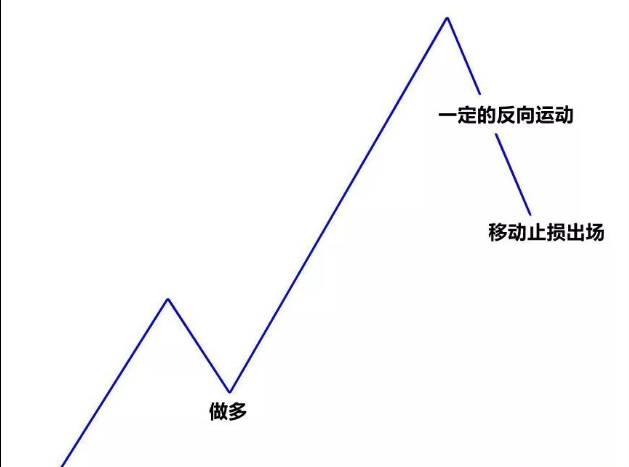
Traders can superimpose these basic methods during the trading process, such as the moving stop loss point composed of the previous high point + the previous low point, the moving stop loss point composed of the previous low point + Fibonacci callback point, the previous The moving stop loss point composed of low point + momentum indicator, etc.
A practical and effective trading system is composed of a clear entry method, a clear initial stop loss and take profit method, a clear trailing stop loss method and a clear money management method. Take profit can reduce some of the profit-gathering situation, and move stop loss can increase part of the trend profit, but remember, no matter what method you use, you can’t catch all the trends and profits in the transaction, and traders should not "dig into the horns" Small things lose big.
Copyright reserved to the author
Last updated: 08/02/2023 02:22
Add

To be honest, as long as it is to stop profit, no matter what method is used, it is at least better than stop loss.
Since it is trend trading, and judging from your content description, 30-minute trend trading, to put it bluntly, is only equivalent to hourly chart or intraday trading on hourly chart. Why do you say that? If you compare the graphs, you will find that in the 30-minute cycle of many trading varieties, if the moving average system is used as the basis for entering and exiting the market, the basic bands are relatively very short.
The other two questions in the problem description, one is dead cross take profit, so that means you are holding long positions, and the other is breaking through the structure and stepping back to take profit? Now that the structure of the market has broken through, it means that the market is developing in the expected direction. Why should we stop profit at this time? Originally, this question can also discuss the way to take profit, but after reading your problem description, I am a bit messy.
Regardless of the description of the problem, I personally prefer that moving take profit is better than moving average take profit. Why do you say that? First of all, the moving average stop profit is sometimes deceived by false breakthroughs or callbacks. Since it is a trend list, the pursuit must be to maximize profits. Wouldn't it be very sad if the stop profit caused by the 30-minute callback was out of the market when the market just started? As for the mobile stop profit, I personally generally break through the important position, and then move the stop profit point to follow up to a certain distance below or above the important position. In this way, only when an important position is broken through in a wave of market, the list in hand will be profitable. In contrast, generally speaking, the profit space is larger than the small-level moving average take-profit space.
Breaking through and stepping back means an important support level or pressure level. After being effectively broken, the price will return to the vicinity of this important support level or pressure level once again. This process is to break through and step back.
Copyright reserved to the author
Last updated: 08/12/2023 06:51
Add

I think it depends on whether you are doing short-term or long-term. As long as you don’t grasp the ground and the top, you can be efficient.
Copyright reserved to the author
Last updated: 08/02/2023 10:26
Add


I also have a trading system that crosses the moving average. Judging from the fluctuation of the moving average and the unilateral performance, the lag is relatively strong, and the trailing stop loss is definitely better. First of all, the cost of entering the market is already high, so the moving stop loss shock market can make a profit in time, and will not wait for the dead cross to lose out; the unilateral market can also respond to price changes in a timely manner, especially when the market reverses rapidly. Spit most of the profits. In general: according to the volatility and characteristics of different varieties, setting a relatively appropriate moving stop loss can maximize the profit of the moving average golden cross dead cross system.
Copyright reserved to the author
Last updated: 08/11/2023 21:05
Add

The advantage of the moving average take profit is that it can withstand a large retracement in the trend movement. The advantage of mobile stop profit is to reduce the extent of profit taking.
The disadvantage of the moving average stop profit is that after the stop profit is triggered, the proportion of the actual profit to the trend movement range may be relatively low. In other words, you may only get a small part of a wave of market conditions. The disadvantage of moving take profit is that a small retracement triggers your take profit, and even if there is a larger profit space later, it has nothing to do with you.
Therefore, these two stop profit methods have their own advantages and disadvantages. If you want to answer this question directly, the answer is: both are good, and neither is good.
Since this is the case, why can't we try to combine these two ways of taking profit? Wouldn't it be more perfect to be able to give full play to their respective advantages while reducing their respective disadvantages in this way?
In addition, since the subject of the topic said that he was doing trading on a 30-minute cycle, wouldn’t it be ridiculous to talk about trend trading? Trading on the 30-minute cycle chart is also a short-term trading idea. Since it is a short-term idea, the golden cross and dead cross of the moving average may also be more frequent. In this way, the profit margin is limited in many cases, and at the same time, the trailing stop loss, because of the limited space, the adjustable position of the trailing stop loss will also be very limited. of. So at this time, which mode feels a bit nonsense.
In addition, only the golden cross and dead cross of the moving average are mentioned, and the moving average of how many periods is not mentioned. This question is equivalent to asking for nothing.
Copyright reserved to the author
Last updated: 08/02/2023 06:59
Add

When trading on a trend, it is recommended to move take profit, because the price will sometimes test the moving average when the price is running, and the order is easily swept out. Although it is in the right direction, there is no profit. The mobile stop profit can refer to the price inflection point setting to let the profit run.
Copyright reserved to the author
Last updated: 08/10/2023 15:43
Add

Believe it or not, if you do a 30-minute period, you can directly choose a number from 60 to 100 points as your take-profit point, which is better than what you said. The 30-minute period moving average takes profit, and the profit is too much, because there wasn't much room
Copyright reserved to the author
Last updated: 08/09/2023 22:18
Add

Both methods have their own trading methods, depending on which one you are used to
1. Moving average stop profit method. When the market rises after a period of time, it starts to pull back stagflation, and the pullback is relatively gentle. Although there are differences between long and short positions, they are limited to a range. At that time, it is recommended to use the moving average stop profit method. The simplest way to say that the moving average stop profit method is: break the 5 line to reduce the position, break the 10 line to clear the position. Returning above the 5 line can be followed up in a small amount. If there is a rise in both volume and price, it is suitable to cover up positions to catch up.
The above is the application of the moving average stop profit method, and it can also be used as a reference for short-term buying and selling points. The so-called moving average stop profit method, to put it bluntly, is to look at support and pressure. If you know how to draw the support line and pressure line, you can determine the buying point and selling point.
2. The mobile take profit method I think this method is more suitable for the skyrocketing market. If there is a continuous rise, there will only be one highest point in the end, but no one knows when the market will be the highest point. At this time, the market is due to continuous pull As a result, a large number of profit-making positions have been accumulated, and there are huge differences between long and short positions. The market often fluctuates extremely violently, often accompanied by big Yinxian and big Yangxian. At this time, the moving average has lost its reference value due to its lag, so as much as possible To save profits, you need to use the mobile stop profit method. The simplest understanding is to let go of a part of the profit and observe whether the trend falls below the second-to-last rising height. Of course, this ratio varies from person to person. Structure, the upward channel or the upper pressure line of the horizontal range boldly take profit, for example, if a horizontal range reaches the horizontal pressure line, it will be sold, and when it returns to the horizontal range support line, it will be bought. The above methods of grasping the buying and selling points are for reference only, and I hope it will be helpful to everyone.
Copyright reserved to the author
Last updated: 08/08/2023 22:54
Add

Novices are thinking about stop profit, while veterans may think about stop loss.
I have seen some very powerful trend traders who never set a stop profit on their trading orders. Because it is a trend trading, they are very clear that this wave of trends will continue to develop. In order to get as much profit as possible from the trend, they gave up setting a stop profit. However, the stop loss is always there, and it must be constantly adjusted as the market changes. So if you look at his trading records, most of the orders were hit with stop losses, but they all turned out to be profitable.
But from the side, this is also a kind of stop profit. It is actually very similar to the two stop profit methods mentioned by the subject, maybe it’s just a different way of saying it. So back to the question itself, which effect is better? I think the effect of mobile take profit may be slightly better. As mentioned above, if you want to maximize the profits brought by the trending market, you should constantly adjust your stop profit (stop loss) range. But the question of the subject seems inappropriate. What you may want to ask is moving stop profit, not stepping back after breaking through the structure. Maybe it's my limited ability to understand, so I can't say much here.
Copyright reserved to the author
Last updated: 08/08/2023 23:04
Add

Regardless of take-profit or stop-loss, if long orders leave the market, it means that it is time to enter the market with empty orders, and when empty orders leave the market, long orders enter the market
Copyright reserved to the author
Last updated: 08/10/2023 19:53
Add

For unilateral market, you can move the stop profit and stop loss, and the shock market is set in the area where the moving average is lower and lower
Copyright reserved to the author
Last updated: 08/09/2023 14:19
Add

Regarding take profit, I have also used some methods, such as moving average take profit, structural position take profit, floating profit retracement ratio take profit, target position take profit and so on.
However, I later felt that there is no need to be too entangled in the way of taking profit. Different strategies correspond to different market conditions. Appropriate, sorry quotes.
The most ideal state is what kind of market conditions, I have what kind of profit stop strategy to do. This is of course too difficult to do.
Specifically, if you use a certain strategy to back-test the market conditions of various markets and various time periods, it must be very easy to use in a certain period of time in a certain market, and you will miss a lot of profits at other times.
Because the profit is high when the means match the market, and the profit is low if it does not match the market. In the ever-changing market, there is no one way to take profit that can adapt to all situations.
Copyright reserved to the author
Last updated: 09/07/2023 02:27
Add

Since it is a trend trading, it must be that the current wave of trends is over, and the next wave of trends has been determined to start and stop profiting! If it is a compound position, then you can consider halving the position after the structure is complete, and the other half of the position will take profit after the end of wave 2 of the next trend! If you trade with moving averages, enter and exit the market strictly according to the moving average signals. If you trade with ultra-short-term trading, you must exit the market if there is a profit. Don't think about the trend! Because the trend has nothing to do with your ultra-short-term! What you are grasping is short-term fluctuations!
Copyright reserved to the author
Last updated: 08/13/2023 14:53
Add

Thank you.
Whether you make money or not, and how much money you make, does not depend on which profit-stop method you choose and stick to. Other Huiyou have analyzed the advantages and disadvantages of each take profit method. Which way is better? The best fit for the market.
Each variety has corresponding funds to operate in it, because different people have different capital sizes, and the rules presented are also different. For the same species, the laws will not be exactly the same in different periods.
There is no one-and-done solution, and every effective method corresponds to a law in a certain period or under a certain condition. A good system is always the result of compromises in all aspects (stop loss, stop profit, asset management, risk control, etc.). Only suitable, not optimal.
Complete classification, in which case, use the corresponding appropriate method to deal with it, and monitor when it fails, and then change to a method that fits the current market.
Copyright reserved to the author
Last updated: 08/07/2023 23:14
Add

Which effect is better means that which method has a smaller retracement.
First of all, no matter what kind of profit stop method is perfect, it may be wrong in hindsight. However, right or wrong is not important, the important thing is to be able to get a market. Don't expect to eat from start to finish.
Second, which method do you want to draw back smaller. A trend-following strategy must be able to tolerate a certain range of shocks. Endure large shocks, and correspondingly, you may also get a bigger market. You can only endure small shocks, and there is a high probability that you will be out of the market prematurely and miss the following market. In a word, as much risk as you can take, you can get as much market value as possible.
So, there is no good or bad method, it depends on which one is more suitable for you.
Copyright reserved to the author
Last updated: 08/08/2023 05:32
Add

0
work
0
subscriber