


Stay in touch!
Subscribe to our newsletter to get the latest updates on live market analysis, trading strategies and more. You can unsubscribe anytime.
By subscribing, you agree to Trading.live Privacy Policy.


Cycle against? In my cognition, there is no problem of contradictory cycles, as long as you can understand the rhythm of the market well, such problems will not appear.
For such a problem, I think the main reason is that it is influenced by some books and analysts in the market, what looks big and small. However, in the process of our transaction, if you want to take into account multiple cycles, the disadvantages outweigh the advantages. Trading should be based on appropriateness. The more you read, the more contradictions will be. In the long run, your trading will be at a loss.
Moreover, experienced traders can completely see the price structure of the large cycle through the small cycle, and there is no need to check the trend of the large cycle too much.
Therefore, my own trading is mainly based on the operation cycle, and the big cycle mainly depends on the obvious support and resistance levels.
①. Regardless of whether it is a large cycle or a small cycle, it has its own market structure. Assuming the price goes from A to B, how many ways can price action work? Most of the cases appear in the form of shocks and rises, and since they are shocks and rises, there must be a similar price structure, so no matter whether it is a small cycle or a large cycle, it must include such a structure. It's like a small sparrow with all five internal organs. Small cycles can also perfectly show the market structure.
If the big cycle rises and keeps refreshing highs, then it is also a rising pattern that keeps refreshing highs in the small cycle; if the big cycle rises and the small cycle falls, it can only mean that the price is blocked at a certain price above and there is a retracement space. There will be two situations here. One is that the retracement is just a retracement. Then the trend has not changed, and you can still use the small cycle to make short orders against the trend and grab small profits. As long as the adjustment state is over, the small cycle can also be reflected. The second is that the retracement has evolved into a reversal. In this case, it will be more advantageous to base yourself on the operating cycle, because you can detect the reversal of the trend in advance, and you can get a good point, so the pressure on holding positions will be much less.
②. Taking into account both large and small cycles may cause conflicts. Why is it possible to use it here? Because for traders who don't understand the market structure very well. Looking at multiple time periods, it is difficult to choose when there is a contradiction. The daily chart is bullish, the 4-hour chart is bearish, and the 1-hour chart is bullish. Which cycle should be the main one? Create confusion for yourself.
The transaction itself does not need so many reference standards, it only needs to be based on a certain price graph, and all market information can be reflected through a graph. This is also my view on the cycle.
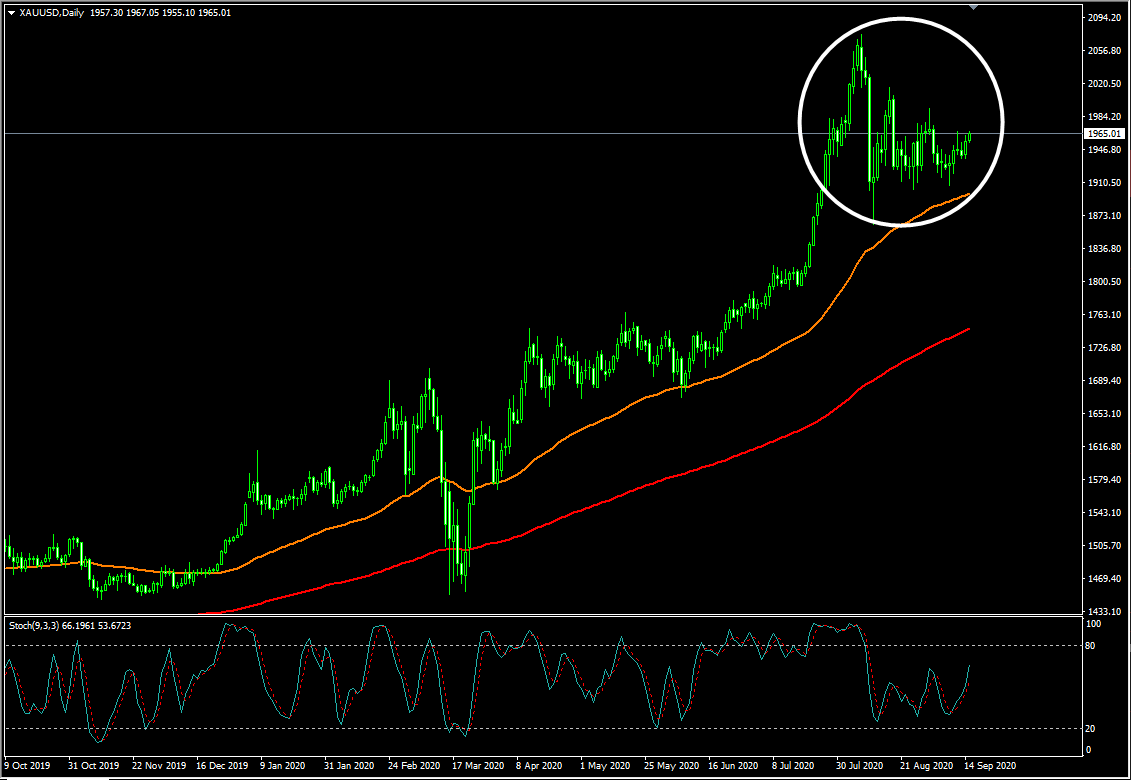
Take gold as an example in the picture below:
We can clearly see that the overall trend of the gold daily chart is upward. Regardless of the market structure or the moving average, the upward trend is no problem. (When I have time, I will write some questions about the trend. The trend is a very important concept that is easily overlooked.) During the period, even if there is a relatively large decline, the trend remains unchanged.
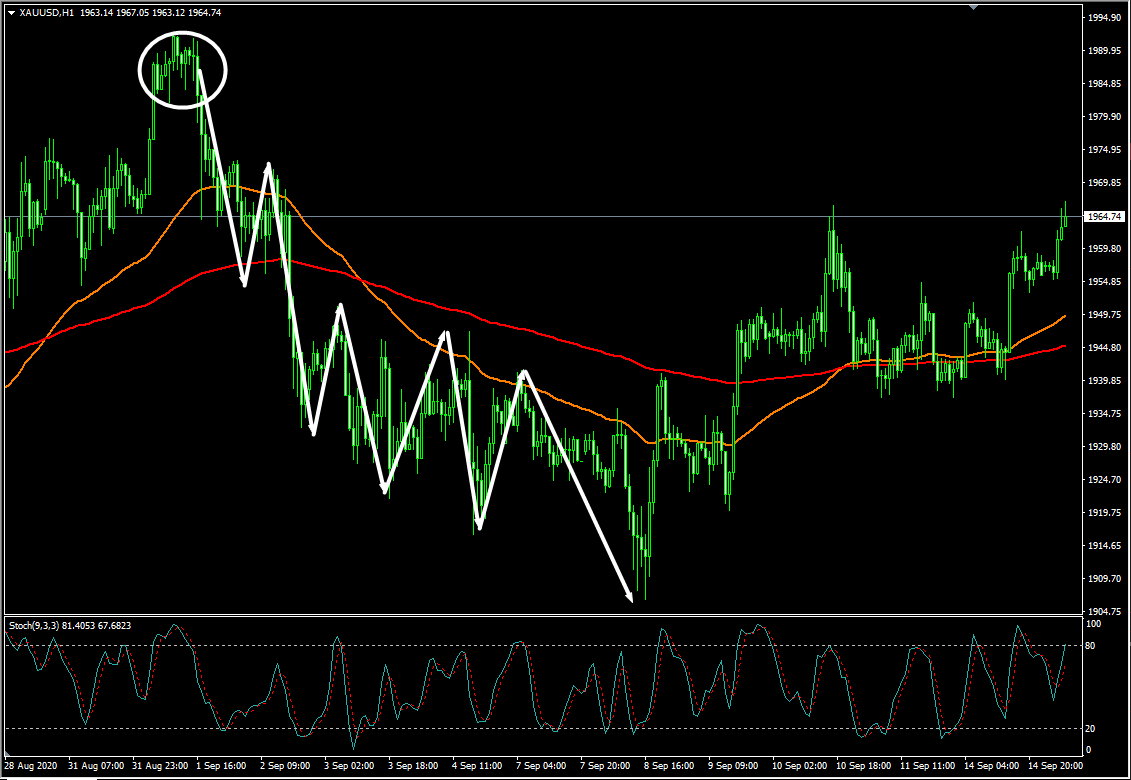
However, in the 1-hour period, the price has already shown a very obvious bearish structure, and the top signal is very obvious. At this time, you still have to take the trend of the large period as the criterion. Looking for a bit to do more?
And if you change your trading thinking and focus on the operating cycle, you will go long when there is a long signal, and short if there is a short signal.
To sum up, I don't think there is a problem of contradictory cycles, and the transaction is mainly based on the current transaction.
Copyright reserved to the author
Last updated: 08/07/2023 21:46
 Add
Add

It’s been a while since I’ve traded, so I’m reluctant to answer a wave. In fact, it’s normal for there to be a conflict between a large cycle and a small cycle!
The market always goes up and down alternately, and the big cycle is the evolution of the small cycle.
For this, you need to know the relationship between large and small cycles, and then make your own judgment, determine the size of the opportunity, and then determine the size of the position to achieve stable profits and control the retracement of returns.
Let me share with you the relationship between the big cycle and the small cycle, hoping to help you:
a. A small cycle promotes a large cycle.
b. The small cycle obeys the big cycle.
c. The inflection point of the trend in the large cycle triggers competition in the small cycle.
d. The large cycle limits the small cycle interval.
The relationship between big and small cycles needs to be savored carefully.
How to use it? In general, the larger cycle of the target cycle judges the trend and the size of the opportunity. Look for accurate buying and selling points in the small week of the target cycle.
Copyright reserved to the author
Last updated: 08/01/2023 19:33
Add

In our trading process, there will be a misunderstanding for friends who are just getting started, and that is the misunderstanding about the use of K-line. What about most cases? Many friends ask me what time period graphics should I look at for trading. In fact, for technical analysis, all cycle graphics have their significance. There is no absolute transaction that can be completed only by looking at one or a few graphics.
Now let’s talk about the wrong operation methods under the common phenomenon, one is to keep a complete eye on the market during the transaction, and the other is to look at the minute chart to make transactions.
Let me first talk about the benefits of looking at the minute chart for trading. A friend who is new to the market will have a high desire to trade, and this desire will make him want to trade all the time. So the graph that fits his trading mentality is obviously not the medium-to-long-term chart of the hourly or daily line. By their natural selection, they would concentrate on trading on the minute chart. Minute charts include 30-minute, 15-minute, 10-minute, 5-minute, and 1-minute candlestick charts. The short-term graphics respond quickly to market changes, the frequency of changes is relatively high, the operation is more exciting, and there are more opportunities to enter the market. But things have two sides. It is not enough to just see the good side. Changes are quick and responsive. This feature reminds me of the KD indicator. The disadvantage of the KD indicator is the high error rate. The purpose of our trading is to make money, and the increase in the error rate will directly affect our income, which can also be said to be his fatal injury.
According to our consistent process of doing transactions, judging the direction is the first priority, that is, we must line up in the right team. Blindly entering the market without even analyzing the direction at that time is undoubtedly suicidal.
The graph should be seen from the big to the small, that is, first look at the daily or weekly chart to judge the direction. The 4-hour or hourly chart can also be used to judge direction, but the time frame of its influence will be relatively small. When you have judged the direction, you can start your operation. At this time, look at the minute chart to choose the appropriate entry point according to the short-term trend. In other words, we don’t look at the minute chart when we make trading decisions, and it is necessary to pay attention to the minute chart only after we have made a decision. Generally, the validity period of the signal impact on the daily line is 1-3 weeks, 4 hours affects 1-4 days, hourly affects 3-6 hours, and it is not necessary to look at the minute chart to judge the direction.
Copyright reserved to the author
Last updated: 08/05/2023 07:34
Add

0
work
0
subscriber