


Stay in touch!
Subscribe to our newsletter to get the latest updates on live market analysis, trading strategies and more. You can unsubscribe anytime.
By subscribing, you agree to Trading.live Privacy Policy.


There is no fixed standard for the concept of market sentiment, and some people in the market even think that sentiment is the biggest driving force for traders to enter the market. The view on the current market, whether gold is long or short, is determined by the traders' own emotions. It can be said that emotions determine our trading behavior.
Let me admit that I am a price action trader, and I may especially value market price action, which of course also includes market sentiment. To judge market sentiment, I usually analyze it from the following angles:
Angle 1, K line
K-line and K-line combinations are one of my tools for analyzing market sentiment. It is mainly measured from the entity size of a single K-line or the time span of the combination of K-lines. Generally speaking, the larger the range of a single K-line, the stronger the rising or falling market sentiment. Of course, as for what kind of K-line has a large range, this can only be determined by your own subjective judgment and combined with the previous K-line, which is highly subjective. As for the K-line combination form, I think that at a relatively high or low level, the longer the span of the structure, the greater the possibility of reversal.
Angle 2, the absolute height of the band
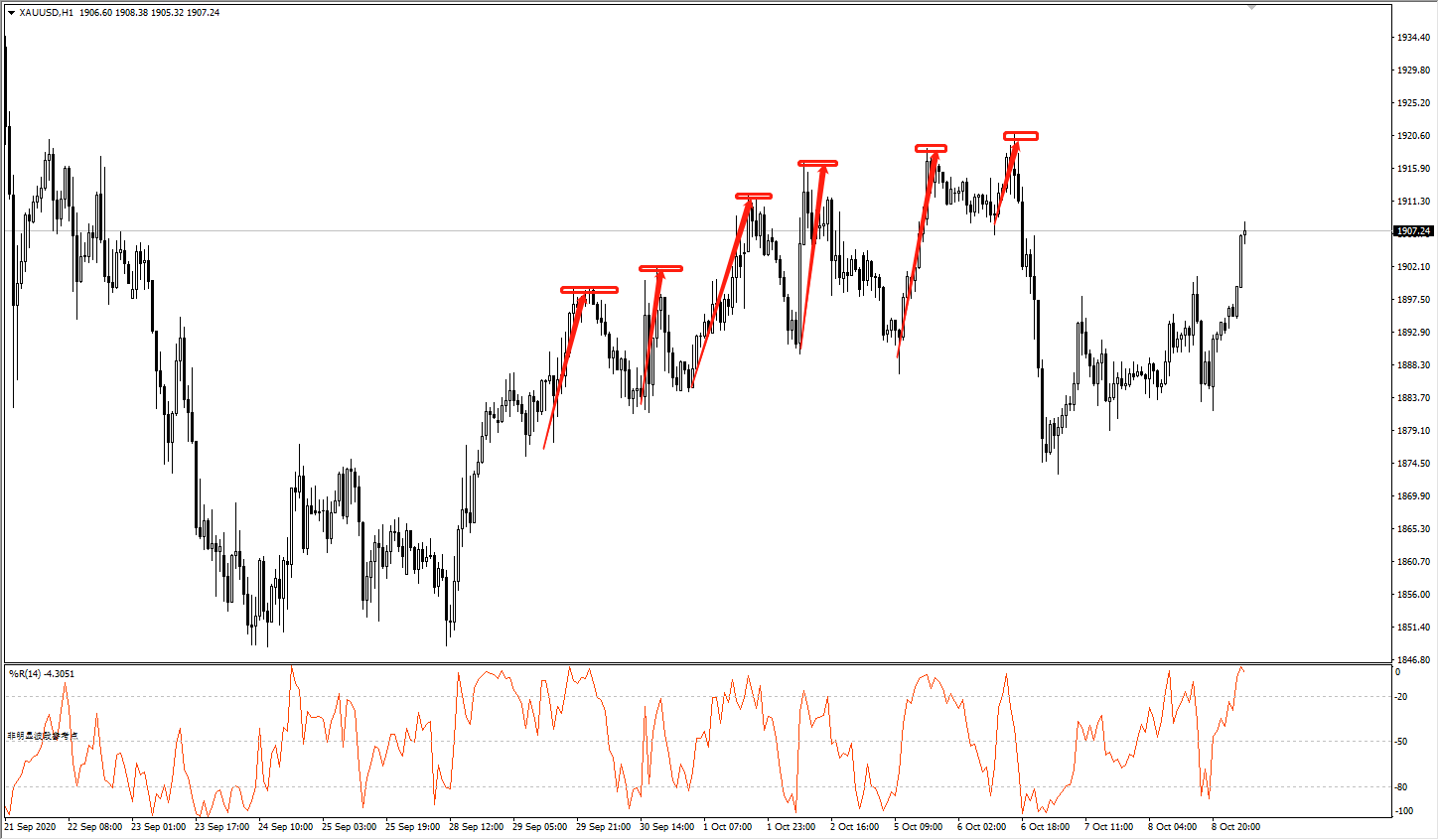
Taking the rise as an example, it is mainly to compare the highs and highs, highs and lows, and highs and lows of adjacent bands. We all know that the upward trend is that the high points continue to increase, and the low points continue to increase. However, transitions between highs and lows are a good indicator of market sentiment.
The following picture is an example. After breaking through the previous high price, the price did not rise rapidly to expand the increase, but retreated. This also shows that the market sentiment is more hesitant. If it breaks a bit, it means a relatively large callback or a direct reversal. The rise is unsustainable.
Similarly, the comparison between the low point and the low point mainly depends on the strength of the backtest of the two. Generally speaking, the smaller the strength of the backtest after the rise, the higher the probability that the market outlook will continue to rise. If the market retests substantially after each rally, the probability of a shift in market behavior increases.
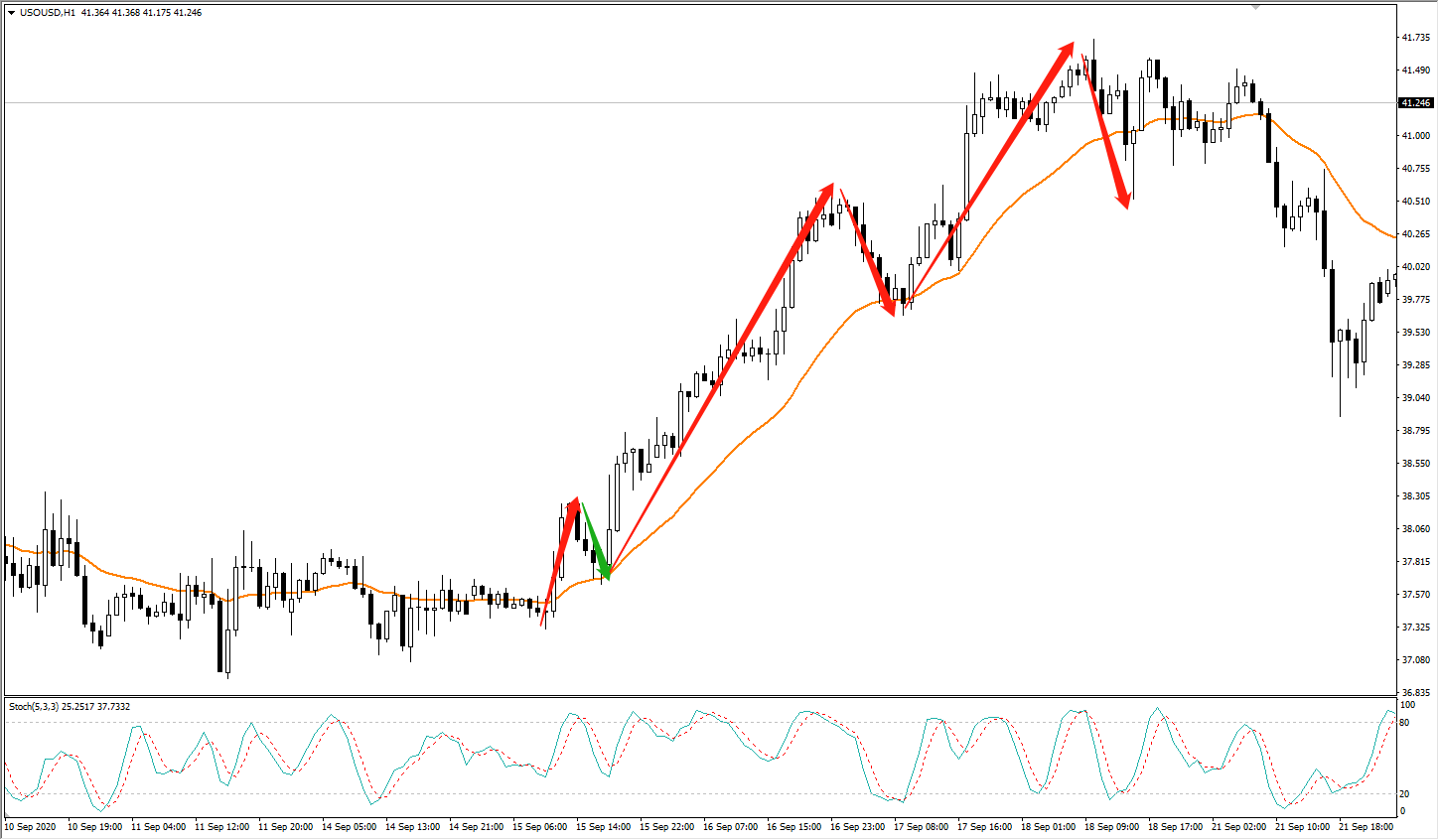
It can be clearly seen that the backtesting range of the price during the rising process is used to judge the sentiment of the market.
It is worth noting that the subjectivity of analysis in this way is relatively strong. You need to establish your own analysis logic, what kind of band is considered a long band, what kind of band is weak in backtesting, and so on. It all needs to be judged by ourselves.
Angle 3, trend line and moving average
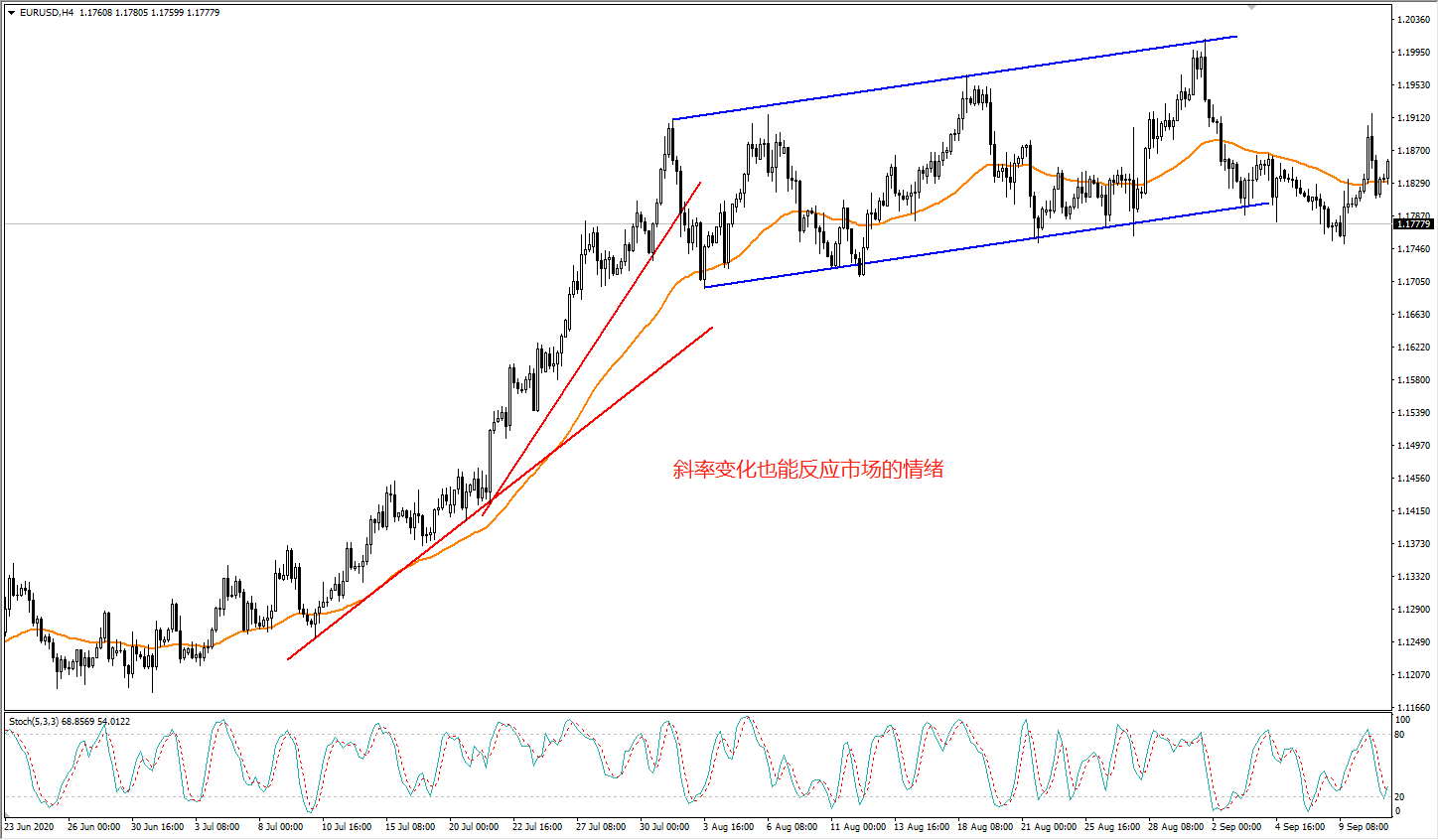
Using trend lines and moving averages, the main tool is to look at the rising or falling rhythm of the market. Simply put, it is to look at the moving average and the slope of the trend. The higher the slope, the stronger the market sentiment. For example, in an upward trend, the slope gradually increases from low to low, which means that the market sentiment is rising.
The problem still lies in the fact that the judgment of the high point of the slope is still subjective, which cannot be avoided. And it is not that the higher the slope, the greater the market outlook, and the end of the trend is often accompanied by an accelerated rise or fall.
Angle 4. Index
For the indicator, my personal understanding is not very deep. But I know that there must be indicators in the market to judge market sentiment. Whether it is the deviation of the indicators, or other factors and so on. Without research, you have no right to speak. If you have better indicators for judging market sentiment, please let me know in the comment area.
Right now, that's all I can think of. Everyone is welcome to add, the road of trading is very lonely, and learning from each other is indispensable.
Copyright reserved to the author
Last updated: 08/06/2023 11:33
 Add
Add

What is market sentiment
To judge market sentiment, you need to know what market sentiment is, right?
Market sentiment is a comprehensive display of the views of all market participants in the overall market. This feeling shared by all market participants is what we call market sentiment. It is also the mainstream view of most participants in the market that determines the overall direction of the current market.
Every trader will explain, from their own perspective, why the market is behaving in a certain way. When trading, traders express their individual views on the trades they make.
But sometimes, no matter how sure a trader is that the market will move in a certain direction, their trades may end up failing. Traders must realize that the overall market is the combined view of all market participants. Yes, all market participants. This feeling shared by all market participants is what we call market sentiment. It is also the mainstream view of most participants in the market that determines the overall direction of the current market.
How to conduct market sentiment analysis?
How to conduct market sentiment analysis As a trader, the analysis of market sentiment is an indispensable part of your trading work. Are the economic indicators showing that the market will rise? Are traders pessimistic about the economy? We cannot tell the market that the situation should develop as we think. All we can do is react to what is happening in the market. It should be noted that using the market sentiment analysis method does not give us the exact entry and exit points for each trade. However, don't despair! Using market sentiment analysis can help you decide if you should go with the market trend. Of course, you can also always combine market sentiment analysis with technical and fundamental analysis methods to make better trading decisions.
The following is the analysis method of market sentiment that I have gained after more than ten years of training in the A-share market, for the subject's reference.
1. Look at the market index first. Whether the index trend is good or bad has a decisive impact on market sentiment. If the index continues to fall, the mood will not be much better. Therefore, it is recommended that you keep analyzing the market index every day to understand whether the index is rising or not. The downward trend, whether it is an upward trend of shocks or a downward trend of shocks, is the most important link in judging sentiment.
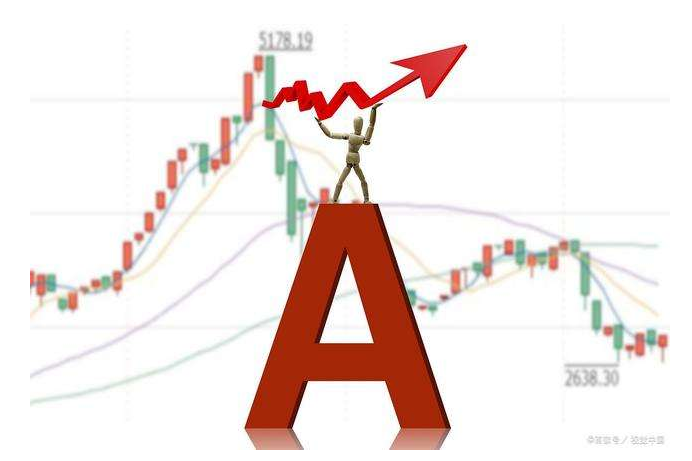
2. After reading the market index, and then looking at the sectors, what is a good mood? It should be that the core hot sectors in the market have a relatively good profit-making effect. At this time, the mood is good. If there are 1-2 hot sectors in the market, it is still The sell-off is more serious, and the effect of losing money is full. At this time, the mood will not be very good. Even if there is a mainstream hot spot at that time, the effect of making money is hot, but the real mood is good. It depends on whether the core sectors in the entire market are making money. The effect is obvious, and other unimportant sectors should not have a sharp drop.
3. Look at the leading stocks in the space. The role of the leading stocks in the space is to open up the space for market speculation. The leading stocks in the space can continue to rise by the limit and rise to a certain height. Only leading stocks in other hot sectors dare to follow suit. The room for hype will only be lower. At this time, it is impossible for emotions to be hot.

4. Look at the core stocks of the core sector again. Each sector has core stocks, such as Long 1, Long 2, Long 3, etc. Focus on Long 1 and Long 2, whether they are continuing to rise, whether they are active in relay, this One point is very important. Only when the leader can continue to rise can it drive other stocks to reach their daily limit, resulting in the so-called profit-making effect of the sector.
5. The last point is to look at several indicators, such as the comparison of the number of daily limit-up stocks and down-limit stocks, the number of connected board stocks, and the number of 4-board stocks. These numbers represent market sentiment.
Copyright reserved to the author
Last updated: 08/05/2023 00:36
Add

0
work
0
subscriber