


Stay in touch!
Subscribe to our newsletter to get the latest updates on live market analysis, trading strategies and more. You can unsubscribe anytime.
By subscribing, you agree to Trading.live Privacy Policy.


The so-called trend trading is what we usually call following the trend.
So what does it mean to follow the trend? Going with the trend means that when the market trend is upward, then go long along the trend line; if the trend is downward, open short along the trend line; if it is a box arrangement, then sell high and buy low .
Then, in order to follow the trend, there must be a trend first.
What is a trend?
The Dow Theory, the patriarch of technical analysis, defines it as follows:
Under normal circumstances, the market does not go straight in any direction. The characteristic of the market movement is twists and turns. Its trajectory is like a series of successive, ups and downs, with obvious peaks and troughs.
The trend is exactly the direction in which these peaks and troughs rise or fall in sequence. As these peaks and troughs increase or decrease sequentially, or extend horizontally, the evolution of their direction constitutes the trend of the market.
Any trend will not appear out of thin air, it has a starting point and an end point. This area connecting the end of the old trend and the beginning of the new trend is what we usually call an inflection point!
In this way, returning to the main question, the answer comes, how to judge the beginning and end of trend trading? In fact, how to grasp this inflection point is as simple as that! If you catch the first inflection point, that is the beginning of the trend; then you catch the second inflection point, that is the end of this round of trend and the beginning of a new round of trend. In a word, the trend continues before the inflection point (old trend), and the trend reverses after the inflection point (new trend comes). Refer to the figure.
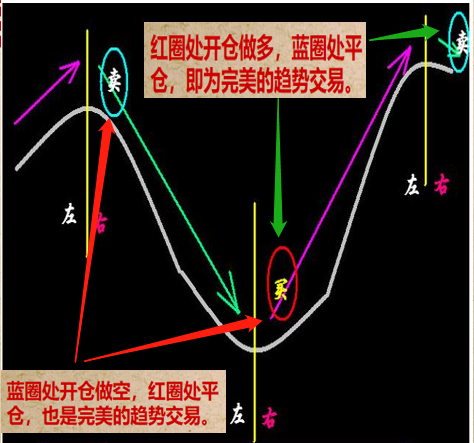
However, predicting the inflection point is often easier said than done, and it is very clear after the fact, and there are various entanglements in the matter. The most classic case is that a generation of master Benjamin Graham misjudged the beginning of the Dow’s upward trend in 1929. And the fact that it almost broke the warehouse.
So, how can we grasp this inflection point well, or grasp the beginning and end of the trend? Personally, I think that the sharp tool for judging the inflection point lies in the technical form + wave theory.
We know that there are two main classifications of technical patterns-reversal patterns and continuation patterns. Reversal patterns are true to their name, meaning that a major trend reversal is taking place, which is often the area where the turning point is located. The wave theory can divide the trend of the market by counting waves, and the junction of the impulsive wave and the adjustment wave is often the area where the inflection point is located.
If the reversal signal in the technical form and the wave type boundary in the wave theory are combined, and where they overlap, then the probability of the inflection point is often close to ten. Combined with the direction of the wave type, then the beginning of a trend and The end is on paper.
Copyright reserved to the author
Last updated: 08/06/2023 11:35
 Add
Add

How to judge the beginning and end of trend trading?
This is simple, that is, when a trend begins, such as an upward trend, then you go long at the beginning of the trend and cash out at the end of the trend, while the downward trend is just the opposite.
So, here comes a new question, so how do I judge the beginning and end of this trend? Or, more precisely, how do I know when a trend in the breed I'm trying to start? What is the trend? Up or down?
At this time, we need to use support levels, resistance levels, trend lines, channel lines and other tools to analyze and judge. As long as the support level and resistance level are not broken, it is often the beginning of a new round of trend; while the trend line and channel line, as long as they are not broken, are often the continuation of the old trend.
Of course, their roles can often be interchanged, and the key points will not be unbreakable. Therefore, how to judge the start and end of trend trading is impossible to draw general conclusions, let alone the dogmatic answers in textbooks. It needs to be adaptable on the spot.
Copyright reserved to the author
Last updated: 08/01/2023 23:17
Add

I still remember that when we first entered the trading industry, the most common question we asked was "what do you think about XX varieties today?" We still ask such questions today, as if judging the trend is an eternal theme for traders.
Trend, the concept itself has great ambiguity. What is a trend may be a point of view that the beholder sees the benevolent and the wise see wisdom, and the trend is often related to the cycle. If we talk about trends without the cycle, we will basically fall into the category of agnosticism. The price of the monthly chart is in the process of rising, while the weekly chart is in the process of falling, and the daily chart is oscillating... So, which cycle can replace the trend, or can each cycle replace the trend? This may be A topic of contention. Therefore, the trend must be a topic that advances and retreats with the cycle. It is meaningless to talk about the trend without the cycle, especially for a trader.
Trend judgment is only a part of your trading analysis process. Correct trend judgment does not necessarily mean that your trading can make money. Trading must be a set of strict operating procedures, not an independent individual.
How to judge the trend?
First, choose the period of judgment. This cycle can be your analysis reference cycle or your trading cycle. However, since it is fixed, there is no need to change it. When you fail to deal with the correlation between the various cycles, frequent replacement cycles will not help you see the market clearly but will more likely make you more confused.
Second, fix the standard of judgment. If you use the moving average to judge, you can only use the moving average to judge. If you use the trend line to judge the current trend, you can only use the trend line. Don't always think about using many different judgment methods to achieve the so-called resonance effect. In fact, the result of doing so is that you can't achieve the resonance effect you want, but only make your own judgment contradict yourself.
Finally, the transaction is your own, and other people's trading systems may not be suitable for you. Instead of searching hard and verifying the trading system, it is better to build your own trading system based on the present.
Copyright reserved to the author
Last updated: 08/06/2023 08:59
Add

0
work
0
subscriber