


Stay in touch!
Subscribe to our newsletter to get the latest updates on live market analysis, trading strategies and more. You can unsubscribe anytime.
By subscribing, you agree to Trading.live Privacy Policy.


We know that black swan events (that is, major unexpected events) will cause violent market fluctuations. It is certainly a risk event for the wrong party, but it is a huge profit event for the right party. So, is there any way to catch this kind of black swan event in advance or calmly deal with it afterwards?
In order to seek this method, I sorted out 20 black swan events around the world since the 1950s, hoping to find out the rules. These 20 black swan events are shown in the table below:
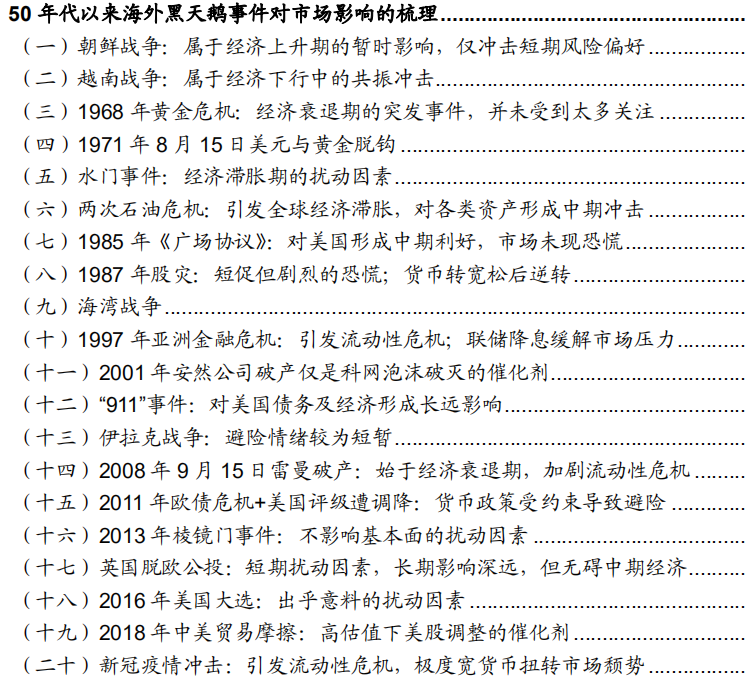
By analyzing the reactions of various assets after the black swan event, I found that the black swan event can be attributed to six types:
First, it is nested under the larger fundamentals so that it is ignored by the market.
Such as "Gold Crisis", "Watergate Incident", "Prism Gate Incident" and so on. These events may be isolated, or they may be the product of some macro context, which is also unexpected by the market, but is ignored because it is nested in some larger macro context. Such emergencies generally do not trigger liquidity risks, so even if they occur during an economic downturn, they will not have a greater impact on fundamentals (but long-term impacts, such as the gold crisis, cannot be ruled out).
Second, the market fluctuated greatly, but it did not lead to a substantial and continuous decline in risk assets.
For example, the Brexit referendum (which also has a long-term impact on the UK, but the short-term impact does not last), the 2016 US election, etc. Such events only exceed market expectations and may have long-term effects, but they will not affect the economic fundamentals of the subsequent period. This sudden event does not affect the operating trend of various assets, but it will intensify market volatility before and after the event, and may also bring trading buying points for many assets.
Third, unexpected events pushed risky assets to fall sharply, but the adjustment time was relatively short.
For example, various short-term geopolitical risks, the Korean War; another example is the 1987 stock market crash, the 2018 Q4 US stock market crash, etc.
Such events only affect short-term market risk appetite, or cause periodic adjustments due to the overvaluation of certain types of assets, and such events will not trigger changes in economic fundamentals, and often occur during economic recovery or even overheating. Once the risk event is over, or the monetary policy is relaxed, the impact of the situation on the market will end.

Fourth , unexpected events trigger the continuous adjustment of risk assets, and even bring about trend effects.
Such events often occur in the late cycle or recession of the economy, triggering the economy to switch from the late cycle to the recession or exacerbating the degree of economic recession. Such as the Vietnam War, the oil crisis, and the current impact of the epidemic.
Fifth, unexpected events have induced a liquidity crisis, which may trigger a continuous adjustment of risky assets.
For example, the bankruptcy of Long-Term Capital, the bankruptcy of Lehman, and the failure of Bridgewater’s riskparity strategy are actually the results of the Asian financial crisis, the subprime mortgage crisis, the epidemic, and the impact of ultra-low oil prices. However, due to the size of the financial institutions or the financial products they created Larger, thus triggering market liquidity risk. Generally speaking, such incidents often occur at the "critical point where a certain transaction model is born in a certain economic and financial environment, and the model is continuously enlarged, and the dividends of the financial environment are continuously swallowed." Taking the Riskparity strategy as an example, the QE-driven fall in risk-free interest rates and the rise in financial asset valuations are important backgrounds for its birth and development. At present, the risk-free interest rate has fallen to an extreme level, and the double killing of stocks and bonds in the same direction has invalidated the strategy and triggered a crisis. Market Liquidity Risk.
Sixth, key long-term turning point events.
For example, "the US dollar was decoupled from gold on August 15, 1971", the oil crisis, the "Plaza Agreement", the 9/11 incident, the "European debt crisis", and the "Brexit referendum". But the impact of such events on asset prices varies greatly, depending on which countries are beneficial or harmful, or whether they are beneficial or harmful to the world.
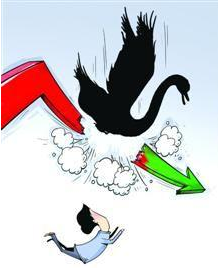
With such a division, the conclusion can be seen clearly: the black swan event itself is only a disturbance factor, because these unexpected events themselves will not cause a reversal impact on the original commodity trend. However, in this process, the amplitude of various assets will inevitably intensify, and its impact on the market even exceeds the limit of our daily consciousness. Under extreme panic, the market will quickly sell risky assets and form a risk aversion mood, but it will soon return to rationality. Buy low-risk assets.
To put it more simply, the black swan event caused the bungee jumping market at the beginning, but as time went by, its influence gradually disappeared, and the market returned to the original trend again.
With this conclusion, we have traces to follow when dealing with the black swan event:
1. If there is a short position in the black swan event, then you can follow the direction before the black swan event, and gradually build a strategic position as time goes by, and plan for the future market return in advance.
2. If you are betting on the right direction in the black swan event, you should make a decisive profit and leave the market within two days of the black swan event.
3. In the black swan event, if you bet on the wrong direction with a full position, you should set a stop loss position on each order. Then at this time, you will be automatically stopped at the beginning, which is equivalent to a short position. Then start to repeat the operation of point 1.
Copyright reserved to the author
Last updated: 08/08/2023 22:06
 Add
Add

Gap and high opening refers to the phenomenon that the opening price in the market exceeds the highest price of the previous trading day. From 9:15 to 9:25 in the morning, during the call auction period, the power of buyers is much stronger than that of sellers, and the opening price at this time is higher than the closing price of the previous day. There are two possibilities for this situation: one may be the dealer’s test action to see how much selling is on the top; the other may be that the dealer’s main purpose is to attract the attention of investors for the convenience of distribution. It is possible to drive high and low. Therefore, it is generally not recommended to leave overnight orders, nor is it recommended to leave orders for weekends, because no one knows what emergencies will happen when you are resting, and what kind of market fluctuations will be brought about, except for medium and long-term trading methods.
Copyright reserved to the author
Last updated: 08/30/2023 08:23
Add

Presumably traders are aware of various "black swan" events in the market. Due to the suddenness of the "black swan" event, it often has an unexpected impact on our transactions. Whether this effect is a surprise or a shock, it is talked about by traders. In this article, we analyze and correctly understand the "Black Swan" event from an objective perspective.

The "Black Swan" event has three distinct features.
One is rarity. A "black swan" event is usually an unexpected event without any expectation, that is to say, there is no evidence in the past that can determine its possibility.
The second is impact. "Black swan" events often bring about extreme market conditions, either flying down 3,000 feet to the limit, or soaring up to 90,000 miles to the limit.
The third is ex post predictability. Only after the "Black Swan" incident happened, people will look for clues to its appearance, and then find out the truth.

The most direct impact of the "black swan" event is the sudden change of the market trend, that is, the original market trend will end suddenly or accelerate suddenly without warning. This also corresponds to a saying often said in the trading market: When you think When you are sure, the market often hits you head-on.
Let’s give a few examples of “black swan” incidents, the most famous of which should be the Everbright Oolong Finger incident in 2013, as well as the previous European debt crisis and so on. Futures traders should be aware of a small "black swan" event in the futures market recently: On the night of November 1, both soybean meal and rapeseed meal went to the limit, only to find out afterwards that it was due to the high-level dialogue between China and the United States, and new developments in the Sino-US trade war emerged. The conclusion, and the price of agricultural products in China has always been closely related to the US market, so it will lead to extreme market prices.
Many futures traders, especially fundamental analysis and arbitrage investors, are particularly afraid of encountering "black swan" events, because "black swan" events that appear without warning often cause a devastating blow to the trading basis they rely on for survival. But this is something we cannot avoid. It fully demonstrates the random characteristics of the market and its "willful and naughty" character.

There are only two things we can do about this:
One is how to prevent the "black swan" incident and minimize the damage it brings. Undoubtedly, setting a stop loss in advance is a good cure.
The second is how to use the market chaos caused by the "black swan" event to expand their profits. Short-term follow-up is a high-risk and high-yield operation technique, but if you don’t understand this kind of market, it’s best to wait and see.
Regarding the "black swan" event, I especially want to say that because the "black swan" event is predictable after the event and the impact of extreme market conditions, many traders try to predict the next "black swan" event before it occurs Come out, become a rule, and even turn it into a basis for your own transactions. I think this is an extremely dangerous misunderstanding. I want to remind traders: For the "black swan" event, what we have to do is to follow the trend after it appears, not to predict when it will appear. I wonder if you have encountered a "black swan" incident that affects you? Welcome everyone to leave a message to share your experience!
Copyright reserved to the author
Last updated: 08/22/2023 09:25
Add

0
work
0
subscriber