


Stay in touch!
Subscribe to our newsletter to get the latest updates on live market analysis, trading strategies and more. You can unsubscribe anytime.
By subscribing, you agree to Trading.live Privacy Policy.



The origin of MACD
To select the most commonly used technical indicators in the trading center, MACD ranks second, and no indicator dares to rank first.
MACD is known as the king of indicators because of the high accuracy of the trading signals it sends out.
What needs to be emphasized here is that any technical indicators are only auxiliary, and the final trading decision is to use your own actual combat experience to build a trading system that suits you.
MACD, the abbreviation of Moving Average Convergence-Divergence, is the exponential smoothing average of similarities and differences, invented by American Gerald Appel in 1979. MACD is used to judge the strength, direction, energy and trend cycle of the trend in order to grasp the timing of buying and selling.
MACD is developed from MA and belongs to the general trend indicator. It consists of two lines and one column.
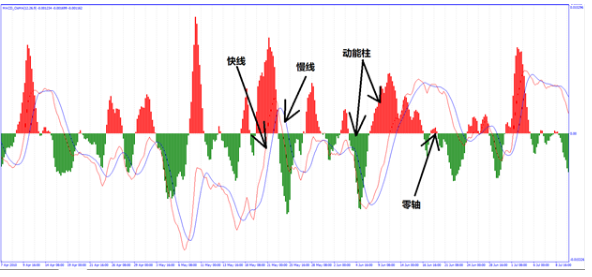
As you can see from the picture above, red is the fast line, blue is the slow line, the red and green columns are energy columns, and the zero axis is the dividing line between long and short.
The automatic setting of MACD is: the fast line is the 12-day moving average (EMA), the slow line is the 26-day EMA, and the kinetic energy column is the 9-day EMA.
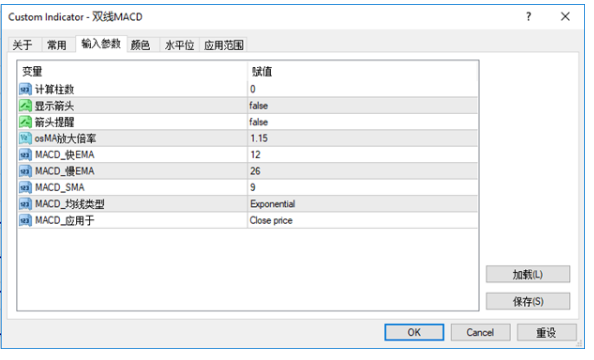
Many traders will change the moving average of MACD according to their trading preferences, risk tolerance and trading products, such as (6, 30, 6) or (6, 30, 9).
The parameter change is to "solve" the problem of MACD passivation, the lower the moving average, the more trivial the trading signal, but the accuracy will be relatively reduced.
For forex and commodity trading, I prefer raw parameters (12, 26, 9). Of course, the MACD index is only a part of the trading strategy. At the same time, it must be matched with the K-line shape, moving average, trend, stop loss and target price, so as to have better results.
MACD absorbs the advantages of the moving average. Moving average buying and selling works well when the trend is clear, but when the market is consolidating, the signals sent by the moving average are too frequent and extremely inaccurate.
And MACD can just be able to overcome the frequent false signals of the moving average to a certain extent in the consolidation market; in the trend market, it can maximize the results of the moving average.
How to use MACD
The basic rule of MACD is:
When the fast line is below the slow line and the red column becomes smaller or the green column becomes larger, it is a short market, indicating that the bulls are still weak and the shorts are strong.
When the fast line is below the slow line and the red column becomes larger or the green column starts to become smaller, it is a long market, indicating that the strength of the bears is weak and the strength of the bulls is strong.
The zero axis is the dividing line between long and short. When the fast line and the slow line cross the zero axis, the rising speed will accelerate; when the fast line and the slow line cross the zero axis, the falling speed will accelerate.
The following are the trading opportunities with the highest probability of winning using MACD:
1. Golden Fork Dead Fork
The fast line and the slow line form a golden fork or a dead fork above or below the zero axis, and this is an opportunity to go long or short.
It is worth noting that although the golden cross formed by the fast line and the slow line below the zero axis may be a signal of bottoming out, it is generally not the best opportunity to go long, because it is still in the empty area at this time, and there will be a lot of opportunities in the future. It may be a continuation of the previous trend after consolidation.
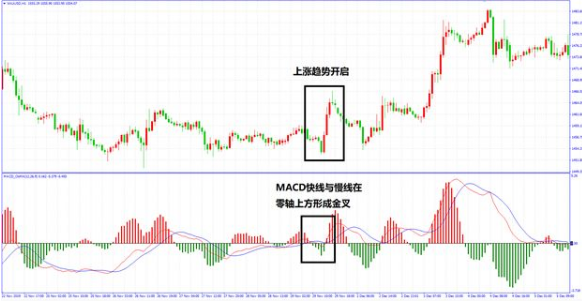
2, the second golden fork dead fork
When the fast line and the slow line form a golden cross, then the price goes up, and then the price pulls back and the fast line and the slow line form a golden cross again above the zero axis. This is a buying opportunity.
When the fast line and the slow line form a dead cross, then the price falls, and then the price rebounds and the fast line and the slow line form a dead cross again below the zero axis. This is an opportunity to sell short.
If the secondary golden cross or dead cross is formed below or above the zero axis, you need to match the K-line form to choose an opportunity to trade.
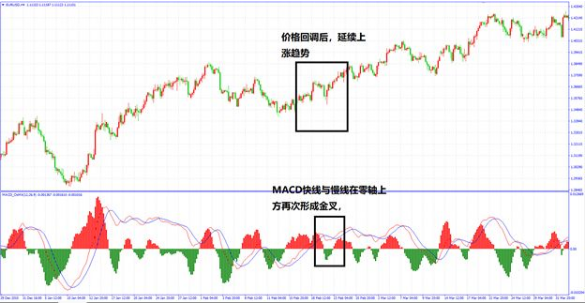
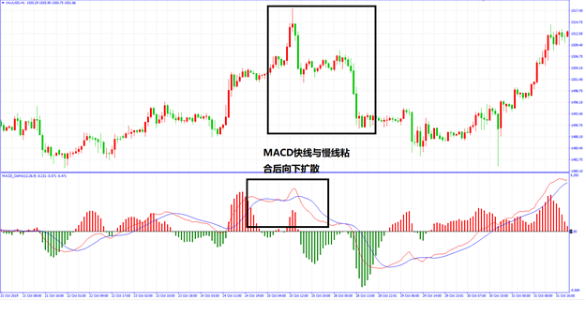
3. Diffusion after double-wire bonding
Taking the opportunity to go long as an example, if the fast line and the slow line cross the zero axis and pull back, the two lines will start to spread after bonding, and the red column will start to become larger at the same time, which is a relatively strong long signal.
On the contrary, it is a strong short signal.
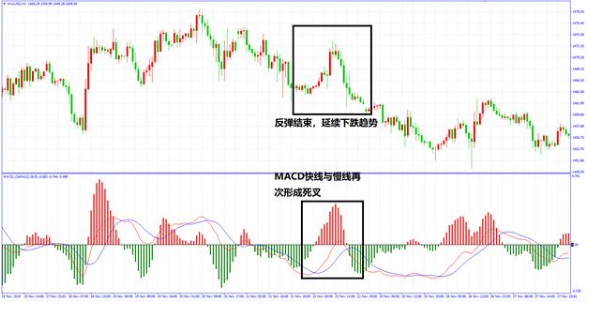
4. Alternate golden fork and dead fork
For the opportunity of shorting, if the fast line and the slow line form a golden cross below the zero axis, and then form a dead fork without crossing the zero axis, it means that the rebound is over, and you can increase your position and short.
On the contrary, it is a long signal.
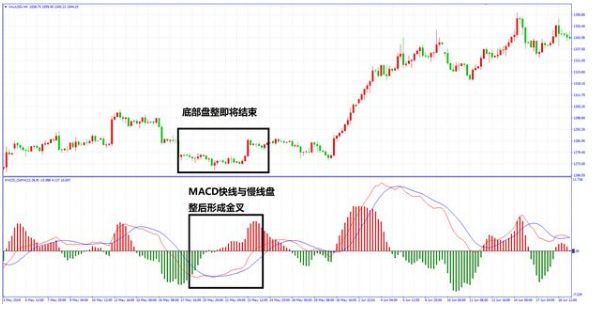
5. After consolidation, the golden fork is dead fork
If the fast line and the slow line form a golden cross after running horizontally below the zero axis, it means that the consolidation is over and the opportunity to go long is coming; otherwise, it is an opportunity to go short.
Divergent trade
For the classic indicator of MACD, in addition to the common golden fork and dead fork, another essence is "divergence".
In foreign exchange trading, it can be said that divergence is the strongest signal and the highest accuracy.
The principle of divergence is simple:
When the price is rising or falling, but neither the kinetic energy bar nor the double line of MACD has made a new high or new low, its trend is just opposite to that of the price.
This shows that the momentum of bulls or bears to continue to rise or fall has been greatly weakened, and a trend reversal is about to appear.
At this time, you can build positions in batches or enter the market decisively after the peaking signal appears.
1. Top deviation
When the price trend is one wave after another, the market has been rising, but the red column and double line trend of MACD is one wave after another.
It means that the strength of the price rise process is insufficient, and the outside is strong but the middle is dry, implying that there will be a wave of decline in the future, which is a strong downward signal.
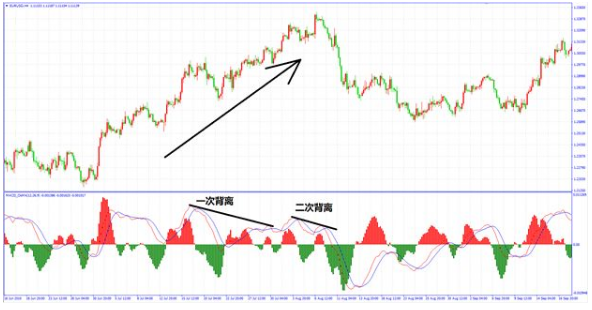
2. Bottom divergence
When the price trend is one wave after another, the market has been falling, and the MACD wave is indeed one wave after another, indicating that the downward trend is about to end.
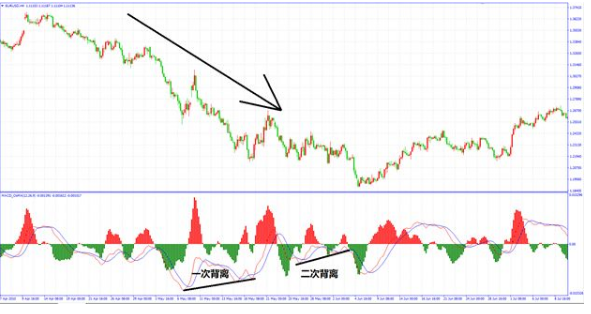
Finally, it needs to be emphasized that if the MACD double-line and the red and green columns simultaneously show divergence signals, and the divergence occurs more than twice in a row, then the possibility of an imminent trend reversal will be greatly increased.
Copyright reserved to the author
Last updated: 08/24/2023 16:18
 Add
Add

Look at the golden fork and the dead fork
Copyright reserved to the author
Last updated: 08/20/2023 14:12
Add

In the MACD indicator, red and green represent the energy strength of bulls and bears respectively. Their market reactions are ahead of the short-term moving average DIF in time. In the MACD indicator, the process of energy release is gradual, usually It is gradually enlarged, using the trend of the red bulls combined with the K-line, when the K-line is 90 degrees, it indicates that the top of the general trend is approaching, especially when the two adjacent red energy columns are connected,
Copyright reserved to the author
Last updated: 08/11/2023 10:38
Add

0
work
0
subscriber