


Stay in touch!
Subscribe to our newsletter to get the latest updates on live market analysis, trading strategies and more. You can unsubscribe anytime.
By subscribing, you agree to Trading.live Privacy Policy.


The most important investment principle for reversing the market is to "buy"
"Trading on the left and trading on the right" must have been heard by many traders, but not many people really understand it. Let's talk about "trading on the left and trading on the right" in detail.
The so-called "trading on the left and trading on the right", taking the picture as an example, the red circle represents the left side, and the blue circle represents the right side.

When the price rises, with the top of the price as the boundary, any high selling on the left that has not yet formed at the "top" belongs to the left side of the transaction, while the sell-off after the "top" falls back belongs to the right side of the transaction; the same is true for the falling market.
Sometimes at the same price, there is a difference between the transaction on the left and the transaction on the right.
The difference between "left and right transactions": To put it bluntly, one is foresight and the other is hindsight.
Trading with the trend is trading on the right, and trading against the trend is trading on the left. At the end of a decline, predictive buying, or at the end of a rising, predictive selling, is left-hand trading. Selling at the beginning of a decline or buying at the beginning of a rise is right-hand trading.
For trading on the left side, before the inflection point, it is generally bought gradually and sold in batches, because it is sold on the way up, so the requirements for buying points are not high, but precise selling points are required. The right side is just the opposite, because the price has reversed, so buying is one-time, and selling is also waiting for the overall trend to reverse, so it is also one-time, and the requirements for buying points are relatively high.
The chart below assumes that prices start to rally higher:

The so-called turning point is often a long-running trend pattern, in other words, the daily line is often a short market. The 60-minute long-short bond breakout in the daily short market is very likely to be a rebound market. That is to say, the rebound market is still trading on the left side as a whole. The breakthrough started, but the 60-minute long-short bonding breakthrough cannot 100% become a turning point. This sentence is a bit difficult to understand.
Any price changes from empty to long, and from long to short. The turning point is the critical point of long and short at 60 minutes.
For example: the blue circle in front is the first long-short critical point in 60 minutes, but there is no success in turning from idling to long. The red circle at the back is also the 60-minute long-short critical point, which successfully turns from idling to long. The question is the same long-short critical point, why did the previous ones fail and the latter ones succeed?
The key lies in the daily line. The small cycle obeys the principle of the large cycle. Let’s take a look at the position of the blue circle in front of the daily line:
In the daily chart, we still have two circles. The blue circle in front is the first long-short critical point at 60 minutes. It is that it did not stick at the critical point of long and short, but broke away from the 60-day line, so according to our general operation method, this is just a short rebound at the daily line level.
The red circle on the daily line corresponding to the 60-minute red circle is completely different. At that time, the 60-minute long-short critical point breakthrough was also the bonding of the long-short critical point of the daily line. In this case, the daily line appeared to be idling. The range is definitely much larger. So we are analyzing whether there is a trading market on the right side, so it is right to watch the market.
What is the practical significance of trading on the left and trading on the right? One is foresight and the other is hindsight. Why do we study left-hand trading and right-hand trading? What is the significance of that? The answer is already obvious, this is the difference between the reversal point and the reversal timing mentioned in your title.
Copyright reserved to the author
Last updated: 08/24/2023 09:52
 Add
Add

Hello, thank you for the invitation.
Regarding the reversal point and reversal timing, they are two key elements in the formulation of trading strategies.
To give a humorous example, just like feelings, if you meet the right person at the right time, you will get married; if you meet the wrong person at the right time, there is no fate; will suffer.
In the same way, the same is true for a trading strategy. The combination of the reversal point and the timing of the reversal is just right, and the transaction will go smoothly; When the right reversal point meets the wrong reversal timing, there will often be a period of shock or retracement of the market, which makes the trader's heart broken and tormented.
Therefore, the perfect coordination of entry timing and cost price in trading strategies is a magic weapon kept secret by every trading master.
Next, I will give a case so that readers can more intuitively understand the perfect combination of reversal point and reversal timing, showing a very smooth unilateral market.
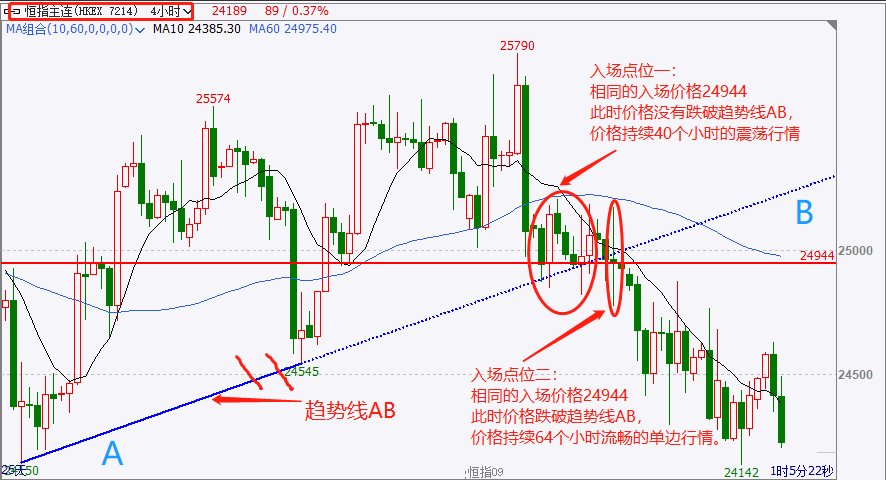
The above is the trend chart of the Hang Seng Index from August 31, 2020 to September 9, 2020, on a four-hour chart.
From the figure, we can clearly compare the same cost price but different entry timing, and experience completely different market results.
Entry point 1: After entering the market, there will be a shocking market that lasts for 40 hours.
Entry point 1: After entering the market, there is a very smooth unilateral decline that lasts for 64 hours.
Obviously, entry point two is the time for each of our traders to enter the market. The matching method of reversal price and reversal timing is a skill that every trader must master.
From the figure, the most important thing is the confirmation of the trend line AB. The trend line AB makes a clear boundary between the volatile market and the unilateral decline.
How to draw the trend line AB?
To sum it up in one sentence, big n's define waves; small n's define bands. A big n is a trend; a small n is a pullback.
I hope the above content can help you fully understand the reversal price and reversal timing.
Copyright reserved to the author
Last updated: 08/06/2023 19:08
Add

0
work
0
subscriber