


Stay in touch!
Subscribe to our newsletter to get the latest updates on live market analysis, trading strategies and more. You can unsubscribe anytime.
By subscribing, you agree to Trading.live Privacy Policy.


The most fundamental purpose of a trend trader is to determine the general direction of market development. Whether you are long-term or short-term, light or heavy, you must first determine the general direction of the market before deciding how to operate. The "determination" mentioned here does not mean It is impossible to know exactly the direction of the future market, it just means that the judged result is most in line with the trader's own trading strategy. Many traders also have mature trading techniques, but they are always trapped when they enter the market. The market seems to have their eyes widened, waiting to trap you. According to my analysis, it is mainly caused by two reasons:
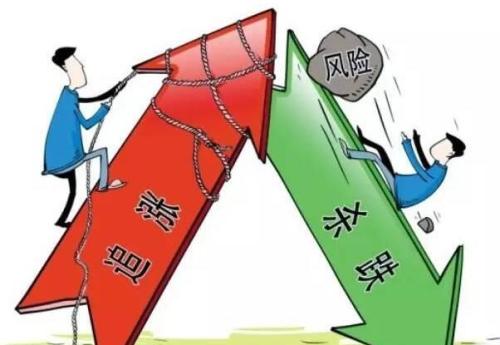
First , traders like to chase the rise and kill the fall. For this type of trader, the currently fluctuating market has the greatest impact on him. When the market goes down, he wants to chase the short, and when the market goes up, he wants to chase the long, regardless of other technical indicators. Traders are attracted by the restless market, and it is easy to sell at the bottom and buy at the top of the mountain, especially when encountering volatile market, they are always slapped in the face by both sides, making one order and losing one order, which is simple. Little do they know that the more subdivided the price, the stronger the randomness of fluctuations. If traders only follow the current market, they will be completely lost like headless chickens.

Second, traders love swing trading. This kind of traders want to eat at both ends of the sugar cane. Contrary to chasing ups and downs, they like to search for tops and bottoms, and only pay attention to various price reversal signals. They always think that the market should reverse, and rush into the market. It's because the market is hanging on the mountainside, and I can't get up or down, and I feel so uncomfortable. If it’s just hanging on the mountainside, it’s fine. Many people will lose money and increase their positions once they fail to find the top. They hope to spread the cost by increasing their positions. As a result, the positions become heavier and heavier, and the top becomes higher and higher, and eventually they lose their positions. thing. The problem with this type of people is that they don't know what the real top and bottom are, and they all take it for granted that the market should reverse.
Here, Mazhu wants to put forward a point of view: the essence of technical analysis is to build a market development model. It's like doing scientific research. Proposing a theory is to create a model to simulate the actual phenomenon. If it can fully explain the principle of the actual phenomenon, and can repeat and predict the phenomenon, then it is a scientific theory. The same is true for trading technical analysis. If there is a certain strategy model that can explain the basic principles of market development and can repeat and predict market phenomena, then it is a set of scientific trading models. Of course, trading technology is not science and technology, it only has statistical significance, it is just generalization, and there is no strict causal relationship. Trends and shocks are just such a classic trading strategy model, which is essentially an artificial simulation of market patterns, artificially distinguishing what is a trend and what is a shock.
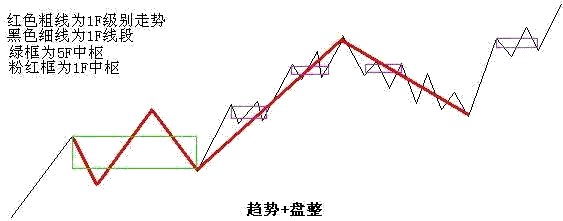
The most perfect trend model that Mazhu has come into contact with and understands so far is the central trend in "Tanglement", which is something that changed my trading worldview. I believe that the market situation in the impression of many traders is a continuous broken line. They subconsciously believe that the market situation is continuously extended, while the market situation in the "entanglement theory" is not linear, but flat. The concept of the center shapes the market into price islands one after another, that is, the shock center, and the unilateral market that connects the two centers. The world of quotes in Tanglun is like a Super Mario game, jumping from one platform to another. Only two continuous centers that do not interfere with each other can form a basic trend, and those market patterns that return to the center after leaving the center can only be defined as the continuation of the center, and the center of continuation can also move the center of gravity , thus defining the direction of the volatile market that originally had no direction.
After we have a trend model, we will first have a comprehensive perspective, divide the complicated market into trends one after another, and can easily judge which part of a certain trend the current market is in, so we can make orders Under the general direction of the trend, we can filter out some small market signals that are against the trend, and only wait for the signals that conform to the general direction of the trend to appear.
Copyright reserved to the author
Last updated: 08/07/2023 21:10
 Add
Add

Generally, large funds will not enter the market. Once the layout of the market is selected, it means that the institution has considered everything thoroughly before entering the market. It is difficult to break through the position where big funds really enter the market. If it is broken, the big funds will decisively stop losses and carry out backhand operations, and follow the funds that are larger than it (the position where large funds enter the market is actually the dividing point between long and short) , so medium and long-term investors should consider finding out the clues left by relatively large funds entering the market
Copyright reserved to the author
Last updated: 08/13/2023 06:48
Add

Thank you for the invitation, but I think you need to elaborate more on your question. After all, what is the general direction, how big is it, and how did you lose in detail? It’s easier to understand if you talk more.
Copyright reserved to the author
Last updated: 08/06/2023 14:15
Add

0
work
0
subscriber